Breast Augmentation with Fat Grafting in Detail: Achieving Upper Breast Volume and a Natural Feel at the Same Time

If breast surgery in the past focused simply on one-dimensional enlargement to increase size, modern aesthetics now center on creating a silhouette that blends naturally with one’s body type and movement that feels innate. In this shift, the hybrid procedure that is drawing attention goes beyond relying on implants alone and combines the technical advantages of breast augmentation with fat grafting, which precisely supplements insufficient soft tissue, presenting an advanced solution that minimizes implant contours while maximizing dimensionality.
In this post, we will take a closer look at the deeper mechanism behind why this approach is not merely a physical combination of two techniques, but a highly refined aesthetic design and an inevitable choice for improving structural completeness.
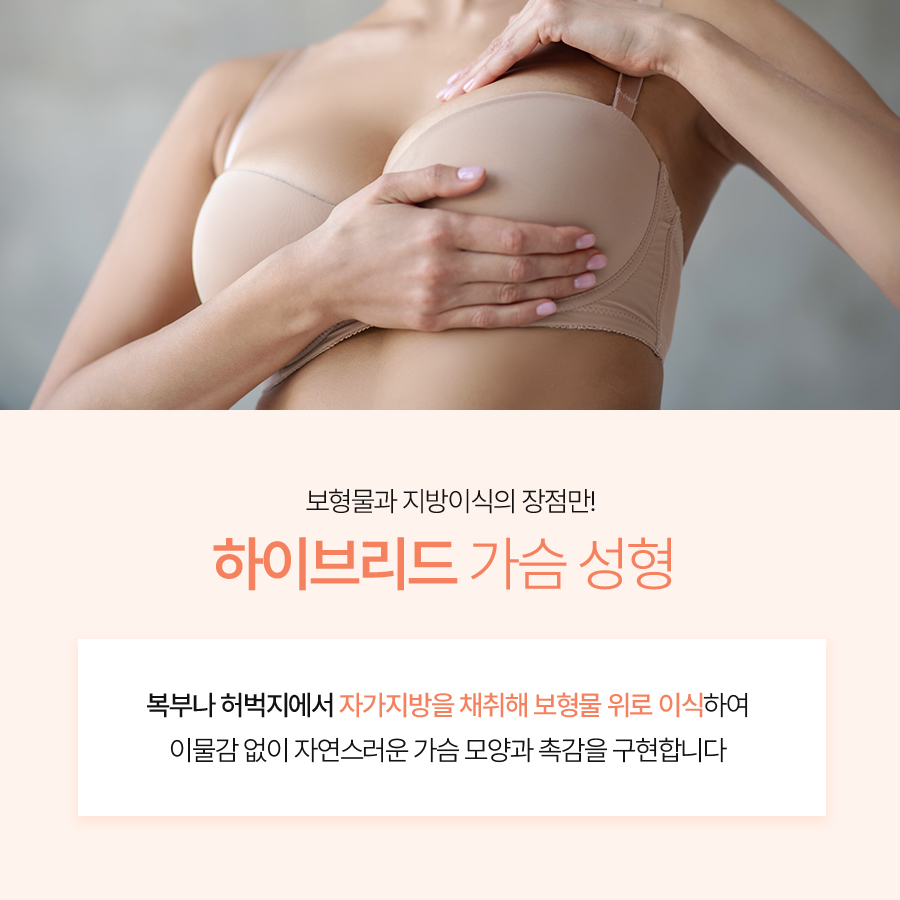
The Essence of Hybrid Design
Hybrid breast surgery is not simply the concept of mixing two materials; it is a highly customized modeling technique that considers the skeletal structure of the chest wall and skin thickness to determine the optimal volume. To address rippling or artificial borders that can commonly appear with implant-only surgery in a slender body type, fat grafting is performed precisely around the implant to strategically increase the density of the soft tissue.
This allows the definite increase in cup size provided by the implant and the supple curves created by the patient’s own fat to produce a complementary synergy, ultimately becoming a high-level aesthetic alternative that achieves both the fullness difficult to realize with autologous tissue alone and the softness difficult to achieve with implants alone.
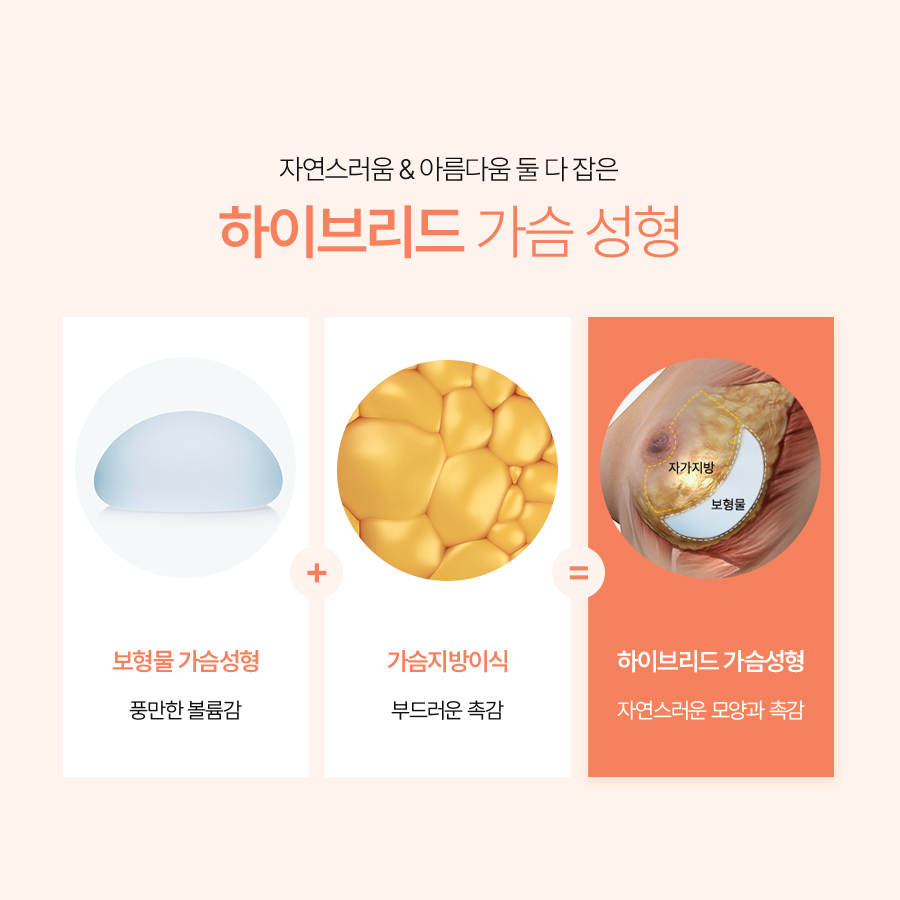
Strategic Placement of Implants and Fat
The true value of the hybrid technique lies not in simply adding materials, but in the “rearrangement of space” and “three-dimensional layering” tailored to the anatomical characteristics of each body type. First, the implant serves as the foundational structure that forms the core volume, firmly establishing the overall projection and height of the breast. Then, finely refined breast augmentation with fat grafting is used to closely envelop areas lacking soft tissue.
In particular, by strategically distributing fat to the narrow cleft in the inner breast, as well as the upper breast and outer contour lines where thin skin may raise concern that the implant could show through, the texture of the firm implant is completely blocked from view, and a soft, natural-looking curve resembling real breast tissue is delicately shaped. This dual-layer design ultimately makes a decisive difference by eliminating visual artificiality and maximizing tactile satisfaction.
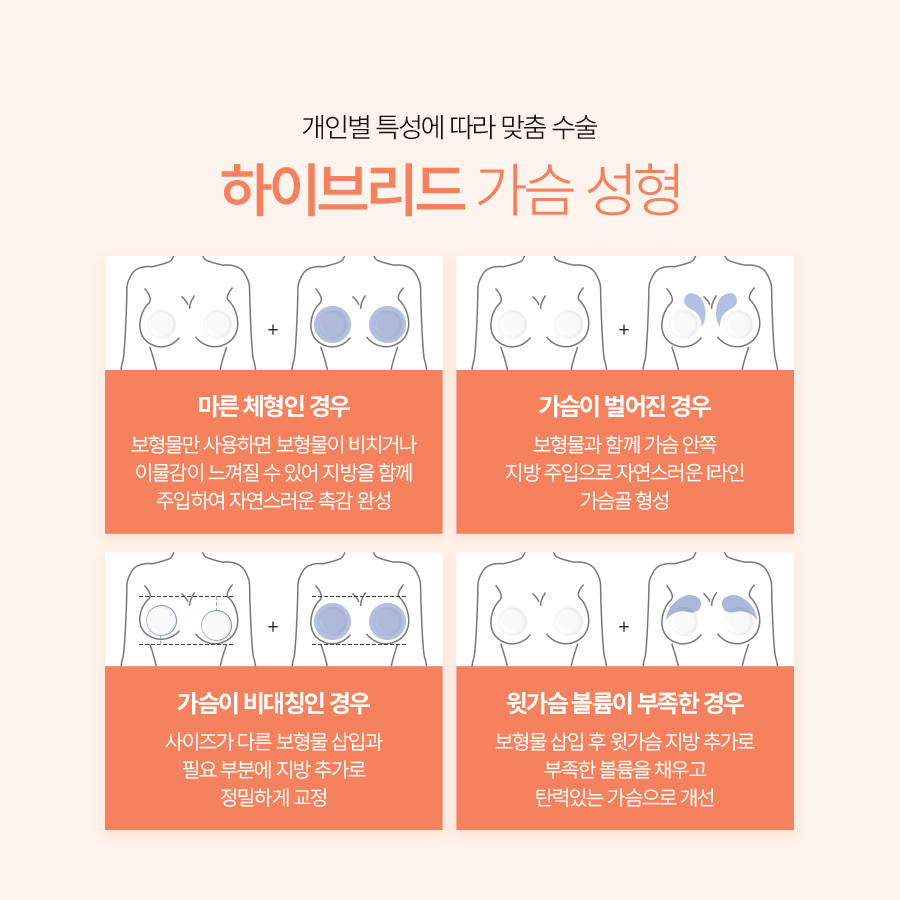
Why Must It Be Hybrid?
The reason the hybrid method receives such an overwhelmingly aesthetic评价 is that it offsets the artificial feel of implants with the flexibility of autologous tissue, creating the optimal balance. The biggest visual difference comes from the density at the center of the breast; by filling the inner soft tissue that implants alone could not sufficiently address through breast augmentation with fat grafting, it creates the soft cleavage of an I-shaped line that forms when the breasts naturally come together, rather than an artificial Y-shaped line.
In addition, to address the upper-breast hollowing common in Asian body types, the upper line is refined into a gentle slope, eliminating the rigid projection that can be a concern with implant insertion and completing a smooth sloping line. Finally, by considering dynamic movement—how the breasts naturally spread or sway according to the laws of gravity—the thickness of the fat layer surrounding the implant is adjusted to secure flexibility similar to real breast tissue, without the unnatural recoil of an implant whether lying down or moving.
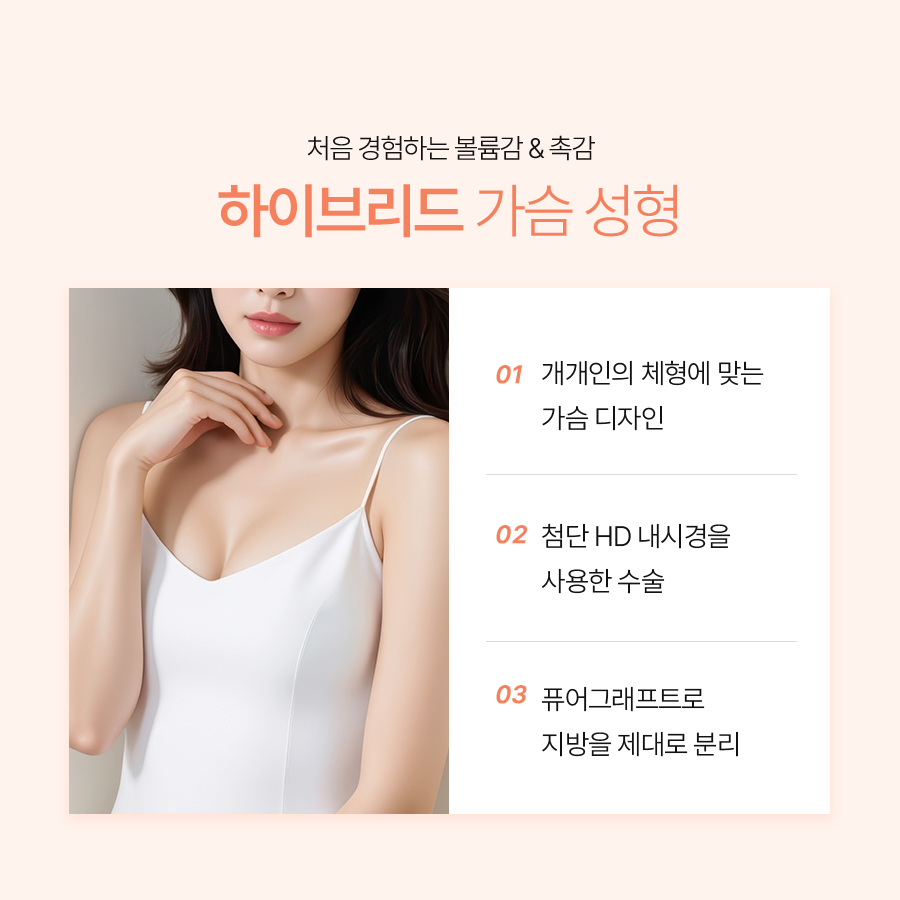
The Key to Engraftment Rate and Safety
The success or failure of hybrid breast surgery depends not merely on injection, but on the surgeon’s skilled handling and a systematic refinement process that maximize the engraftment rate of autologous tissue. It begins with securing the material through low-pressure suction from areas with excess fat accumulation, minimizing cell damage. The harvested tissue then undergoes a special centrifugation process and is reborn as a highly concentrated, pure cell state with all impurities removed.
After an implant optimized for the individual’s chest wall structure is first placed to secure baseline volume, the core technique of breast augmentation with fat grafting—the “multi-layer injection”—is performed. Rather than injecting a large amount of fat into a single area, this advanced technique distributes small amounts broadly and evenly across anatomical layers such as the skin layer and subglandular layer, helping the transplanted fat develop blood vessels smoothly and allowing the implant and autologous tissue to integrate perfectly as if they were one organic structure, without calcification or clumping.
In conclusion, hybrid breast surgery is more than the simple sum of two techniques; it is an aesthetic process in which the implant’s reliable shape retention and the supple texture of autologous tissue work together organically to create the best possible three-dimensional effect. For body types with little body fat and a high risk of the implant texture becoming visible, the micro-contouring process added through breast augmentation with fat grafting becomes an advanced alternative that can precisely design not only an artificial increase in size, but also the breast’s unique curves and dynamic flow.
Ultimately, if a customized design is carried out by precisely analyzing each individual’s unique skeletal structure and skin elasticity and optimally combining implant volume with fat density, you will achieve a satisfying result that maximizes your natural physical advantages while completing an ideal silhouette without a sense of mismatch.