Breast Revision Surgery for Capsular Contracture: Methods Based on Symptoms and Severity

Over time after breast augmentation, the breasts may become firmer than they were initially, or the shape of one breast may change. These changes may be caused not only by changes in the implant itself but also by changes in the tissue surrounding the implant.
Capsular contracture is a condition in which the capsule formed around the implant becomes abnormally thick and firm, affecting the feel or shape of the breast. If you are considering breast revision surgery for capsular contracture, the first steps are to examine the symptoms currently present, assess the condition of the implant and surrounding tissue, and determine whether surgery is necessary.

What changes can occur with capsular contracture?
When an implant is placed, the body naturally forms a capsule around it. A normal capsule is relatively thin and flexible, but if it becomes excessively thick and contracts for various reasons, the breast may feel firm or its shape may change.
Even if it initially begins as only a change in feel, progression may cause the implant to become palpable or alter the breast contour. Breast revision surgery for capsular contracture should involve more than simply replacing the implant; it is important to assess the condition of the capsule and surrounding tissue together when determining the extent of surgery.
Stages of capsular contracture vary by severity
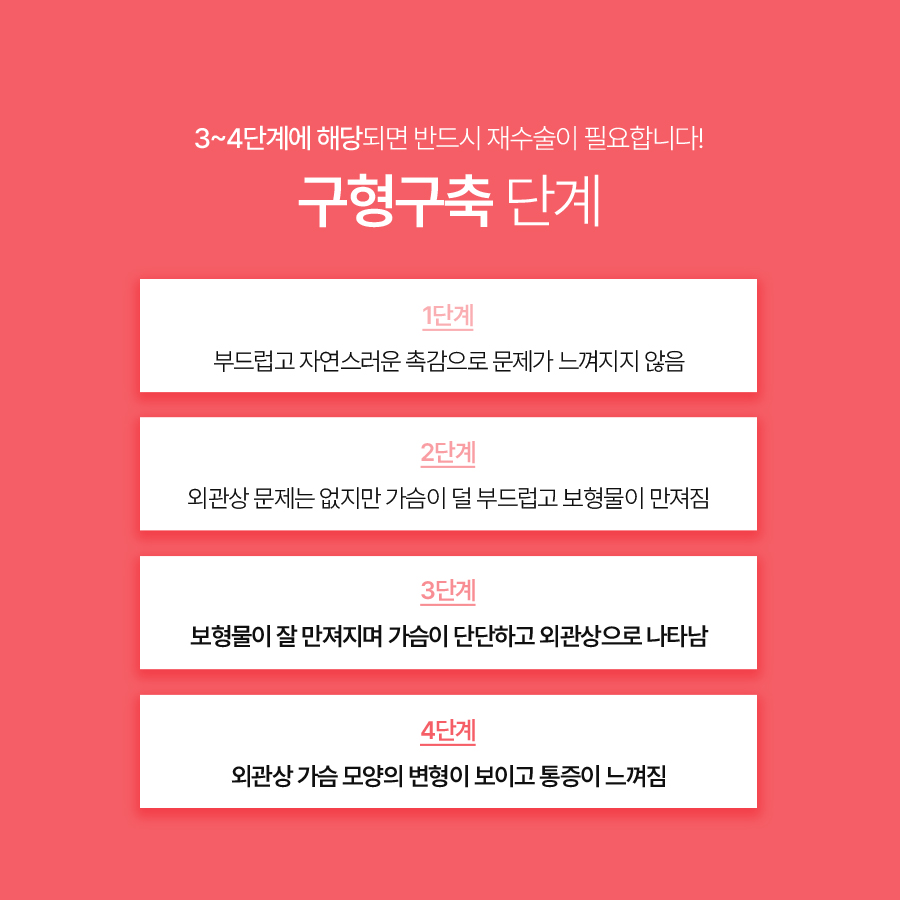
Capsular contracture is assessed in four stages, from 1 to 4, based on the breast’s feel and appearance and whether pain is present. In Stage 1, the breast is soft and natural, with no noticeable abnormality. In Stage 2, there may be little visible change, but the breast may feel firmer than before, or the implant may be palpable.
By Stage 3, the breast becomes noticeably firm, the implant can be felt easily, and changes in breast shape may occur. Stage 4 refers to a condition in which breast deformity is pronounced and accompanied by pain. Because the symptoms of capsular contracture vary according to its progression, planning breast revision surgery also requires assessing the current stage, as well as the breast’s feel, shape, and whether pain is present.

Multiple factors can contribute to its development
The development of capsular contracture may involve a combination of factors. A weakened immune system may affect the tissue recovery process, while an infection or hematoma after surgery may also affect the tissue response around the implant.
Because the degree of tissue response varies from person to person, individual differences in tissue characteristics should also be considered. Inadequate postoperative care may have an impact as well. Therefore, if capsular contracture is suspected, it is necessary to assess the changes that appeared in the breasts after surgery together with the current condition of the tissue, rather than attributing it to a single cause. When planning breast revision surgery for capsular contracture, the cause of its development and the current condition should be reviewed comprehensively to determine an appropriate surgical approach.

Breast revision surgery through an axillary incision
The surgical approach for breast revision is determined after assessing the position of the existing implant, the condition of the capsule, and changes in the breast tissue. When an axillary incision is selected, the surgical area is accessed through the armpit, and the necessary corrections can be performed while examining the internal structures at an enlarged view using an HD endoscope. An endoscope can be used to examine deep surgical spaces that are difficult to see directly, helping the surgeon identify the locations of blood vessels and surrounding tissue and adjust the surgical extent more precisely.
When planning breast revision surgery for capsular contracture, it is also necessary to assess the severity of the contracture, the implant position, and the condition of the capsule before determining whether an axillary incision can be used. Therefore, rather than deciding on the incision site first, it is important to comprehensively assess the current condition of the breasts and the extent of correction required before selecting an appropriate approach.
Breast revision surgery for capsular contracture is intended not only to improve the firmness or shape of the breasts but also to take into account the condition of the existing implant and surrounding tissue. Even in cases of capsular contracture, the extent of correction required may vary depending on the degree of capsular change, the implant position, and the amount of breast tissue.
At UAA Plastic Surgery Clinic, we focus on developing a surgical plan suited to each individual’s circumstances by assessing the changes that occurred after the previous surgery together with the current breast shape and the condition of the capsule and breast tissue.
When deciding on revision surgery, it is necessary to accurately identify the current problem and carefully review the specific correction methods required, rather than making a decision based solely on a particular incision method or whether the implant will be replaced. It is important to fully understand the condition of your breasts and the purpose of revision surgery before establishing an appropriate surgical plan.