It is easy to think that everything is fine
if none of your teeth hurt.
However, even without pain,
inflammation may still be progressing inside.
We would like to share the story of a patient who recently visited our dental clinic for scaling only,
but was found to have a significant problem.
Why can it be dangerous without symptoms?
When a cavity deepens and reaches the dental nerve,
pulp necrosis can occur, in which the nerve gradually dies.
The problem is that during the process of the nerve dying,
many people actually have difficulty feeling pain.
If this condition continues for a long time,
inflammation can settle around the tip of the tooth root.
This is called apical periodontitis.
It means inflammation at the tip of the tooth root.
It can be caused not only by cavities,
but also by trauma or cracked teeth.
When the nerve dies, the tissues responsible for sensing pain also die,
so the tooth may actually feel less painful.
If any of the following applies to you,
we recommend getting an examination at least once.
-
The color of a tooth has become noticeably darker
-
You feel a subtle discomfort when chewing
-
A small pimple-like bump repeatedly appears on the gums
What is apical periodontitis? It is a condition in which inflammation develops in the bone at the tip of the root as the dental nerve dies. Because it often causes no pain, it is easy to leave untreated.
Because there are no symptoms,
many patients live without knowing about the condition at all.
A lesion discovered during a visit for scaling
This patient had been living abroad
and had returned home for the first time in a while.
Because the schedule was tight, the patient planned to receive a simple scaling treatment and leave,
but during the examination, a small pus-draining opening was found near the gum of a molar.
Dentists call this a sinus tract.
In simple terms, it is a passage through which inflammation inside drains out.
We recommended taking an X-ray,
and the patient agreed, so detailed imaging was performed.
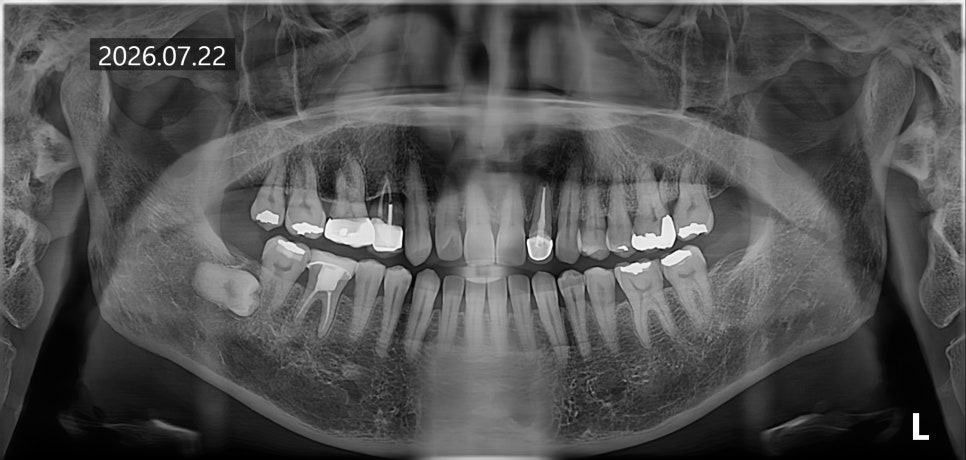
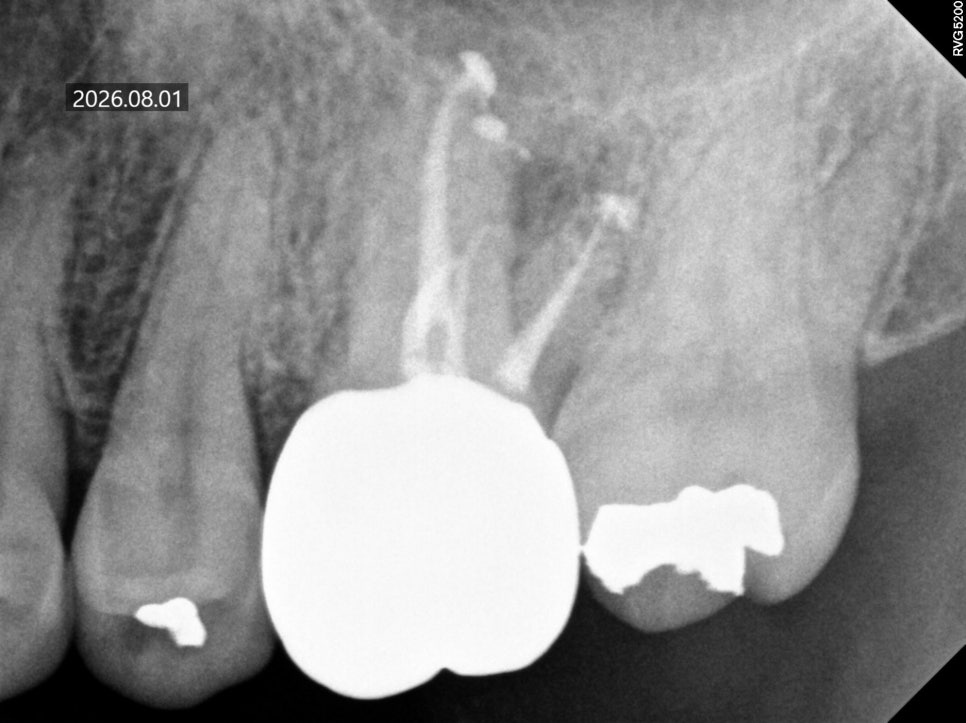
The imaging showed
an obvious inflammatory lesion at the tip of the root of the tooth.
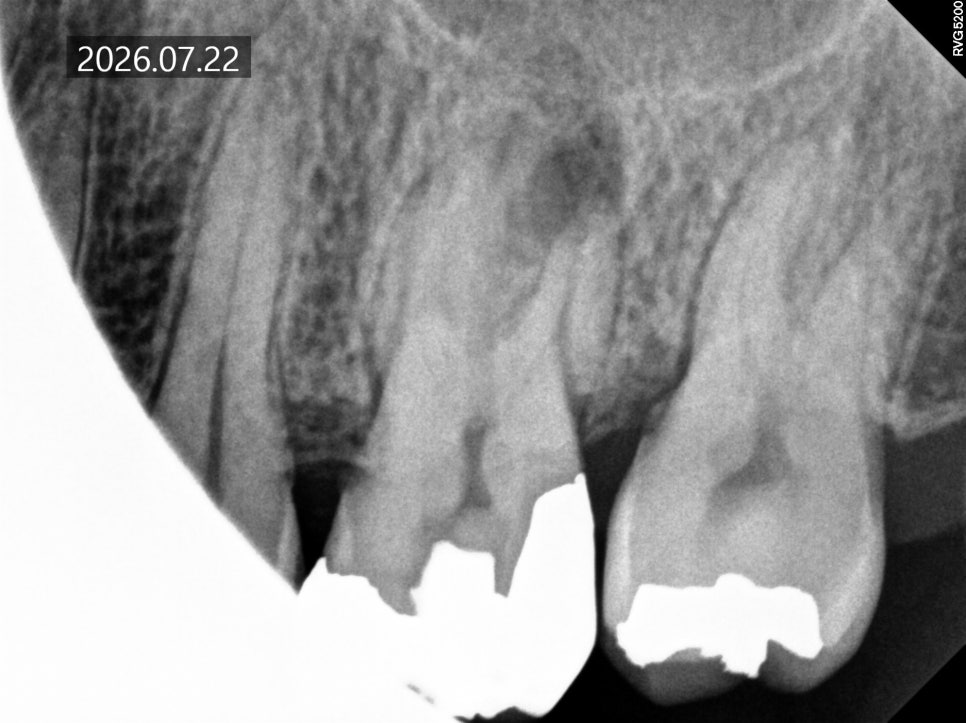
Fortunately, the patient was able to adjust the departure schedule slightly,
so we decided to proceed with root canal treatment and crown treatment.
How is root canal treatment performed?
Root canal treatment removes dead nerve tissue
and areas affected by inflammation.
After disinfecting and cleaning the inside of the root canal,
it is filled with a medication and sealed.
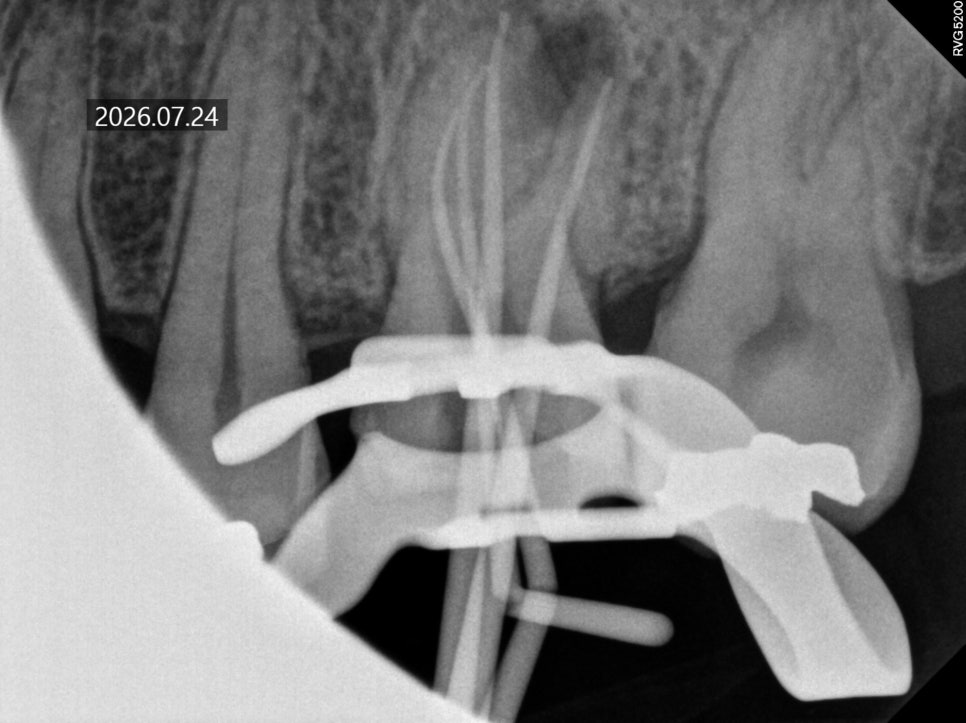
After treatment was completed, the opening that had been draining pus disappeared naturally.
This can be regarded as a sign that the cause of the inflammation had been resolved.
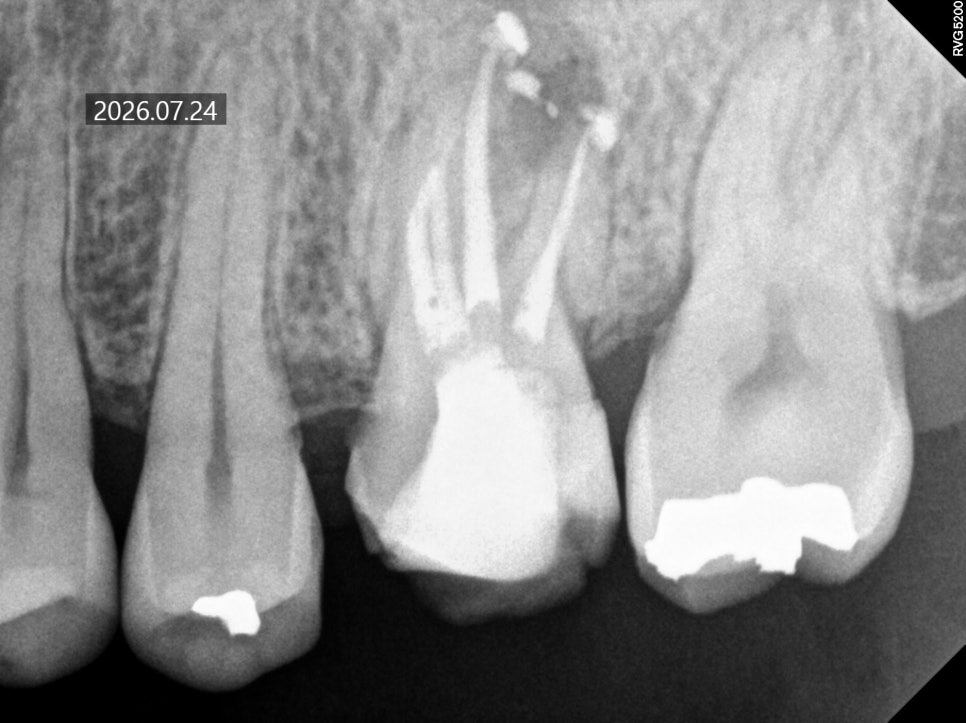
A tooth that has undergone root canal treatment
can become fragile because its supply of moisture and nutrients has been cut off.
Therefore, a crown that covers the entire tooth is needed
to prevent it from breaking under chewing forces.
We completed the treatment by placing a crown
to protect the weakened tooth.
If you need root canal treatment at Yeomchang Station
If you are considering root canal treatment or crown treatment
at a dental clinic near Yeomchang Station,
we recommend starting with a detailed X-ray examination.
This is because a tooth that looks fine on the outside
may be in a different condition inside.
When providing treatment,
I try not to assume that everything is fine simply because there are no symptoms.
As with this patient, there are actually many cases in which a serious problem is discovered in advance
when someone visits only for scaling.
In particular, for patients visiting the dentist for the first time in a long while,
I generally recommend checking an X-ray at least once.
That does not mean that every tooth
will automatically require root canal treatment.
Our principle is to first carefully determine
whether the natural tooth can be preserved.
Why regular checkups are important
When life gets busy, dental checkups
easily get pushed aside.
By the time tooth pain appears,
the condition has often already progressed considerably.
That is why regular checkups and X-ray examinations are necessary
even when there are no unusual symptoms.
The longer a condition is left untreated,
the more difficult it may become to save the tooth.
We recommend having a checkup along with scaling
about once every six months.
*All case photographs were posted with the patient's consent in accordance with Articles 23 and 56 of the Medical Service Act.
*All treatment photographs are of patients treated at this dental clinic.
*All treatment photographs are of the same person
and were taken under the same conditions.
*Depending on individual differences,
side effects may occur after procedures or surgery.
Please consult thoroughly with your medical provider.