Hello. I’m Park Jae-hyung, Chief Director of Wonjin Dental Clinic.
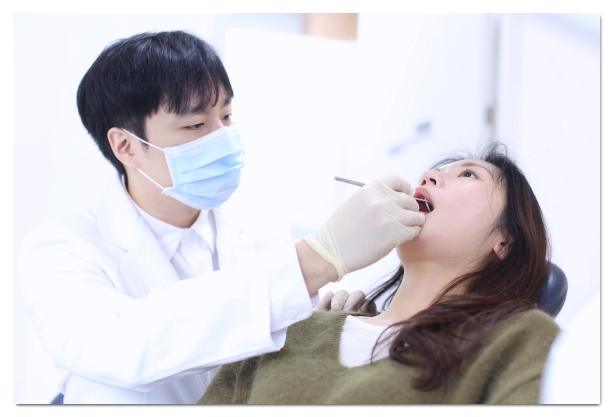
The resin on my front tooth has turned yellow.
Should I have it redone?
Depending on the cause of discoloration, the solution may be polishing, resin retreatment, or even veneers.
Rather than immediately retouching it, it is best to consider the least invasive method first,
step by step, as that is the best way to preserve the tooth.
Here is a 3-line summary of the causes of front tooth resin discoloration and the solutions by type.
-
If only the surface is stained: polishing
-
If the resin itself is discolored or the margin is stained: resin retreatment (replacement)
-
If discoloration keeps recurring or the aesthetic limit feels clear: switch to veneers
In this post, under the topic of A Complete Guide to the Causes of Front Tooth Resin Discoloration and Solutions by Type,
I will clearly explain everything from the fundamental causes of front tooth resin discoloration to the solutions by type,
as well as prevention and care methods.
Table of Contents
-
How front tooth resin discoloration occurs
-
Four causes of front tooth resin discoloration
-
Front tooth resin discoloration: solutions by type
-
How to prevent and manage front tooth resin discoloration
-
Frequently asked questions (FAQ)
How front tooth resin discoloration occurs
Resin is a treatment that naturally restores the tooth color,
but it has the property of absorbing pigments through microscopic pores.
Over time, external pigments build up on the surface,
or the material itself oxidizes and turns yellow.
In particular, front teeth tend to discolor more quickly because they directly contact food.
Four causes of front tooth resin discoloration
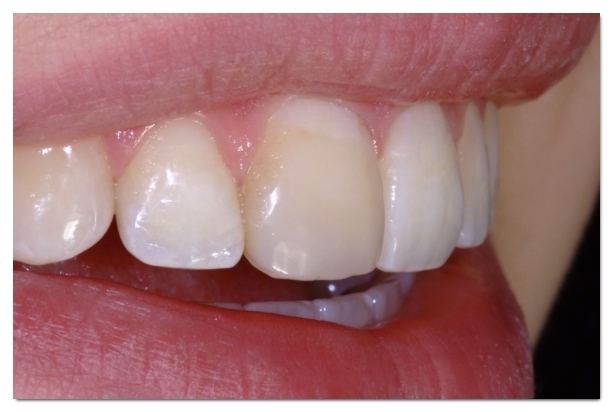
- Discoloration of the resin material itself
Over time, the resin oxidizes and turns yellow.
Natural discoloration usually begins after an average of 5 to 7 years.
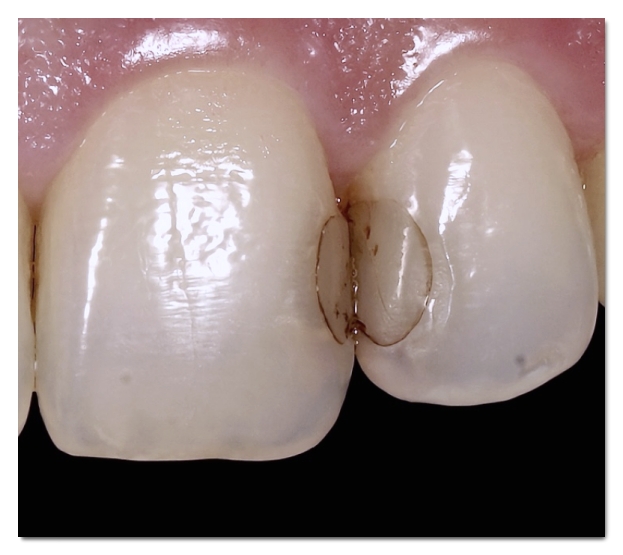
- Staining at the margin between the tooth and the resin
Pigments get trapped in the tiny gap between the resin and the natural tooth, making the boundary line look dark.
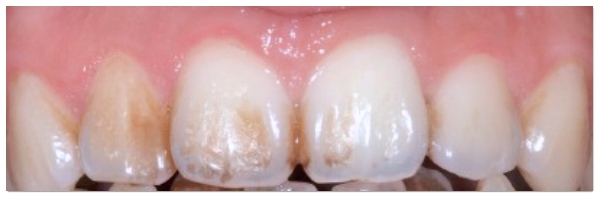
- Surface staining caused by diet and lifestyle habits
Coffee, black tea, wine, curry, and smoking are typical examples.
This means pigments are only attached to the surface.
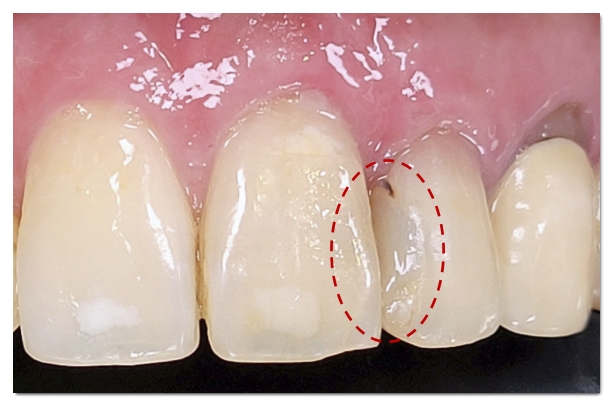
- Discoloration caused by secondary cavities
If decay progresses under the resin, it appears dark from the inside.
This is the type that requires the most caution.
Front tooth resin discoloration: solutions by type
- If it is surface staining
Polishing / abrasion If it is simply surface staining, the color can be restored with polishing alone.
It is the lightest treatment, with lower cost burden and a quick completion time.
- If the resin itself is discolored
Resin retreatment The oxidized existing resin is removed and replaced with new resin.
This is the most common solution.
- If it is staining at the margin
Partial correction The margin area is smoothed with polishing or refilled to finish neatly.
This is less costly and time-consuming than replacing the entire restoration.
- If it is secondary decay
Retreatment after cavity treatment The decay is removed first, then a new resin filling is placed.
If left untreated, it can progress to root canal treatment, so prompt care is important.
- If recurring discoloration feels burdensome
Switching to veneers Even if resin retreatment is repeated, it may discolor again,
and if you want a more natural and longer-lasting result, veneers may be worth considering.
Veneers are made of porcelain, which is resistant to discoloration,
and their lifespan can be as long as 10 to 15 years, so they offer excellent aesthetics and durability.
However, not all veneers last a long time.
To reduce discoloration, breakage, detachment, cavities, bad breath, and gum recession,
it is important to minimize tooth reduction at the beginning
and use good materials with proper bonding.
How to receive veneers while reducing these risks is explained in the post below.
In fact, the most important thing is accurately diagnosing the cause of the discoloration.
If simple surface staining is treated with resin retreatment,
it means grinding away perfectly healthy resin,
and conversely, if secondary decay is handled only with surface polishing,
the decay may continue and even lead to root canal treatment.
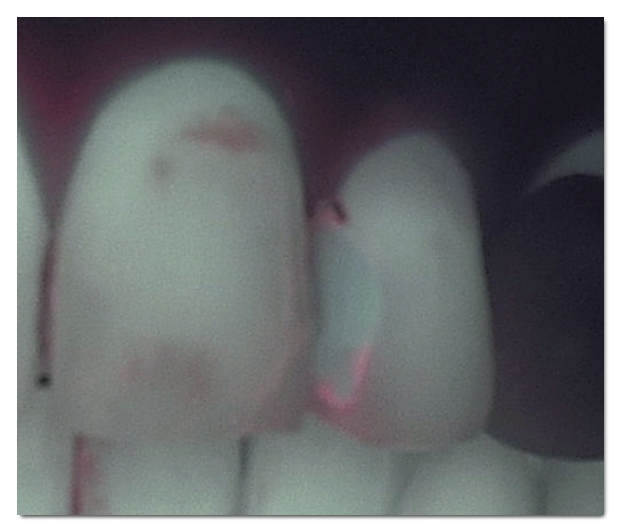
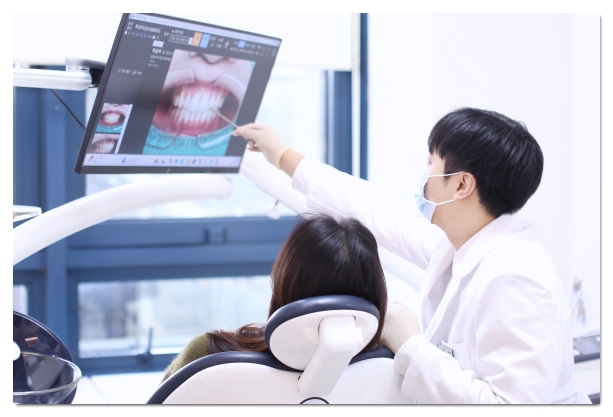
That is why we use magnification, an oral camera, X-rays, and CEREC, among other tools,
then determine the treatment direction after examining the cause of discoloration from multiple angles.
In the case below, the same patient’s teeth showed both
-
A case that had progressed into decay
-
Mild staining
both types were found.
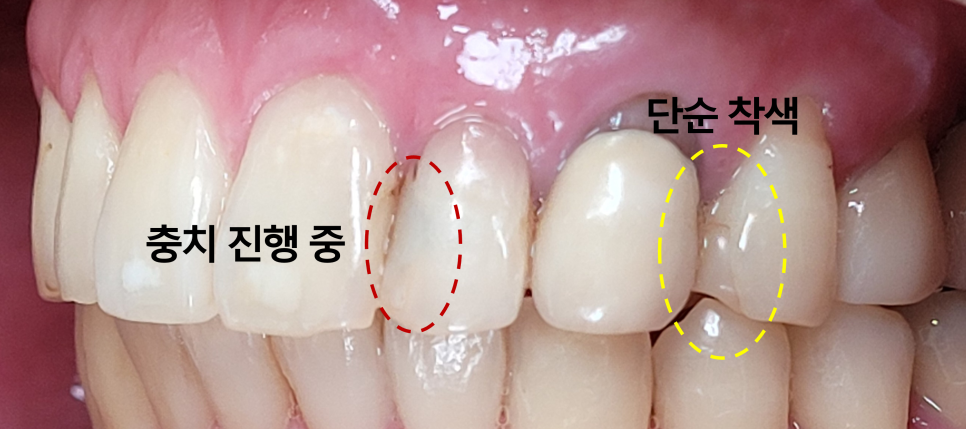
The yellow-circled area in the photo above was mild staining, and since it was a small molar area that was not very noticeable,
we finished it with surface polishing.
How to prevent and manage front tooth resin discoloration
- Rinse with water after consuming beverages with strong pigments, such as coffee, black tea, and wine
- Avoid smoking
- Have scaling and regular checkups every 6 months to 1 year
- Brush carefully with soft-bristled toothbrushes
- Over-the-counter whitening products may cause a color difference between resin and natural teeth, so use them only after consulting a dentist
Frequently asked questions (FAQ)
Q1. How long does front tooth resin last?
On average, it lasts 5 to 7 years, and it may last longer depending on care.
Q2. What is the difference between front tooth resin and veneers?
Resin can be done without removing tooth structure and is less expensive, but it is vulnerable to discoloration.
Veneers require some tooth reduction, but they are more resistant to discoloration, last longer, and offer better aesthetics.
Q3. Can discolored resin be made brighter with whitening treatment?
Whitening agents work only on natural teeth and are not effective on resin.
Conclusion
Front tooth resin discoloration is best addressed by accurately diagnosing the type of cause.
If it is simple staining, polishing alone may solve it,
but if discoloration keeps recurring, switching to veneers may be a better long-term option.
If the color change is noticeable, I recommend getting a dental examination to confirm the exact cause.
Thank you. This was Park Jae-hyung.