Hello, this is dentist Park Jae-hyung.

It’s been about 2 years since I got laminates,
and the inside looks black.
When I drink cold water, it feels sensitive.
Does that mean I have to redo them?
For those who visit the dental clinic worried about symptoms like these,
in today’s post, I’ll clearly explain the symptoms that may indicate cavities under laminates and how to treat them.
[Key Summary of Cavities Under Laminates]
- Symptoms that suggest cavities under laminates: Analysis by symptom, such as discoloration along the margin, sensitivity, and throbbing pain
- Why secondary decay occurs in a restored tooth: The relationship between the lifespan of the restoration and tiny gaps
- Customized treatment by cavity stage: Step-by-step response options, from partial treatment to remaking the laminate and root canal treatment
Just because a tooth feels sensitive or looks discolored does not mean it is definitely a serious cavity or that the existing restoration must always be removed.
I’ll explain which cases you can feel reassured about,
and which cases require prompt treatment.
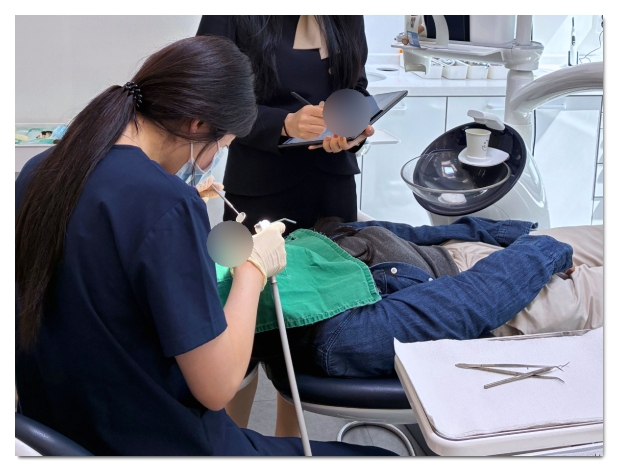
- How to check for cavities under laminates by symptom
- When the margin turns black (suspected secondary decay)
As time passes, the tiny gap between the laminate and the natural tooth may appear dark.
If even one of the four signs below applies, you should suspect decay inside the laminate (secondary decay).
- Touch: The margin feels rough when touched with a fingernail or tongue
- Floss catching: Dental floss keeps catching or tearing in that area during brushing
- Sensitivity: A localized sensitive feeling remains in the discolored area
- Spread of discoloration: The dark area gradually becomes wider
※ In the dental clinic, as shown below, a fluorescence examination device called Q-ray can be used
to clearly identify internal decay in red.
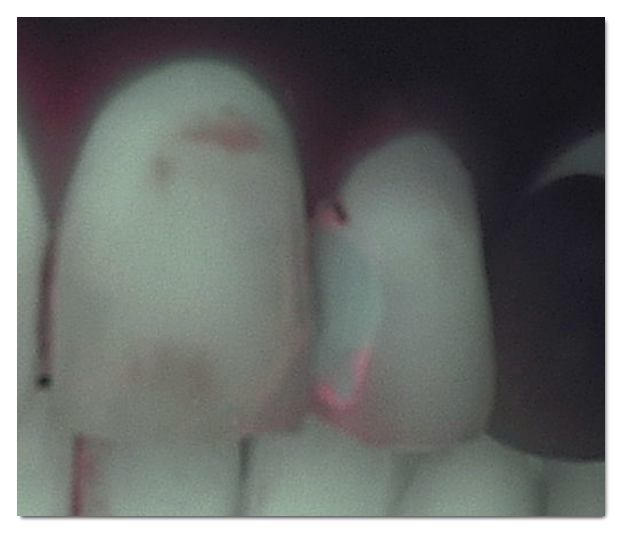 The red glowing area in the photo means that plaque is present there.
- When the inside looks visible and dark
Laminates are thin porcelain materials, so light passes through them.
If the color of the tooth underneath could be seen from the beginning, it may be a problem with thickness or translucency.
However, if it was fine right after the procedure but
became darker over time,
it is highly likely that decay inside is progressing or that the tooth itself has discolored due to changes in the pulp (nerve).
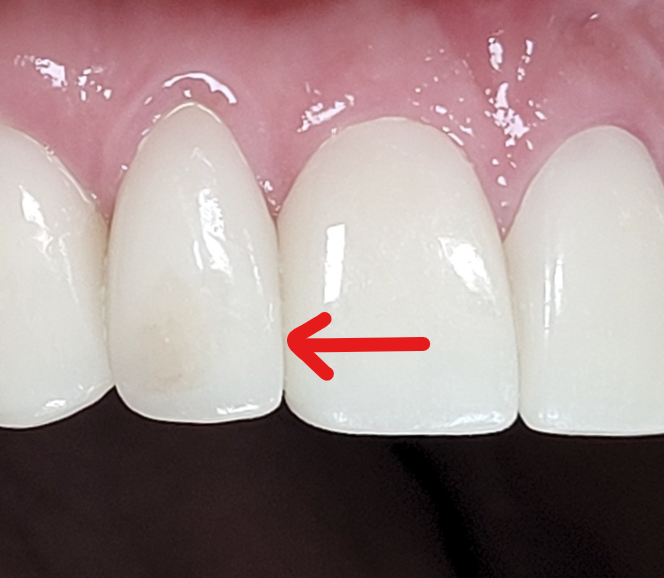 A brownish tone is visible on the surface of the laminated tooth in the photo.
- When it feels sensitive to cold food
Temporary sensitivity due to tooth reduction immediately after the procedure is a common symptom.
But if sensitivity appears newly after there was none before,
it may be a sign that a tiny gap has formed at the edge of the restoration or that decay has begun.

- When it throbs and hurts even while resting (prompt visit recommended)
There is a high chance that the tooth nerve has been affected, beyond simple external stimulation.
In this case, you should visit the dental clinic without delay.
- Causes of cavities in laminate teeth
The main reasons cavities develop in restored teeth are as follows.
- Tiny gaps: Loss of adhesive over time and aging of the restoration margin
- Lack of maintenance: Poor hygiene on the interproximal surface of teeth where floss does not enter easily
- Physical stress: Gaps caused by night grinding or a habit of clenching the teeth tightly
In comparison, it is similar to the “silicone coating” between bathroom tiles and the wall.
At first, it fits smoothly and tightly,
but after a few years, it lifts slightly, allowing grime to build up in the gap.
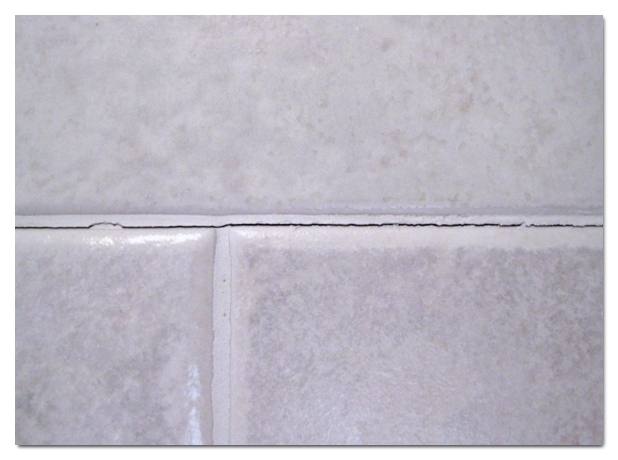
If the initial bonding is not perfect or the bite is not aligned properly, this gap forms more quickly.
That is why getting the procedure done correctly from the start is more important than anything else.
- Do laminate cavities always require removal of everything?
This is probably the part many of you are most curious about.
It is not necessary to remove everything.
The treatment method depends on the stage of the cavity.
[Customized treatment methods by cavity stage]
| Cavity stage | Customized treatment |
|---|
| Only surface staining | Finish with scaling and surface polishing |
| Decay in an area not covered by the laminate | Keep the restoration and perform partial resin treatment only in that area |
| Decay has progressed under the laminate (lifting/gap formation) | Remove the existing restoration → treat the decay → remake the laminate |
| Decay has progressed to the nerve (pulp) | Perform root canal treatment, then switch to a crown (a restoration that covers the entire tooth) |
[Three-step examination system for an accurate diagnosis]
In the dental clinic, we do not rely only on visual inspection,
and instead use the following three methods together to make an accurate diagnosis.
- X-ray: Check for hidden decay between the restoration margin and the adjacent tooth surface
- QLF (Q-ray): Use fluorescence light to visualize areas of decay progressing inside the tooth
- Explorer examination: Use a fine dental instrument to check the margin line for height differences or lifting
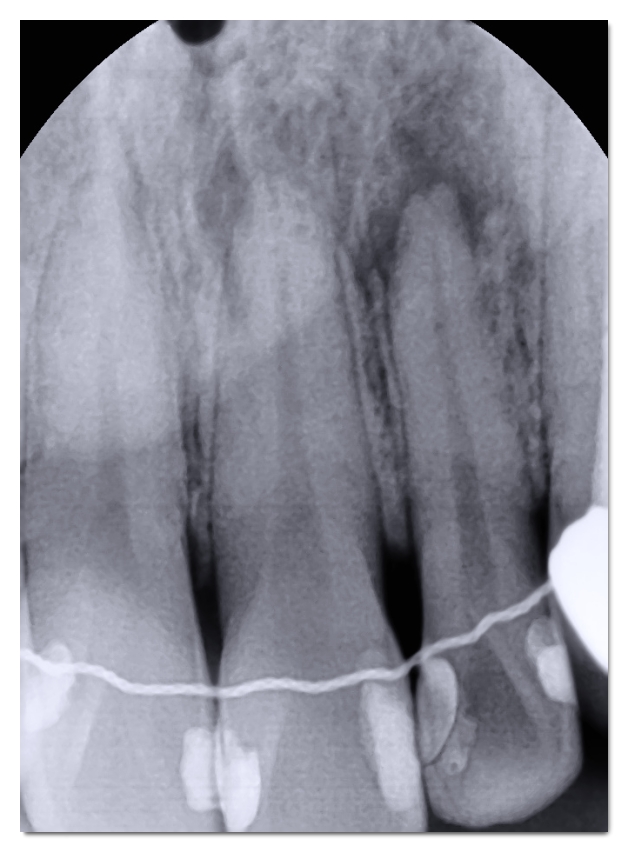 A view of the tooth being examined with an X-ray
- Key summary of secondary decay under laminates
After laminate treatment, discoloration or sensitivity does not always mean serious decay.
Also, even if decay is found, if it is in the early stage,
there are ways to preserve the restoration or respond simply.
The key is to find it before it reaches the final stage.
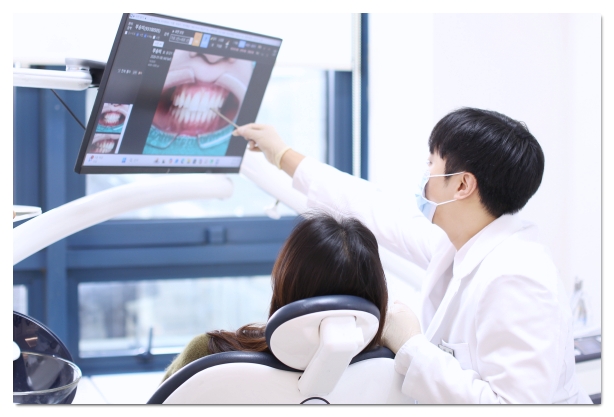
Rather than worrying while trying to judge the symptoms on your own,
I recommend visiting the dental clinic for an examination before the problem grows.
The earlier it is found, the more options you have to preserve the natural tooth.
Thank you. This was dentist Park Jae-hyung.