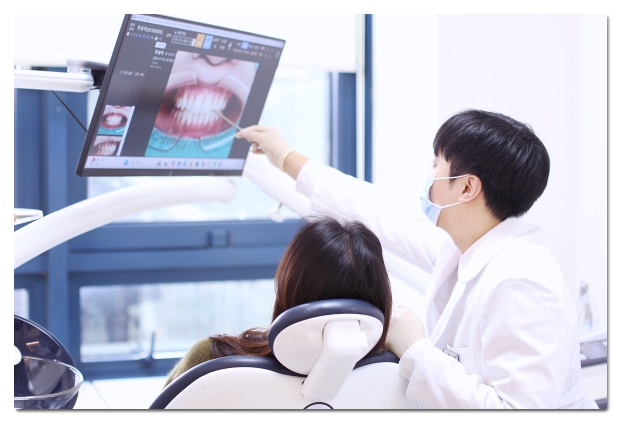
Hello, I’m Park Jae-hyung, the chief director of Wonjin Dental Clinic.
It’s only been a few years since I got veneers,
but they seem to have changed color. Do I need to get them done again?
The veneer material itself is resistant to discoloration,
but depending on the condition of the internal tooth, the margins, the surface, and the surrounding teeth,
they can appear discolored.
That is why whether retreatment is needed depends on the cause.
In this post, I’ll summarize the four causes of veneer discoloration
along with the criteria for retreatment by symptom,
and the key points you must check during treatment.
I’ll give you a 3-line summary of the answer to “What causes veneer discoloration, and what are the criteria for retreatment?”
-
The true location of discoloration may be the internal tooth or the margins, not the veneer itself
-
Surface wear is not discoloration, but cases like discoloration
-
Depending on the symptoms, the solution can vary completely, from polishing to full retreatment
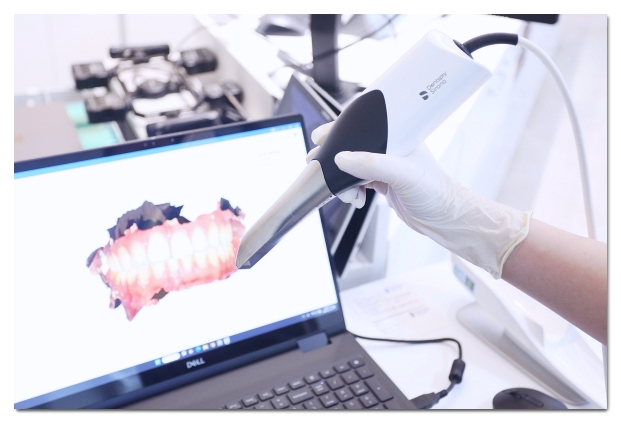
Table of contents
-
Four causes of veneer discoloration
-
Retreatment criteria and solutions by symptom
-
Points that must be considered during retreatment
-
How to manage and prevent veneer discoloration
Four causes of veneer discoloration
- Discoloration of the natural tooth underneath the restoration
Veneers are very thin, about 0.1 to 0.5 mm thick,
so light passes through them to some extent.
If the natural tooth underneath the veneer darkens,
that color can show through on the surface.
This usually happens when a tooth naturally discolors after a previous root canal treatment,
when the pulp (nerve) is damaged from external trauma,
or when secondary decay develops under the restoration.
In these cases, no matter how thoroughly the surface is cleaned,
the color will not return.
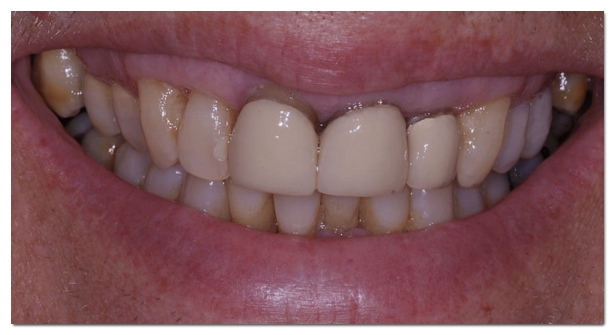
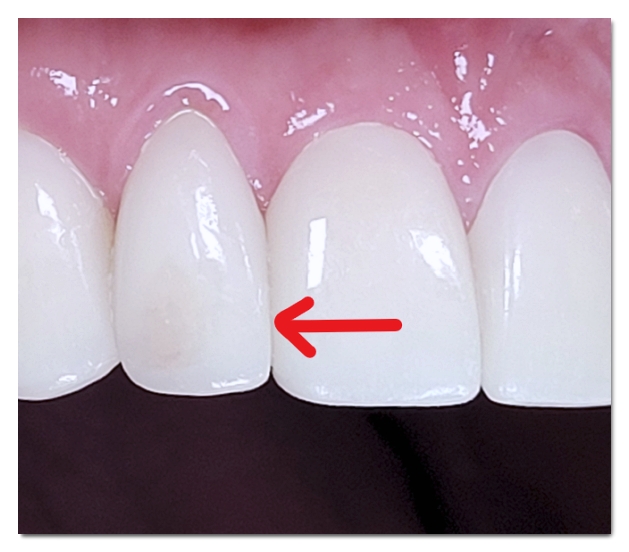 The veneer on the tooth indicated by the arrow in the photo above shows a slight color change.
- Staining at the margin between the restoration and the tooth (cement line)
The adhesive cement line used when bonding the natural tooth and the veneer
can also discolor quite often.
Over time, the cement itself may yellow,
or pigments may infiltrate through tiny gaps.
As the gums recede, this margin becomes exposed,
making the color difference more noticeable.
Especially if the finishing was too bulky when first placed,
food can get trapped easily at the margin,
causing staining to progress more quickly.
If left untreated, this can lead to gum disease
or tooth decay.
So if you want to minimize veneer discoloration and keep them clean for a long time,
the treatment must be done with good bonding materials, careful execution at each stage, and precise timing.
I wrote more details below about how to prevent side effects such as yellowing, gum recession, and decay.
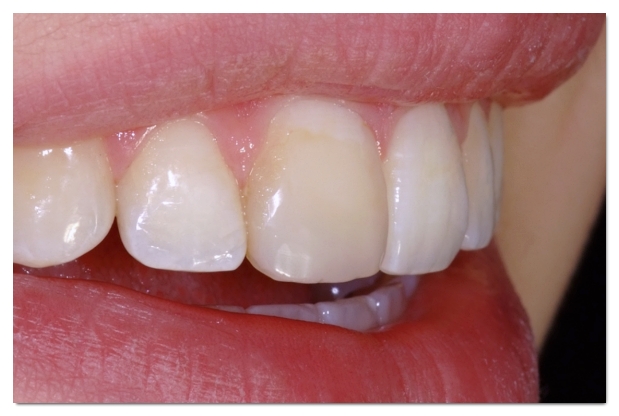
- Wear and scratches on the surface gloss layer
The outer surface of a veneer has a layer that creates its characteristic clear gloss.
If you often use a rough toothbrush, toothpaste with strong abrasive ingredients, or at-home whitening products,
this gloss layer can be gradually worn away.
When the surface becomes rougher, light reflection decreases,
so the teeth can look yellow even though they are not actually discolored,
and pigments adhere more easily to the roughened surface.
- Material limitations and external stains
There is also a big difference depending on the material used.
Ceramic (porcelain) absorbs very little pigment,
so it maintains its original color for a long time,
but
resin (composite) materials naturally absorb pigments over time,
so discoloration occurs gradually as part of the material’s characteristics.
If you add strongly pigmented foods or drinks like coffee, wine, or curry,
or smoking,
the discoloration process becomes much faster.
In particular, smoking is the main culprit that causes strong staining on both the tooth and the margin of the restoration.
Retreatment criteria and solutions by symptom
| Type of discoloration | Solution |
|---|
| Discoloration of the underlying tooth (trauma, after root canal treatment) | Non-vital tooth whitening or full retreatment |
| Discoloration due to secondary decay underneath | Retreatment after treating the decay |
| Discoloration of the marginal cement line (deep penetration) | Retreatment (replacement) |
| Surface scratch wear | Surface re-glossing (polishing) |
| Surface staining from external pigments | Polishing |
| Discoloration of the resin veneer itself | Retreatment (replacement, consider switching to ceramic) |
The first step is an accurate diagnosis of the cause, and the path to preserving the tooth is to review options step by step, starting with the least invasive method.
Points that must be considered during retreatment
- Accurate diagnosis of the cause comes first
Even if the discoloration looks the same, whether the problem is inside the tooth,
a margin issue, surface damage,
or a material issue makes a completely different solution necessary.
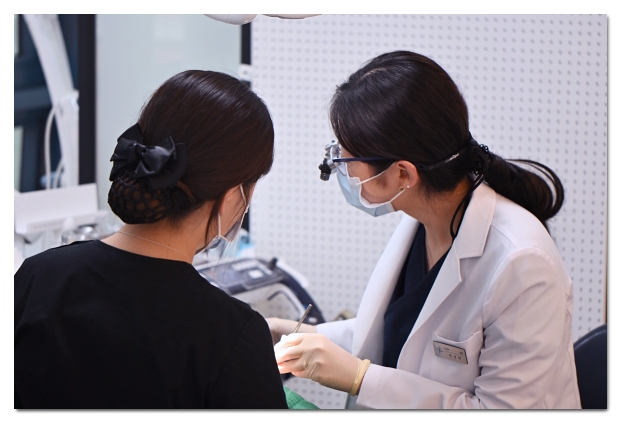
Because it is difficult to judge with the naked eye,
precise diagnosis using magnification, an intraoral camera, X-rays, and Qray is necessary.
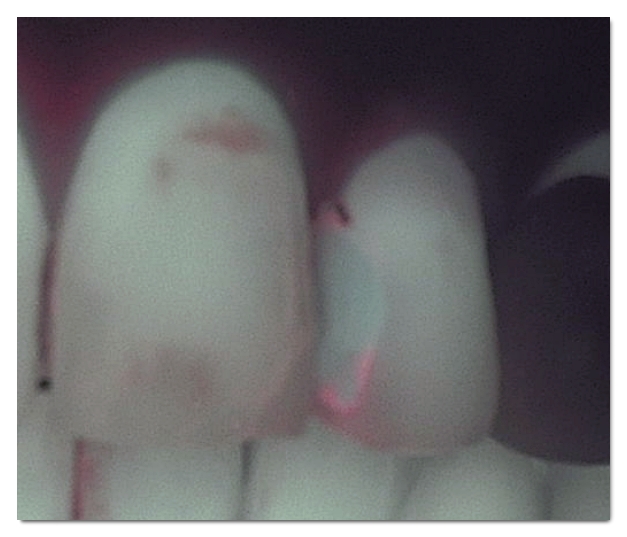 The photo above shows a tooth taken with a Qray device, and the part glowing red means there is plaque.
- An opportunity to choose a better material
Ceramic (porcelain) veneers have high resistance to discoloration,
but resin (composite) veneers will discolor over time.
Retreatment is also an opportunity to choose a more suitable material again.
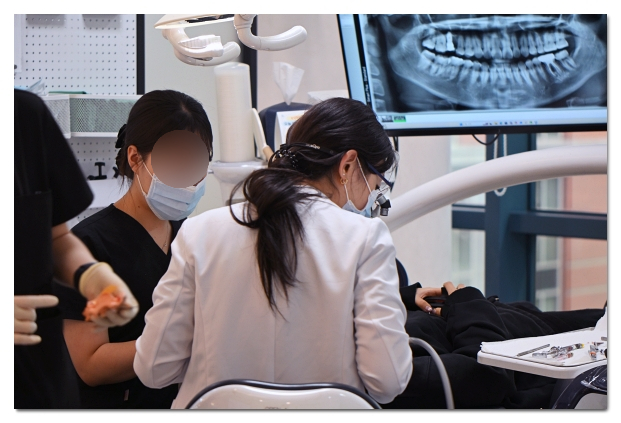
- Treatment precision
Looking at many cases of patients who visit because of discoloration,
the cause is often insufficient precision in bonding and finishing during the original treatment.
So when retreatment is performed,
it is a good idea to carefully check the skill and experience of the clinician.
How to manage and prevent veneer discoloration
-
Rinse with water after consuming strongly pigmented drinks: Make it a habit to rinse immediately after coffee, wine, or black tea
-
Reduce smoking: The most powerful cause of margin staining
-
Get checkups and cleanings every 6 months: Margin staining can often be managed with polishing if caught early
-
Use soft toothbrush bristles: Rough toothbrushes and abrasive toothpaste damage the surface layer
-
Be careful during the first 48 hours after treatment: Since this is the adhesive stabilization period, avoid foods with strong pigments
Closing
Veneer discoloration has many possible causes, and the solution varies just as much.
Before deciding on retreatment unconditionally, I recommend getting an accurate diagnosis of the cause first.
Because in some cases, simple polishing alone can restore the color.
Thank you. This was Park Jae-hyung.