Hello, I’m Park Jaehyung, chief director of Wonjin Dental Clinic.
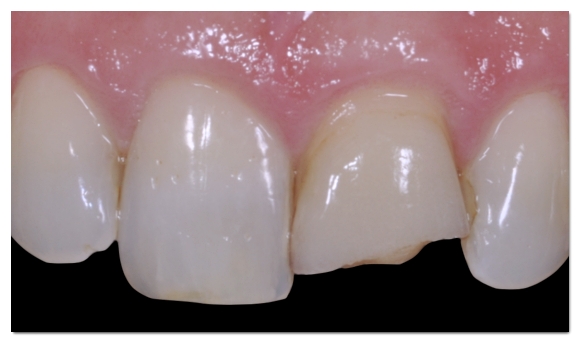
I chipped my front tooth while exercising.
It’s only a small chip...
It should be okay not to treat it right away, right?
Today, I’ll honestly explain whether a dental visit is really necessary when a front tooth is chipped,
and which treatment is appropriate depending on the situation.
Do You Need to Visit a Dentist for a Chipped Front Tooth? Treatment Options by Situation: Key Summary
-
A chipped front tooth cannot heal on its own. The longer it is left untreated, the more the crack can spread, leading to more extensive treatment
-
Minor chips: can often be completed with same-day resin treatment
-
If the damaged area is wide or has been repeatedly damaged: laminate veneers or a crown may be needed
-
Conclusion: Regardless of the size of the chip, it is safest to visit a dentist quickly for an accurate diagnosis first
Table of Contents
-
Do You Need to Visit a Dentist for a Chipped Front Tooth?
-
Cases That Can Be Finished with Same-Day Resin Treatment
-
Cases That Require Laminate Veneers or a Crown
-
A Side-by-Side Comparison of Chipped Front Tooth Treatments
- Do You Need to Visit a Dentist for a Chipped Front Tooth?
To start with the conclusion: yes, you should definitely visit a dentist.
A chipped front tooth is not something that naturally recovers like a healing wound,
and the condition is more likely to worsen over time.
Even a case that could initially have been finished with a simple resin restoration,
can end up requiring more complex treatment such as a laminate veneer or crown if left untreated.
The broken edge of a tooth is weaker than the original tooth. A good way to think of it is as a “broken window.”
As the window is opened and closed, or as wind and rain hit it, the glass repeatedly receives impact.
Over time, the crack grows larger until it suddenly shatters.
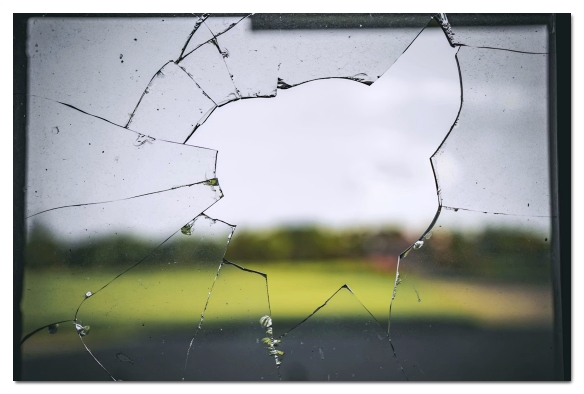
Teeth are the same.
When you talk or eat, repeated force is applied to the chipped area,
and even a tooth that only had a small chip at the edge can eventually develop a larger fracture as stress accumulates.
The problem is that if the dentin inside the tooth becomes exposed, it can cause severe sensitivity and pain.
In that case, instead of resin or a laminate veneer, the whole tooth may need to be covered with a crown.
That means the treatment becomes more complex, and both the time and cost increase.
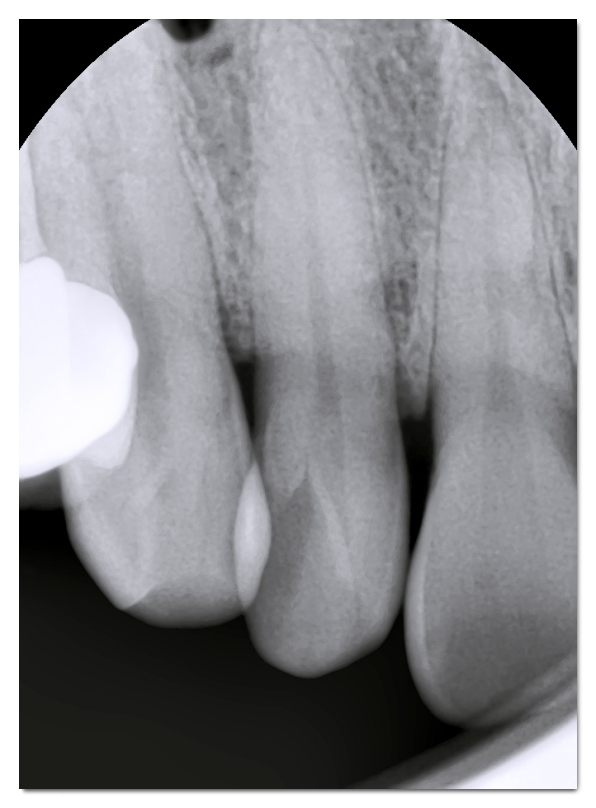 The translucent core in the center of the tooth in the photo is the nerve. If this is exposed, root canal treatment and a crown may be needed.
Step-by-step changes if a chipped front tooth is left untreated (example)
| Time | Tooth condition | Required treatment |
|---|
| Right after the chip | Edge damage, reduced strength | Resin restoration |
| Left untreated for 1 to several months | Crack progresses, risk of further fracture | Laminate veneer |
| Long-term untreated | Dentin exposure, nerve irritation | Root canal treatment + crown |
As you can see, the longer a chipped front tooth is left untreated, the greater the loss becomes.
Rather than brushing it off as “not a big deal,” it is safest to visit a dentist quickly
and get an accurate diagnosis first.
- Cases That Can Be Finished with Same-Day Resin Treatment
When a front tooth is only slightly chipped, the first treatment usually considered is resin.
That is because it is one of the simplest and most cost-effective esthetic treatments.
Resin is a tooth-colored plastic material used to restore the damaged area by adding material to the chip.
Put simply, you can think of it as filling the broken part with dental putty.
Its biggest advantage is that it can be done simply without removing healthy tooth structure.
Because only the damaged area is partially restored, the original tooth can be preserved as much as possible.
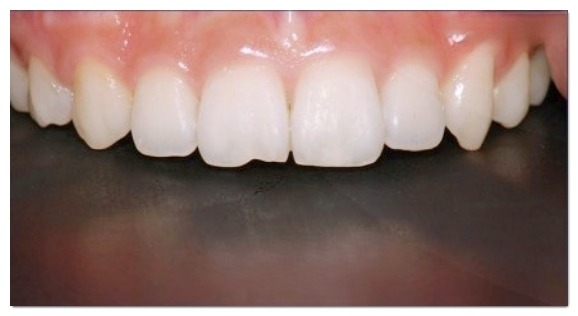 If only the tip of the tooth is slightly chipped, as shown in the photo above, it can be restored relatively simply with resin.
Cases where resin treatment is suitable
-
When the damaged area is not large
-
When only part of the front tooth edge is damaged
-
When the gap between teeth (black triangle) is very small
In cases like these, treatment can often be completed in one day.
The cost is also relatively low, so treatment is not a major burden.
Disadvantages of resin treatment
Because of the material’s properties, resin is not very strong and may chip or come off under strong impact or repeated pressure.
It can also become discolored over time due to coffee, smoking, and similar factors.
If you do not take care of it, its lifespan will naturally become shorter.
- Cases That Require Laminate Veneers or a Crown
If the chipped front tooth is damaged over a wide area or if the inside of the tooth has been affected,
laminate veneers or a crown may be more appropriate.
Because the tooth lacks enough structural support to rely on resin,
a separate prosthetic restoration must be made and attached.
The ceramic materials commonly used for laminate veneers and crowns
have the following advantages compared with resin:
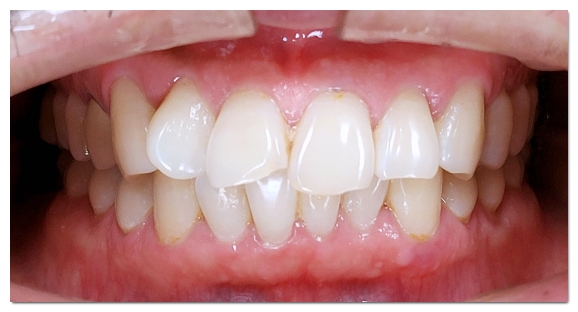
Cases where laminate veneers or crowns are suitable
-
When the fracture area is relatively large
-
When an existing resin restoration repeatedly comes off
-
When you want to improve the tooth shape and color as well
Disadvantages of laminate veneers and crowns
Both treatments require removal of tooth surface.
Because laboratory fabrication of the prosthesis is necessary, they are not easy to complete on the same day, and they tend to cost more than resin.
However, if too much tooth structure is removed during the laminate veneer process,
the veneer that was carefully bonded in place can come off easily or cause sensitivity.
This is because laminate veneers bond strongly when they are attached while preserving as much of the enamel on the tooth surface as possible.
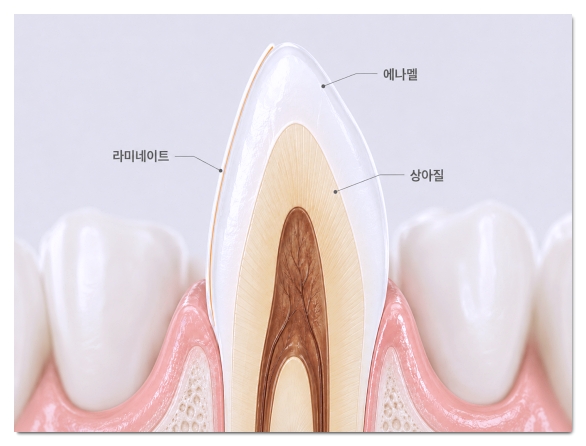
That is why I always emphasize that minimal tooth reduction is important for laminate veneers.
In addition, to help prevent veneer debonding, chipping, cavities, bad breath, and other side effects,
please read the article below for how to get laminate veneers.
A Side-by-Side Comparison of Chipped Front Tooth Treatments
| Category | Resin | Laminate Veneer | Crown |
|---|
| Suitable damage | Minor chip | Moderate fracture | Extensive fracture, nerve exposure |
| Tooth reduction | Almost none | Some reduction | Extensive reduction |
| Treatment period | Same day possible | About 1–2 weeks | About 1–2 weeks |
| Cost | Low | Medium | High |
| Aesthetics | Average | Excellent | Excellent |
| Average lifespan | About 3–5 years | About 10 years | About 7–15 years |
In closing
In the end, resin is not always the right answer just because it is cost-effective,
and laminate veneers or crowns are not always the right answer just because they are more esthetic.
Each treatment has clear advantages and disadvantages, and the appropriate cases are different.
The two most important things are:
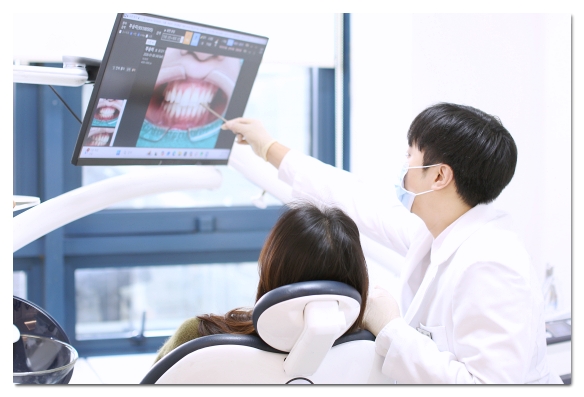
That concludes my detailed explanation of why you should visit a dentist for a chipped front tooth
and the treatment options depending on the situation.
A chipped front tooth may not cause major inconvenience in daily life right away.
But if you leave it untreated, you may have to deal with greater pain and higher costs,
so I recommend not ignoring even a small problem.
Thank you. This was Park Jaehyung.