Hello. I am Park Jae-hyung, director of Wonjin Dental Clinic.

I went in to get laminate veneers, but they told me
I needed crowns. Is that really the case?
What is the difference between laminate veneers and crowns?
Recently, someone visited us because they wanted laminate veneers on their front teeth.
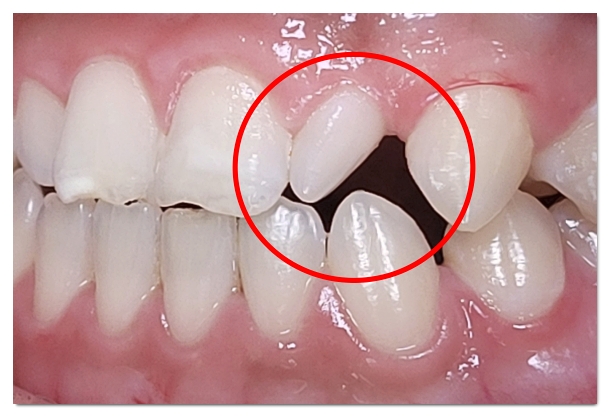
Four teeth were suitable for laminate veneers, while one tooth required a crown. (See the photo below.)
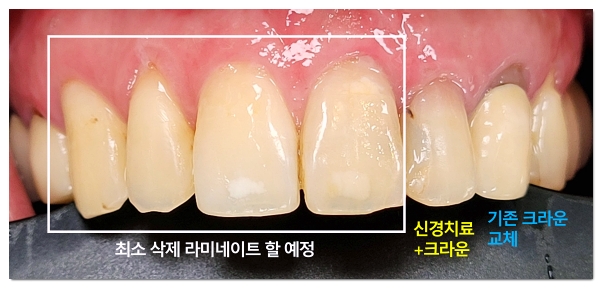
This was because the inner nerve had been damaged and the tooth required root canal treatment.
Today, I will summarize the differences between laminate veneers and crowns, as well as which option is appropriate in each situation, just as I explain them to patients in the treatment room.
[Key Summary of the Differences Between Laminate Veneers and Crowns]
-
Laminate veneers are an “esthetic” procedure in which only the front surface is lightly shaped and covered with a thin material, while crowns cover the entire tooth to “restore its function as well.”
-
If your teeth are healthy and you are concerned about their color, shape, or slight spacing, laminate veneers may be suitable. If you have extensive decay, have undergone root canal treatment, or have a severely damaged tooth, a crown is generally safer.
-
“Removing less tooth structure” is not always the right answer. Choosing the option that matches the condition of your teeth is what is most likely to last.
The Purposes of Laminate Veneers and Crowns Are Different
The first thing I tell patients is that the starting points of the two procedures are different.
Laminate veneers are a procedure for “esthetic improvement,” while crowns are used to “restore damaged teeth so they can be used again.”
Once you understand this difference, the rest becomes much easier to understand.
Laminate veneers are placed by lightly shaping only the front surface of the tooth and attaching a porcelain shell.
You can think of it as similar to applying a nail tip to a fingernail.
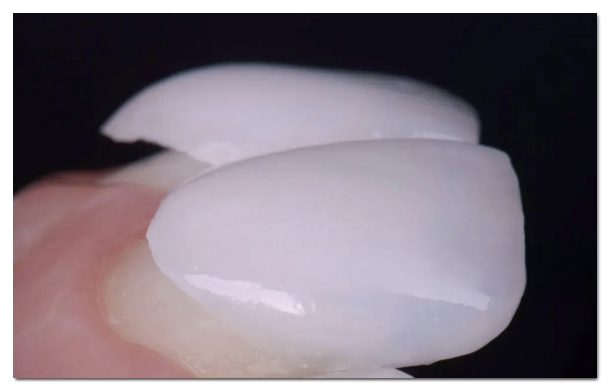
Because only about 0.01–0.3 mm of the front surface is shaped, much of the natural tooth can be preserved. Laminate veneers are recommended when you want to improve the appearance of discolored front teeth, slightly spaced teeth, or minimally chipped teeth.
However, the nerve and root must be healthy for this procedure to be possible.
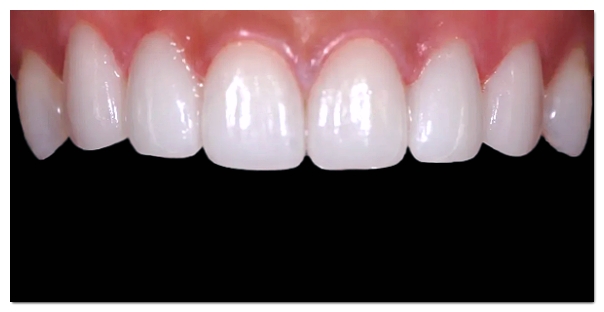
These days, procedures that involve no tooth reduction or minimal tooth reduction are also commonly performed to preserve as much of the natural tooth as possible.
The reason is that if laminate veneers are placed improperly, complications such as lifting, debonding, chipping, and decay may occur, while reducing less tooth structure can help reduce these complications.
Therefore, the amount of tooth reduction should be minimized and the bonding should be performed precisely to reduce the risk of complications.
The specific methods are described in more detail in the article below.
Crowns are made by shaping the entire tooth and covering it completely with an artificial tooth restoration.
Because a crown surrounds the tooth 360 degrees, more tooth structure is removed than with a laminate veneer, but it also firmly supports a tooth that has been weakened.
For this reason, crowns are used when a tooth has been significantly weakened, such as when decay has progressed extensively, the tooth has undergone root canal treatment, or it has been severely fractured.
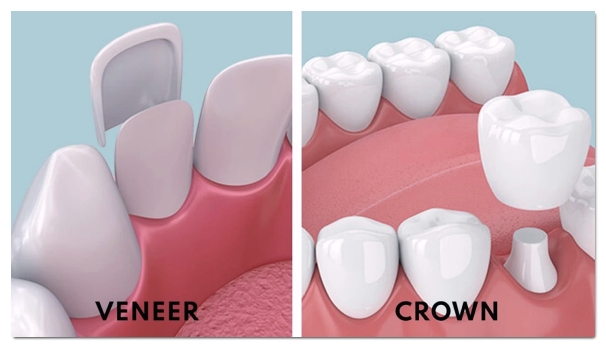
As shown in the photo above, the laminate veneer on the left is attached only to the tooth surface, while the crown surrounds the tooth and covers it with a restoration.
The Differences Between Laminate Veneers and Crowns at a Glance
| Category | Laminate Veneer | Crown |
|---|
| Main purpose | Esthetic improvement | Functional restoration + esthetics |
| Amount of tooth reduction | Minimal, mainly on the front surface (approximately 0.01–0.3 mm) | More extensive, covering the entire tooth |
| Suitable for | Color, shape, or spacing concerns in healthy teeth | Damaged or weakened teeth |
| Lifespan | Around 10 years with proper care | Around 10 years with proper care; more favorable for resisting fracture |
| Reversibility | Difficult (the tooth is shaped) | Difficult (the tooth is shaped) |
Which Option Is Right for My Teeth?
Laminate veneers and crowns are each appropriate in the following situations.
When Laminate Veneers Are Appropriate
-
When there is a slight gap between the teeth
-
When the teeth are naturally small or asymmetrical in shape
-
When there is severe tooth discoloration that cannot be resolved with whitening
-
When a tooth is only slightly chipped, causing no functional problem but affecting its appearance
As shown in the photo above, small teeth are a representative case in which no-prep laminate veneers may be possible.
When Crowns Are Appropriate
-
When decay is so deep and extensive that more than half of the tooth has been damaged
-
When a tooth has been severely fractured or broken due to trauma
-
Teeth that have undergone root canal treatment
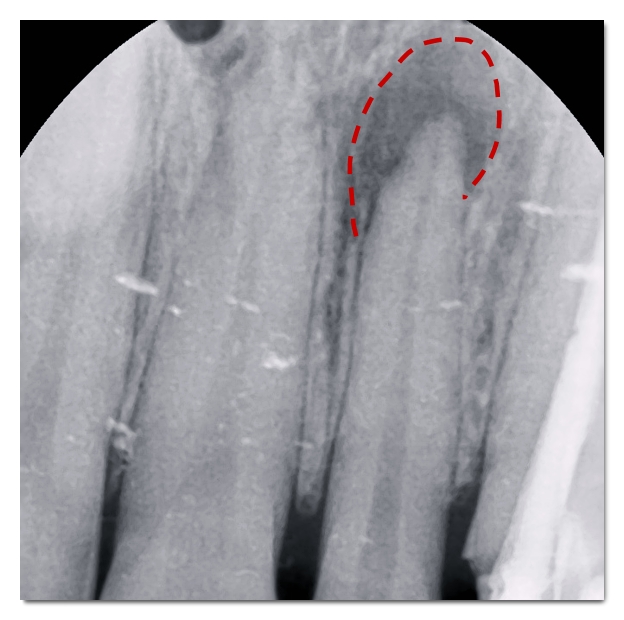
As shown in the photo above, when inflammation has developed at the root of a tooth and root canal treatment is necessary, the tooth can become extremely weak without a crown, making it difficult to withstand pressure and impact.
If the treatment does not match the condition of the tooth, it may not last even if minimal tooth structure is removed, and you may ultimately need retreatment.
That is why it is important to accurately assess the extent of the damage from the beginning.
Things to Check Before Choosing a Dental Clinic
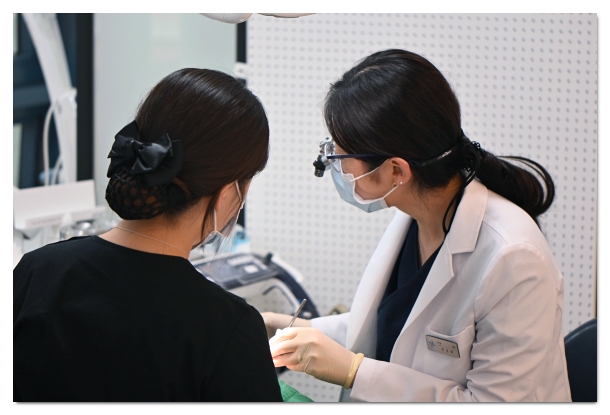
When choosing a dental clinic, be sure to check the following:
-
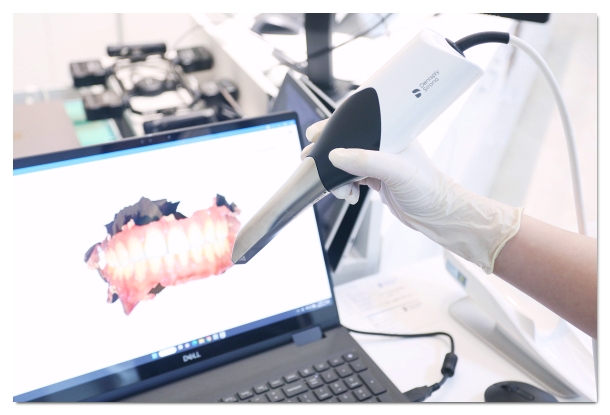
Whether they explain the condition of your teeth based on a thorough examination, including X-rays and an oral scan
-
Whether they present alternatives appropriate for your case instead of recommending only one option
-
Whether they clearly explain the materials used and the standards for aftercare and warranties
-
Whether they transparently explain the cost before treatment
-
Whether they explain the treatment process and expected results well enough for you to understand them
Frequently Asked Questions
Q. How long do laminate veneers and crowns last?
Depending on how they are maintained, they generally last around 10 years, and in some cases they can last longer with proper care.
Q. Can my teeth be restored to their original condition after treatment?
Because both procedures involve shaping the teeth, it is difficult to return them completely to their original condition.
That is why a thorough consultation before treatment is important.
Conclusion
It may be difficult to determine on your own whether laminate veneers or crowns are right for you.
To make an accurate assessment, we need to consider the amount of remaining tooth structure, the bite between the upper and lower teeth, the condition of the gums, and even habits such as teeth grinding.
Even when two people both have “spaced front teeth,” laminate veneers may be sufficient for one person, while another may require a different approach.
The best option is to receive an accurate examination from a professional who has treated a wide variety of cases.
Rather than worrying about it on your own, I recommend first having the condition of your teeth assessed through an accurate examination.
Thank you. This has been Park Jae-hyung.
[If you are considering laminate veneer treatment, be sure to read the article below]