Hello. I am Park Jae-hyung, the director of Wonjin Dental Clinic at Gangnam Station.
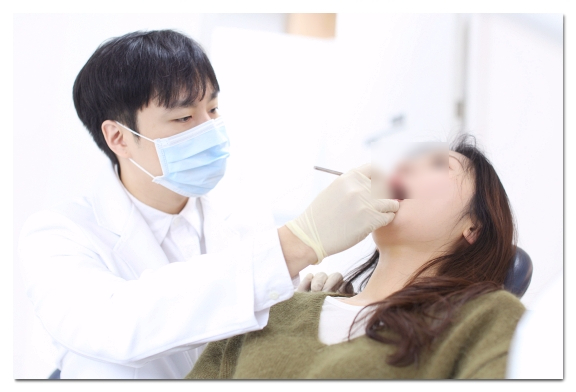
Does teeth whitening
always cause sensitivity?
Many people looking into teeth whitening near Gangnam Station hesitate because of concerns like this.
In the consultation room, the first question people considering whitening usually ask is about sensitivity.
To give you the conclusion first, sensitivity can be reduced substantially, and some people barely feel it at all depending on how the treatment is performed.
Rather than postponing the procedure without understanding it, it is much more helpful to learn how it works and prepare accordingly.
Today, I will explain why teeth can become sensitive during whitening and how to undergo teeth whitening while minimizing sensitivity.
Simply knowing these points before treatment can help reduce concerns about sensitivity as a side effect.
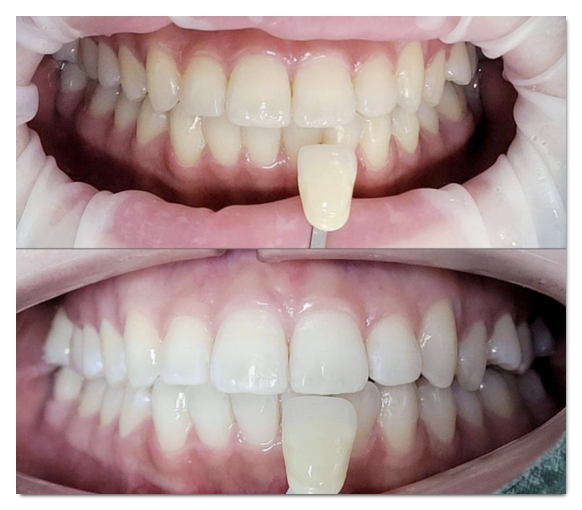
2026.06.01
Table of Contents
-
Why do teeth become sensitive during whitening?
-
4 ways to undergo teeth whitening without sensitivity
-
Teeth whitening at Gangnam Station: Does sensitivity mean the whitening was done incorrectly?
Why do teeth become sensitive during whitening?
First, let us look at why teeth become sensitive after whitening.
The main ingredient in teeth-whitening products is a hydrogen peroxide compound.
This ingredient passes through the enamel on the tooth surface and penetrates into the dentin beneath it, breaking down accumulated pigments.
During this process, the nerves can be temporarily stimulated through the dentinal tubules, which are tiny channels in the dentin.
That is why you may feel a sharp sensation when drinking cold water or breathing in cold air.
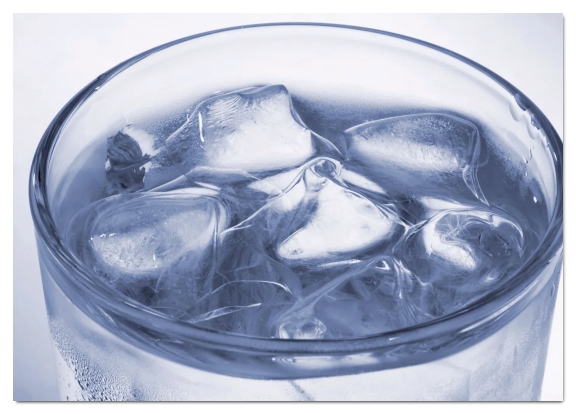
The important point here is that this sensitivity is generally a temporary, reversible response—not something caused by nerve damage.
It usually subsides within a day or two after the procedure.
However, the degree of sensitivity varies considerably from person to person, so the key is to approach treatment with the goal of reducing sensitivity from the beginning.
In particular, people whose teeth are normally sensitive to cold foods, whose gums have receded and exposed the tooth roots, or whose enamel is thin are more likely to experience sensitivity.
Knowing in advance which category you fall into can make a difference in how you prepare.
The degree of sensitivity also varies depending on the whitening method.
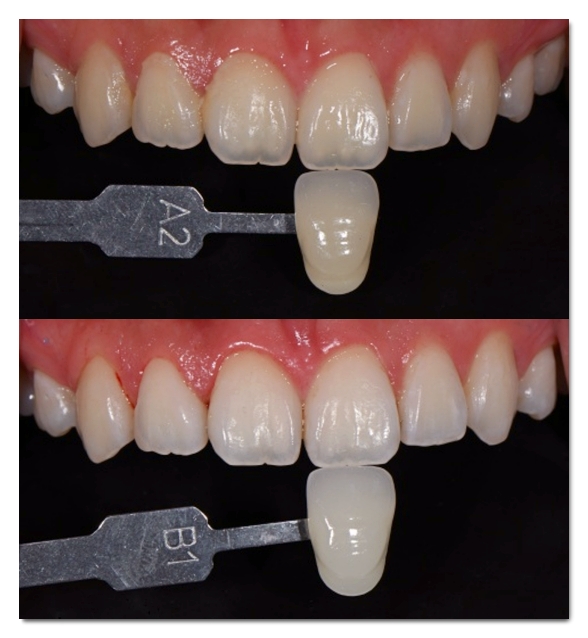
Professional whitening performed in a dental office uses a high-concentration product for a short period, while also allowing the dentist to protect the gums and provide measures to relieve sensitivity.
For reference, the whitening product we use is Beautis.
Since the results and degree of sensitivity can vary significantly depending on which whitening product is used, it is a good idea to check in advance.
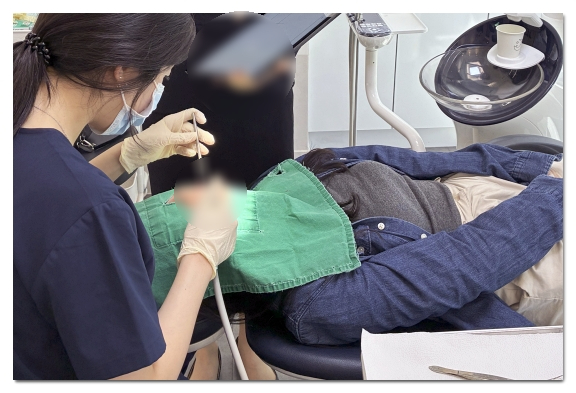
By contrast, at-home whitening uses a lower-concentration product over a longer period.
Although it is relatively less irritating, insufficient care can allow the product to come into contact with the gums and cause discomfort instead.
Many people also combine the two methods.
Because the appropriate combination depends on the condition of your teeth and the desired level of brightness, it is safest to decide through a consultation.
4 ways to undergo teeth whitening without sensitivity
So, how can you undergo whitening without sensitivity?
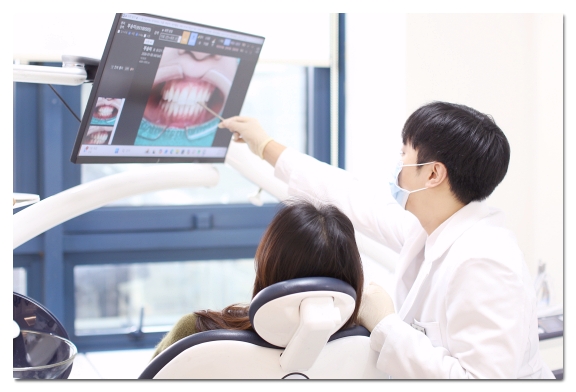
First, checking your oral condition before whitening is the most important step.
Teeth with cavities, areas where the roots are exposed because the gums have receded, or fine cracks may allow the whitening product to penetrate more deeply and cause greater sensitivity.
If these issues are treated or protected first, discomfort can be significantly reduced.
Therefore, whitening should not be viewed simply as a procedure in which a product is applied. The first step should be a diagnosis to confirm whether your teeth are in an appropriate condition for whitening.
Second, it is best not to set the concentration and treatment time too aggressively.
Trying to brighten the teeth quickly with a high concentration also increases the risk of sensitivity.
Adjusting the concentration and carrying out the treatment over several sessions can produce a similar final result with much less irritation.
Ultimately, satisfaction is higher when you proceed at a pace your teeth can tolerate rather than prioritizing speed.
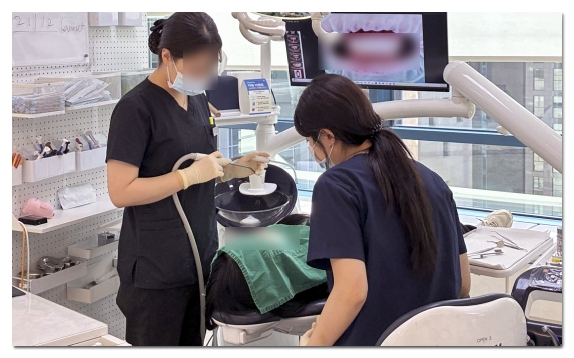
Third, use sensitivity-relief measures before and after the procedure.
Applying products containing potassium nitrate or fluoride can stabilize the dentinal tubules and reduce nerve stimulation.
Carefully protecting the gums during in-office whitening serves the same purpose.
If the product comes into contact with the gums, it can cause not only sensitivity but also stinging, so accurately applying a protective barrier has a greater effect on the outcome than you might expect.
Fourth, care immediately after whitening is also important.
It is best to temporarily avoid very cold or hot foods, as well as strongly colored foods and beverages, immediately after the procedure.
This is because the teeth are more sensitive to external stimuli than usual during this period.
Taking care for just a few days can help the sensitivity subside more quickly and help the whitening effect last longer.
If the sensitivity lasts longer than usual or one particular tooth continues to hurt, there may be another cause unrelated to the whitening itself, so it is a good idea to have it checked.
26.06.05 ~ 26.06.05
Teeth whitening at Gangnam Station: Does sensitivity mean the whitening was done incorrectly?
There is one more point I would like to address.
Feeling sensitivity does not mean that the whitening was performed incorrectly.
Rather, it is closer to being a sign that the product is working inside the tooth as well.
Therefore, there is no need to worry too much if you feel slight sensitivity.
However, if the pain is difficult to tolerate or does not subside after several days,
you must let us know, as this may mean that the concentration or frequency needs to be adjusted.
Simply proceeding without considering your symptoms is not the answer.
Adjusting the treatment based on your response each time is the most reliable way to complete whitening while minimizing sensitivity.
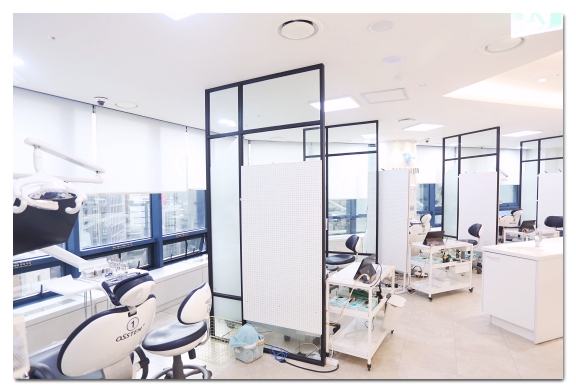
In summary, sensitivity during teeth whitening is not an unavoidable side effect; it is something that can be managed.
You can greatly reduce the burden by first accurately checking the condition of your teeth, appropriately adjusting the concentration and number of sessions, and receiving sensitivity-relief treatment as well.
If you are considering whitening near Gangnam Station, I recommend receiving a thorough consultation to determine whether the method suits the condition of your teeth, rather than simply choosing fast and intense whitening.
For those who have postponed whitening because they were worried about sensitivity, starting with a diagnosis may be the answer.
Thank you. This was Park Jae-hyung.
How to Whiten Yellow Teeth?
Teeth Whitening vs. Laminate Veneers