Hello. I’m Park Jae-hyeong, director of 원진치과의원.
I accidentally bit down on a pair of chopsticks and cracked my tooth. 😭
I noticed a crack, but I don’t even know when it happened.

Because your front teeth are immediately visible when you smile, you may first worry that the tooth could break if you leave it as it is,
and wonder whether you need to visit the dentist right away.
However, how you should respond to a crack in a front tooth depends entirely on how deep it is.
It could simply be a fine line on the surface, or it could be a crack extending all the way to the nerve.
In today’s post, I’ll explain everything you need to know about dealing with a cracked front tooth—from a self-check to help you decide whether you need to visit the dentist immediately, to treatment options tailored to the condition of the crack,
as well as identifying the underlying cause to help prevent it from recurring.
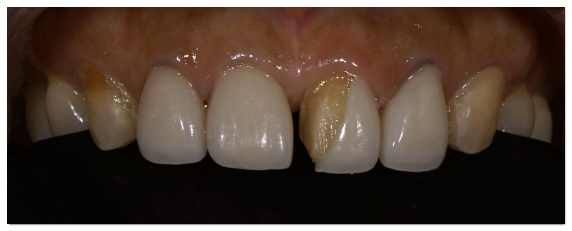
Table of Contents
-
When you need to visit the dentist immediately vs. when you can wait
-
A “crack” and a “chip” are different
-
Self-checking the severity based on symptoms
-
Why you should address it before the tooth breaks
-
Treatment methods according to the depth of the crack in a front tooth
-
You also need to examine why the crack occurred
-
Summary
When you need to visit the dentist immediately vs. when you can wait
To start with the conclusion, not every crack is an emergency.
However, the first step is to distinguish between cases that require an immediate visit and those where you can wait a little.
If the crack occurred after an impact or while chewing something hard, and the tooth is loose, out of position, or bleeding, you should visit a dentist as soon as possible.
On the other hand, if you have not injured the tooth and only noticed a line in the mirror without any pain,
it may not be an emergency requiring immediate attention, but it is still a good idea to have it checked in the near future.
If a piece has fallen off in the meantime, do not throw it away. Place it in milk or saline and bring it with you;
depending on the situation, it may be possible to use it again.
Avoid chewing on the cracked side for the time being, and try to avoid foods and drinks that are extremely cold or hot.
A “crack” and a “chip” are different
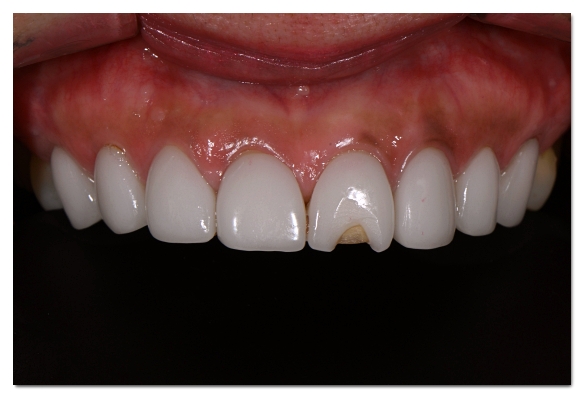
Although people commonly say that a tooth is “cracked,” a surface crack in which only a line appears is different from a fracture in which a piece has come off.
With a crack, the shape of the tooth remains unchanged even though a line is visible. With a fracture, part of the edge or another section has actually broken off.
Because it is difficult to judge the depth of a crack just by looking at it, an examination is needed. With a fracture, the size of the missing piece and whether the nerve is exposed determine the treatment.
For both conditions, it is safer to have a dentist examine the tooth rather than relying on self-diagnosis.
Self-checking the severity based on symptoms
You can get a general idea of how extensive the crack is from your symptoms.
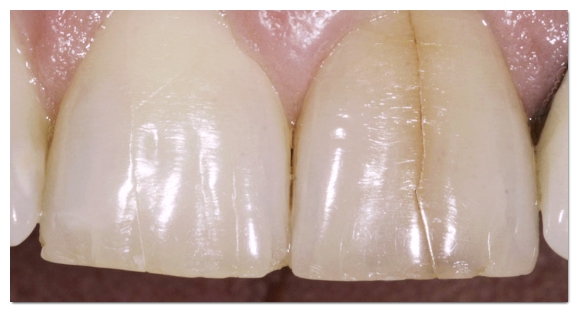
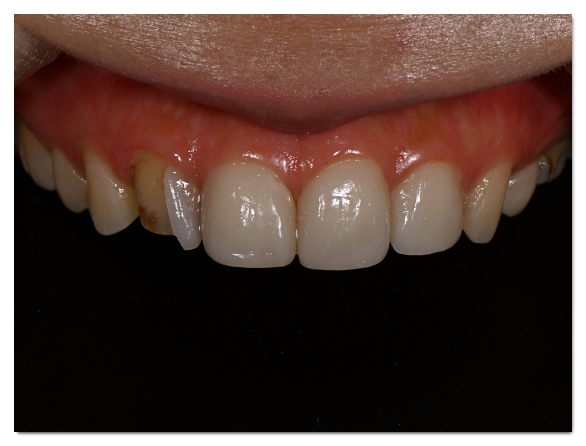
If you can see only a hairline-like mark in the mirror and have no symptoms, it may be a fine crack limited to the surface enamel.
In such cases, it may not cause a major problem immediately, but you should monitor whether it progresses.
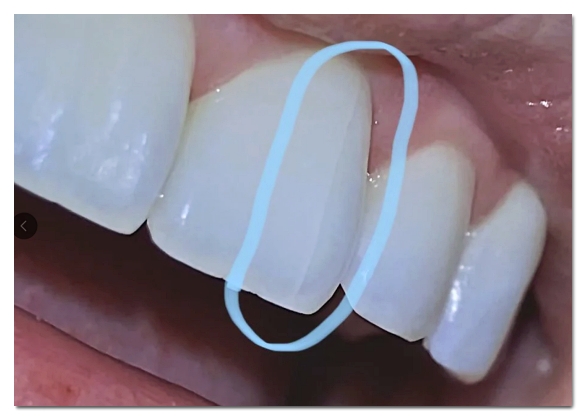
A crack that is faintly visible on the surface, as in the photo above, may be a fine surface crack.
On the other hand, if you experience a dull or sharp pain when chewing, sensitivity to cold water,
or discoloration that appears to have seeped into the crack, these may be signs that the crack has extended inward.
In this case, do not put off an examination.
There is one more thing to note: if you feel a brief sharp sensation when you bite down on something and then release it, rather than when you are simply resting,
it means the crack is responding to chewing pressure, so it should be examined with greater care.
Why you should address it before the tooth breaks
Cracks tend to widen gradually over time. A crack that initially remains on the surface can become deeper when it is repeatedly subjected to chewing forces.
If bacteria enter through the gap, decay may develop inside, or the area along the crack may become darkly discolored, affecting the appearance of the front tooth.
In other words, something that could have been handled simply when small can gradually become a larger problem.
Front teeth are especially prone to repeated stress in the same area because force is concentrated there when you bite through food.

Treatment methods according to the depth of the crack in a front tooth
Treatment varies according to the depth of the crack.
A light surface crack or small fracture can often be repaired naturally with composite resin alone.
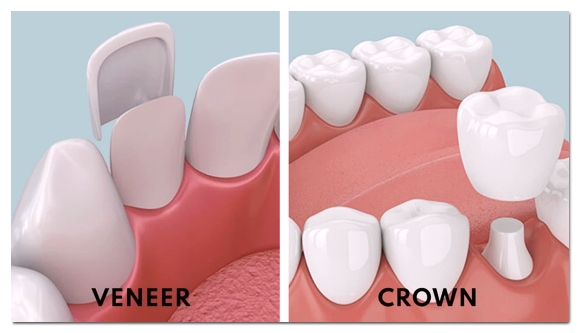
If a larger portion has broken off or the shape also needs to be refined, veneers may be considered.
The important thing is to determine which type of restoration will provide long-term stability while preserving as much of the natural tooth as possible.
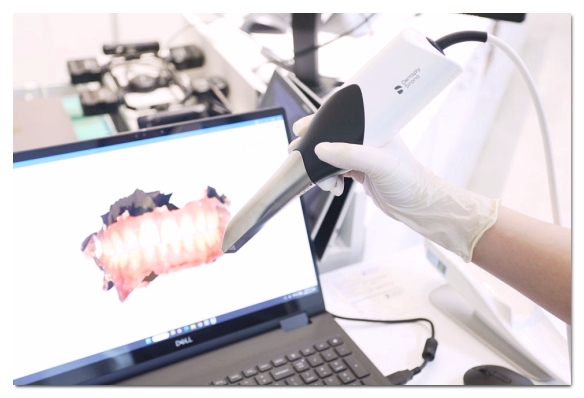
Even with veneers, excessive tooth reduction or an improper bite can cause complications such as easy detachment, repeat breakage, or decay developing in the gaps.
Therefore, the amount of tooth reduction should be minimized, the bonding protocol should be followed carefully so that the veneer does not detach easily, and the bite should be adjusted thoroughly through to the end.
For information on how to receive veneers without regrets, please read the article below.
If the crack has progressed close to or into the nerve, the tooth should be protected by covering it with a crown after root canal treatment.
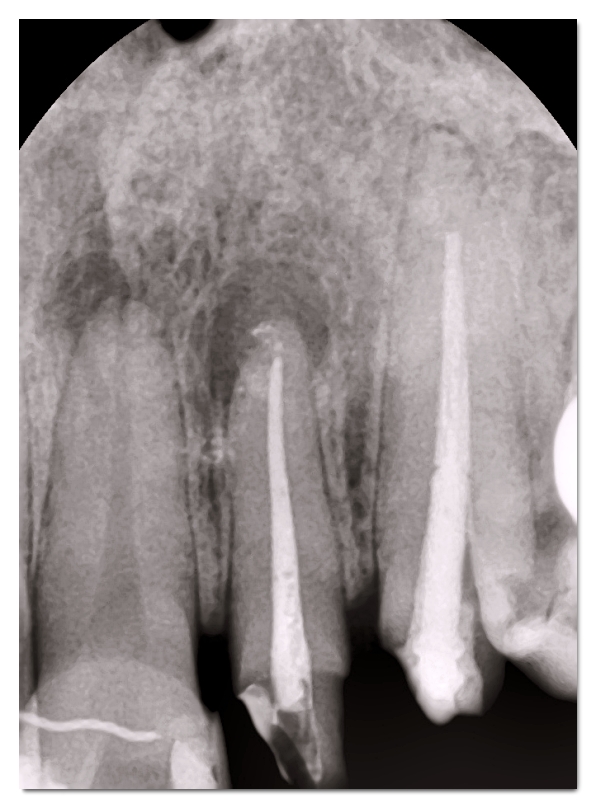
X-ray image of a tooth that has undergone root canal treatment
In rare cases, if the crack extends deeply down to the root, it may be difficult to save the tooth, and extraction followed by consideration of an implant may be necessary.
However, these cases are uncommon, and in most situations treatment can focus on preserving the tooth.
Why you also need to examine the cause of the crack
It is also important to identify why the crack occurred.
Teeth are more likely to crack if you frequently bite through hard foods with your front teeth, grind or clench your teeth, or have a tooth that was injured in the past.
If the cause is examined and protective measures such as a night guard are recommended, the treated tooth can last longer.
If the underlying cause is left unchanged, another crack may develop next to the treated area.
Ultimately, reducing recurrence requires addressing not only the crack itself but also why it occurred.
Summary
The most important thing when a front tooth develops a crack is not to decide on your own that everything is fine.
Even if you have no symptoms, only an accurate examination can determine whether it is a fine surface crack or a deeper one. The earlier it is addressed, the more of the tooth may be preserved.
If you are in pain or the crack appeared immediately after an injury, I recommend getting it checked promptly. Even without symptoms, it is advisable to have it examined in the near future.
Thank you. This was Park Jae-hyeong.