Hello. I am Dr. Jae-hyung Park, Director of Wonjin Dental Clinic.
They say partial orthodontic treatment takes 2–3 months.
If I start now, it should be finished quickly, right?
Most people looking into partial orthodontic treatment for their front teeth have similar concerns.
Often, there is a slight gap between the front teeth, one or two teeth are positioned inward, or a single tooth is crooked like a snaggletooth.
Since the overall alignment of the teeth is not severely misaligned,
many people hesitate to undergo lengthy and burdensome full orthodontic treatment and would rather quickly correct only the front teeth that bother them.
Some people also search for treatment before an upcoming wedding, job interview, or important photo shoot.
The first thing I would like to tell such people is that partial orthodontic treatment for the front teeth is not possible in every case.
So, in this article, I will discuss the conditions under which partial orthodontic treatment is possible, the available methods, and realistic treatment periods and costs.
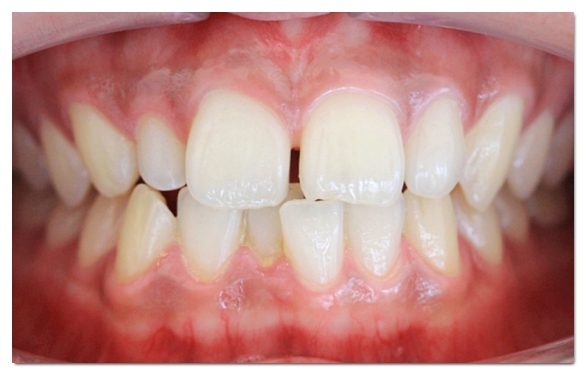
Table of Contents
-
Conditions for partial orthodontic treatment of the front teeth
-
What types of partial orthodontic treatment for the front teeth are available?
-
Factors that determine the duration and cost of partial orthodontic treatment for the front teeth
-
Why retention is important after partial orthodontic treatment for the front teeth
-
If you are deciding between partial orthodontic treatment for the front teeth and veneers
-
Conclusion
Conditions for partial orthodontic treatment of the front teeth
The key factor determining whether partial orthodontic treatment for the front teeth is possible is the occlusion—in other words, how the upper and lower teeth fit together.
If only the alignment of the front teeth is problematic while the molar occlusion and overall skeletal structure are stable, partial orthodontic treatment may be sufficient to improve the condition.
For example, this may include a small gap between the front teeth or one or two teeth that are mildly rotated.
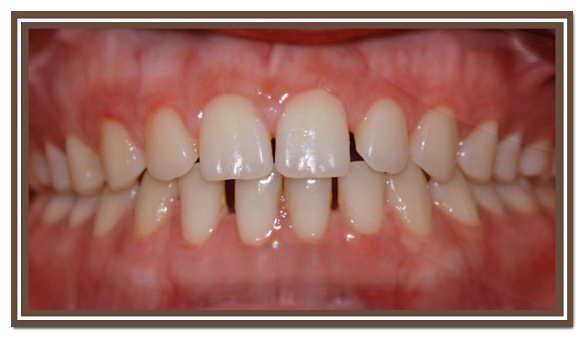
On the other hand, if there is malocclusion or insufficient space and the front teeth are moved forcefully on their own,
this can cause the bite with the other teeth to become misaligned or create new, unexpected spaces.
In such cases, a comprehensive approach rather than partial orthodontic treatment may be necessary, and forcing treatment may actually make the process more complicated.
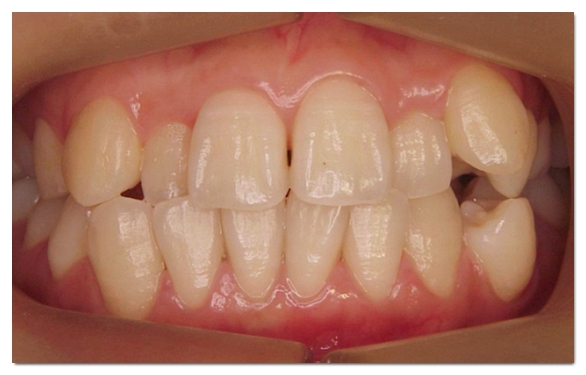
Cases like the one shown above often have limitations that cannot be addressed with partial orthodontic treatment alone. Since the alignment and occlusion of the molars may also be misaligned, it is not appropriate to change only the front portion.
Therefore, rather than judging based only on the front teeth, it is essential to examine the overall alignment and occlusion first
and determine whether partial orthodontic treatment is appropriate.
Even if you are told that it is possible, it is best to clearly understand the extent of the expected improvement before beginning treatment.
What types of partial orthodontic treatment for the front teeth are available?
Partial orthodontic treatment for the front teeth can largely be divided into clear aligners and partial braces.
Clear aligners are inconspicuous and removable, making daily life relatively convenient, but there are limits to how far the teeth can be moved at one time.
Partial braces are attached only to the necessary teeth, allowing them to be moved precisely.
Rather than deciding that one method is always better, the suitable appliance depends on the distance and direction the teeth need to be moved and their condition.
In other words, even for the same front-tooth problem, clear aligners may be more suitable for one person, while partial braces may be a better fit for another.
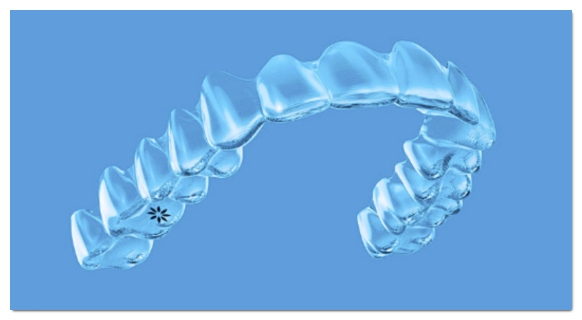
The image above shows treatment with clear aligners (Invisalign).
Rather than choosing based only on the type of appliance, it is better to make your decision based on how far and in what direction your teeth need to be moved.
During your consultation, it may also be helpful to ask about cases similar to yours and review how those cases progressed.
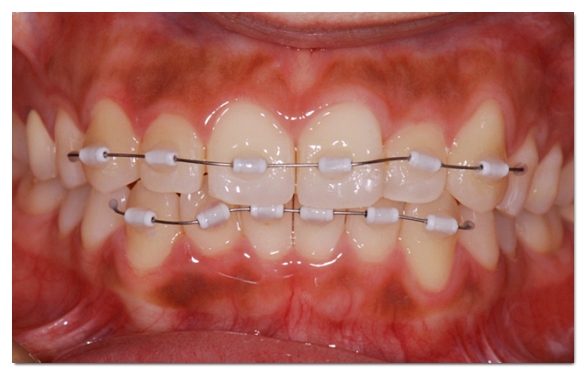
The image above shows an MTA rapid orthodontic appliance.
Factors that determine the duration and cost of partial orthodontic treatment for the front teeth
The treatment period for partial orthodontic treatment for the front teeth is said to range from as little as 3–6 months to around one year, but it varies greatly from case to case.
The shorter and simpler the distance the teeth need to be moved, the shorter the treatment period. If rotation or space adjustment is required, the period becomes longer.
At our clinic, partial orthodontic treatment generally costs KRW 1.5–1.8 million per arch, depending on the case.
The cost also varies depending on the type of appliance, the treatment scope, and the duration, so it is difficult to state a uniform price.
Rather than using average prices found online as a reference, it is better to have your condition directly evaluated and then receive a cost estimate.
Why retention is important after partial orthodontic treatment for the front teeth
The process is not completely over simply because active treatment has ended.
Moved teeth have a tendency to return to their original positions, so after orthodontic treatment, a period of stabilization with retainers is necessary.
If this process is neglected, the front teeth that were carefully improved may become misaligned again.
Partial orthodontic treatment does not mean that the retention phase can be skipped, so it is best to consider not only the treatment period but also the follow-up care.
At your initial consultation, ask in advance how long you will need to wear the retainers and how follow-up care will continue.
If you are deciding between partial orthodontic treatment for the front teeth and veneers
When looking into partial orthodontic treatment for the front teeth, many people compare it with veneers.
Although the two treatments may appear to have similar goals, their approaches are entirely different.
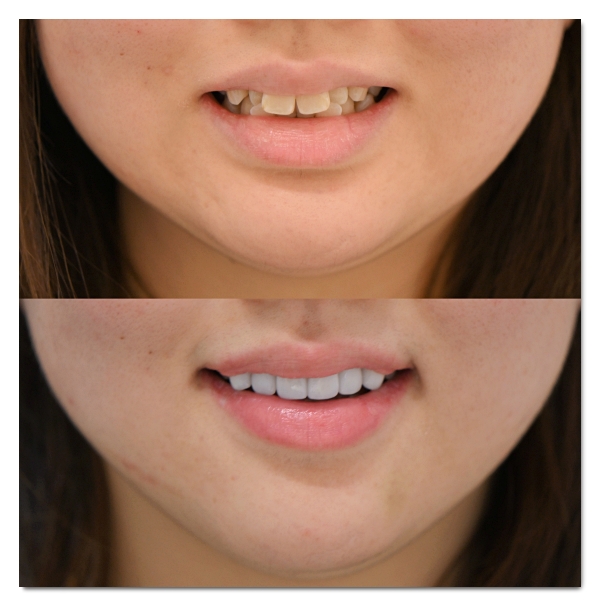
Partial orthodontic treatment leaves your natural teeth intact and changes only their positions,
whereas veneers involve slightly reshaping the teeth and covering them with a new surface.
26.05.14 - 26.05.22
If preserving your natural teeth is your priority, even if it takes time, orthodontic treatment may be considered. If rapid cosmetic improvement is more important, veneers may be an option.
If improvement is necessary but the tooth roots are too weak or short,
and there are concerns about possible complications from moving the teeth orthodontically, veneers may actually be more appropriate.
Whichever option you consider, making your decision based on preserving your teeth as much as possible is safer and better for the future.
Conclusion
Partial orthodontic treatment for the front teeth is a way to improve only the areas that concern you relatively simply, but it is not a universal solution that applies to everyone.
Whether it is possible, which method is appropriate, and how long it will take ultimately depend on your occlusion and dental condition.
Rather than reaching a premature conclusion based on vague information, I recommend receiving an accurate diagnosis to determine the approach that is right for you.
Even when only a small area is involved, moving teeth is still a treatment procedure,
so I believe prioritizing stable results over quick results is ultimately the way to achieve greater satisfaction.
Thank you. This has been Dr. Jae-hyung Park.