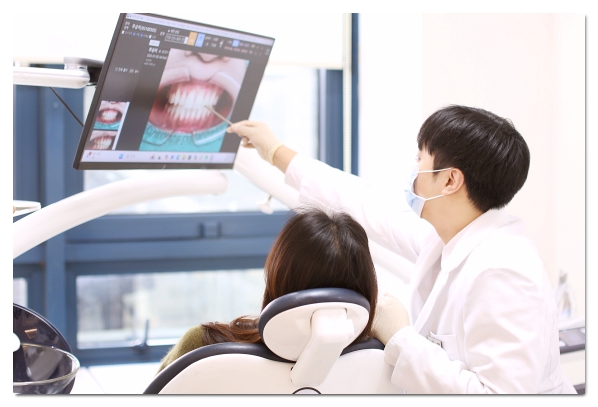
Hello. I’m Park Jae-hyung, director of Wonjin Dental Clinic.
Would it be better to fill the gap between my front teeth with resin,
or would veneers be the right choice?

The gap between your front teeth catches your attention every time you look in the mirror.
Many people find themselves covering their mouths whenever they smile, or experience discomfort in daily life because food easily gets stuck between their front teeth after meals.
In particular, quite a few people hurry to the dentist before important events such as job interviews, weddings, or wedding photo shoots.
There are two representative methods for addressing these gaps between the teeth, medically known as a diastema.
They are “front-tooth resin” and “veneers.”
Today, from the perspective of a dentist who performs both treatments every day, I’ll summarize the advantages and disadvantages of resin and veneer treatment, along with the criteria for choosing the option that is right for you.
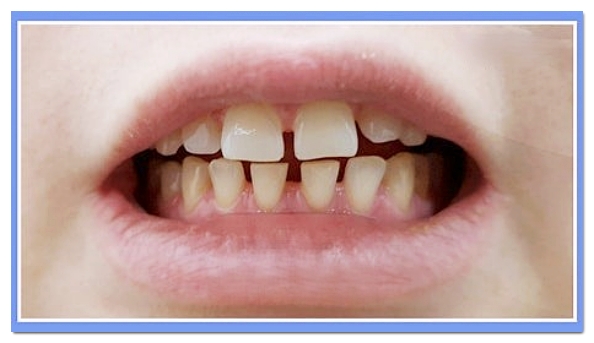
Table of Contents
-
Completed in one day: Fast and convenient resin treatment for front teeth
-
Long-term whitening effects and aesthetics: Veneers
-
Resin vs. veneers: Which treatment is right for me? (Selection guide)
-
Completed in One Day: Fast and Convenient Resin Treatment for Front Teeth
What is resin treatment for front teeth?
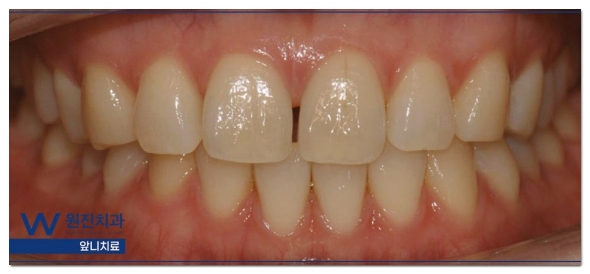
This method involves directly packing a reinforced dental plastic material that most closely matches the natural color of the teeth into the gap, filling the space, and shaping it.
[Advantages of Resin]
The greatest advantage of this method is that it preserves your natural teeth without filing them down.
Because the teeth are not reduced at all, or only the surface is minimally roughened to improve bonding, the treatment is relatively low-burden.
In addition, there is no need to have a restoration separately fabricated at an outside dental laboratory, so the entire process—from diagnosis to treatment—can usually be completed during the same dental visit, in about two hours.
Compared with veneers, the initial financial barrier is also lower, making it a relatively easy option to choose.
[Disadvantages of Resin]
However, resin also has clear limitations.
Because the material naturally contains microscopic pores on its surface, the boundary between the resin and the tooth may become yellowish within a few years if you frequently drink coffee, cola, or consume curry, or if you smoke.
Also, because the material is added onto the sides of the teeth, its strength is not particularly high. There is a risk that it may chip or come off if you bite into hard food with your front teeth.
Above all, caution is needed when the gap is particularly wide.
If a wide gap is filled excessively with resin alone, the teeth may become abnormally wide from side to side, making them look somewhat unnatural, like oversized front teeth.
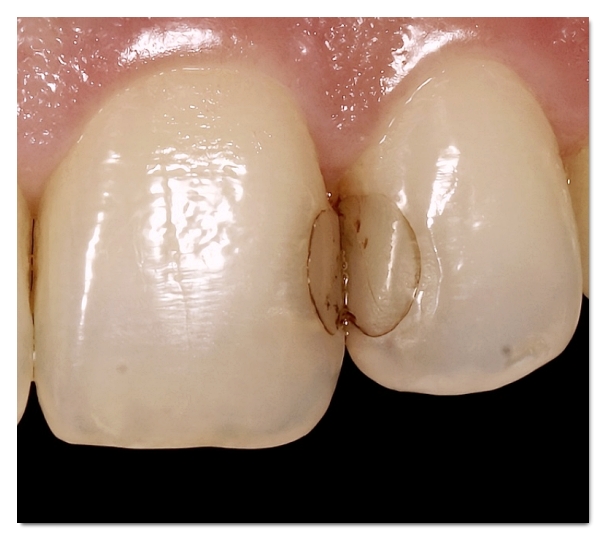
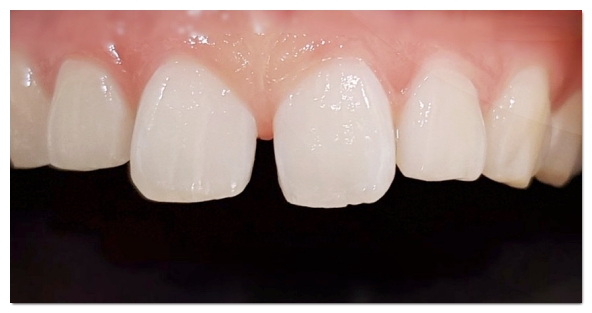
In the photo above, you can also see dark staining along the boundary between the tooth and the resin restoration.
- Long-Term Whitening Effects and Aesthetics: Veneers
What are veneers?
Veneers are a treatment in which the outer surfaces of spaced front teeth are lightly prepared, and thin ceramic artificial teeth designed to match the shape of the face and the smile line are attached over them.
Recently, “no-prep” or “minimal-prep veneers,” which aim to avoid damaging the natural teeth, have also become widely available.
[Advantages of Veneers]
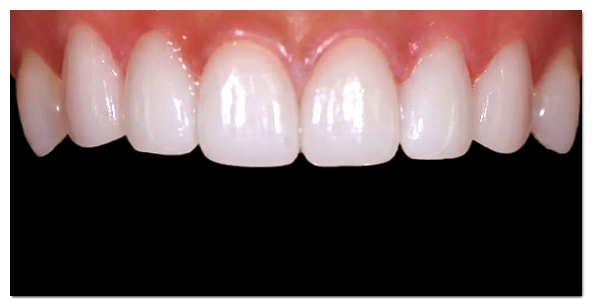
The outstanding advantage of veneers is their excellent translucency and texture, making them difficult to distinguish from your real teeth.
(Of course, this also depends on whether they are made entirely by machine or handcrafted by a dental technician.)
Beyond simply filling the gap, veneers can be precisely designed to reflect your preferred tooth shape and size, including ideal proportions.
In particular, because they are made from high-density ceramic, they are more resistant to discoloration than resin and can maintain a clean color over the long term.
Furthermore, because they are firmly bonded to the enamel layer of the teeth, they have a low detachment rate and can remain strong for a long time.
[Disadvantages of Veneers]
However, there are also some drawbacks to consider before deciding on veneers.
Although many more cases can now be treated without tooth reduction,
depending on the angle or degree of protrusion of the patient’s existing teeth, it may still be unavoidable to prepare the tooth surfaces.
This can create psychological concern about having the teeth reduced.
In addition, because time is needed to precisely fabricate a customized ceramic restoration, you must visit the dental clinic at least twice.
It is also worth knowing in advance that the initial treatment cost is relatively higher than that of resin.
That is why I always emphasize the following:
When getting veneers for the first time, it is important to minimize the amount of tooth reduction.
With veneers, the existing restorations are removed and the teeth are prepared each time the treatment is performed.
(Of course, we use a water laser to minimize tooth damage and the amount of reduction, and I believe this is worthwhile even if it takes a little more time.)
If too much of the tooth surface is removed each time, veneers alone may eventually no longer be sufficient, and crowns, implants, or other treatments may become necessary.
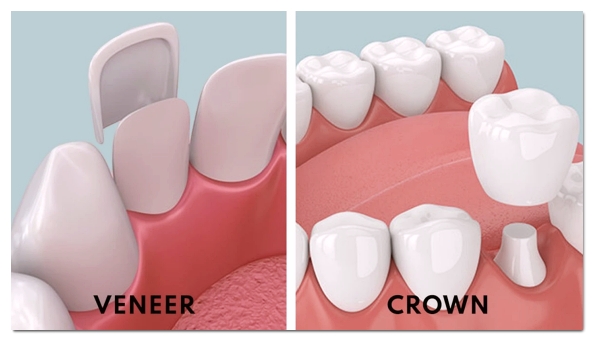
In the photo above, you can clearly see the difference in the amount of tooth reduction between the veneer on the left and the crown on the right.
Not everyone is eligible for no-prep or minimal-prep treatment.
From a dentist’s perspective, I believe it is important to make an accurate diagnosis and recommend a method that preserves as much of the natural tooth as possible.
I have explained in more detail in the article below how to reduce the amount of tooth reduction and receive treatment safely.
- Resin vs. Veneers: Which Treatment Is Right for Me? (Selection Guide)
This is not something that can be decided or recommended hastily by saying, “Resin is always better” or “Veneers are always the answer.”
The appropriate method varies completely depending on each patient’s oral condition and needs.
Cases Where Resin Is Recommended
-
People with a very mild gap of approximately 1–2 mm between their teeth
-
People who are satisfied with the overall shape and alignment of their teeth and only want to fill the “empty space”
-
People who have an important event coming up and need to see the treatment results in just one day
-
People who feel uncomfortable with permanently bonding a restoration or having their teeth reduced
Cases Where Veneers Are Recommended
-
People with a wide gap where filling it with resin may make the teeth look too wide and unnatural
-
People who want to improve not only the gap but also asymmetry on both sides of the teeth and slight misalignment at the same time
-
People who frequently drink coffee or tea and want a whitening effect without discoloration
-
People for whom long-term maintenance is important
Conclusion
Many people search only for treatment costs or reviews when looking for ways to address gaps between their front teeth.
However, it is most important to receive an accurate diagnosis of your bite and gum health.
This is not a problem that ends simply by filling the empty space.
If the bite between the upper and lower teeth is tight and resin or ceramic is added forcefully, the restoration will come into contact whenever you chew, causing it to chip or come off quickly.
Also, if the gap was caused by gum recession, fundamental gum treatment should be performed first, before cosmetic treatment, for safety.
Even if it takes a little more time, please seek treatment at a clinic that openly explains these factors and recommends the treatment method that is best for you.
Thank you. This has been Park Jae-hyung.