Hello. I am Jae-hyung Park, the director of Wonjin Dental Clinic.
I went to the dentist for cavity treatment,
but each dental clinic recommended a different treatment.
Which should I choose among
composite fillings, inlays, and crowns?

When you visit a dental clinic for cavity treatment, you may hear about more treatment options than you expected.
Even with the same cavity, one clinic may recommend a composite filling, while another may suggest an inlay or crown.
“What determines the difference in treatment?”
“Why is there a difference in cost?”
These are natural questions for patients to have.
So today, I will explain the differences among composite fillings, inlays, and crowns, as well as the cost structure and criteria for choosing a dental clinic, in an easy-to-understand way.

Contents
-
Differences among composite fillings, inlays, and crowns for cavity treatment
-
How do cavity treatment costs differ?
-
Why do dental clinics recommend different treatments?
-
What are the criteria for choosing cavity treatment?
-
Frequently asked questions
-
Differences among composite fillings, inlays, and crowns for cavity treatment
The approach to cavity treatment varies completely depending on the extent of the damage and the structural stability of the remaining tooth.

Composite filling: The most conservative approach
A composite filling involves removing the decayed area and directly filling it with a tooth-colored material.
It is generally used when the cavity is relatively small and enough of the tooth structure remains.
Inlay: Reinforcement made to fit precisely
An inlay involves removing the cavity, taking an impression, and reinforcing part of the tooth with a custom-made piece.
A variety of materials can be selected, including gold, ceramic, and zirconia. Inlays are characterized by greater strength and durability than composite fillings.
Crowns: Protecting the entire tooth
Finally, a crown involves reducing the outer portion of the tooth overall and completely covering it to provide protection.
Crowns are generally used when the cavity is extensive or to protect a tooth that has been weakened after root canal treatment.
- How do cavity treatment costs differ?
Treatment costs vary depending on the material—such as composite resin, ceramic, gold, or zirconia—the fabrication method, and the extent of treatment.
The dental clinic’s operating system may also be reflected in the cost.
However, general price ranges are as follows.
-
Composite filling: 100,000–300,000 won
-
Inlay: approximately 200,000–550,000 won
-
Crown: 400,000–800,000 won

<Summary Table of Key Differences Among Cavity Treatment Methods>
| Category | Extent of damage | Amount of tooth reduction | Strength |
|---|
| Composite filling | Early cavity | Small | Low to moderate |
| Inlay | Moderate cavity | Moderate | High |
| Crown | Extensive damage | Large | Very high |
- Why do dental clinics recommend different treatments?
When the number of cavities or the recommended treatment differs from one dental clinic to another,
patients naturally may first feel doubtful and anxious, wondering, “Could this be overtreatment?”
However, this is often due to differences in each dentist’s treatment philosophy and treatment standards.
The biggest difference lies in how early-stage cavities are viewed.
A conservative approach that says, “We should preserve the natural tooth as much as possible, so let’s maintain good brushing habits and monitor it,” differs from a preventive approach that says, “Let’s treat it in advance before the cavity becomes deeper because of a busy schedule or inadequate care later on.”
Differences in diagnostic equipment also play a role.
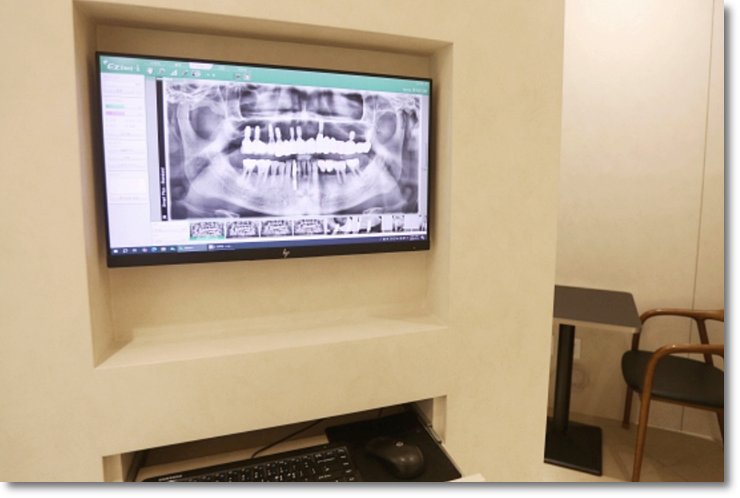
The depth and extent of a cavity may be assessed differently when viewed with the naked eye, on an X-ray, with Qray, or in detail using the latest 3D CT.
Also, when the extent of tooth damage falls near an uncertain borderline,
one dentist may say, “Let’s use an inlay to reduce the amount of tooth reduction even slightly,” while another may say, “Let’s cover it with a crown to prevent the tooth from splitting in two.”
Treatment plans may also differ depending on the situation and on each dentist’s preferred materials and techniques.
There is no single correct answer in dental treatment.
What matters is not the number of cavities or the cost itself, but clear communication that explains, from the patient’s perspective, “why this treatment is necessary now” and what the expected outlook is.
- What are the criteria for choosing cavity treatment?
When deciding on cavity treatment, you should consider several criteria together rather than looking only at the cost.
First, consider the depth and extent of the cavity.
A cavity in its early stage, close to the surface, can often be treated adequately with a composite filling. However, if it has progressed deeper inside, an inlay or crown may be necessary.
Second, consider the remaining tooth structure.
If the tooth has been significantly weakened, for example by root canal treatment, protecting the entire tooth may be more stable than simply filling it.
Third, consider the location of the cavity.
For areas that bear significant force, such as molars, the long-term risk of fracture should be taken into account.
Ultimately, the key question is: “How long can the tooth remain functional in its current condition?”

- Frequently asked questions
Q. Can a composite filling break later?
A. It is possible. In particular, areas with extensive damage or areas that bear significant force, such as molars, may develop wear or fractures over time.
Q. Why can’t an inlay be completed in one visit?
A. Because an impression must be taken and the inlay must be fabricated at a dental laboratory, about two visits are usually required.

Q. Is root canal treatment always performed before getting a crown?
A. In most cases, it is, but depending on the extent of tooth damage, a crown may sometimes be necessary without root canal treatment.
Q. Why is care after treatment important?
A. Regular care is important because secondary cavities may develop at the margins of the restoration rather than in the restoration itself.

In closing
Cavity treatment should not be decided based solely on cost or convenience of the treatment process.
You should consider together how extensively the tooth is currently damaged and how long it can be used stably in the future.
If you are having difficulty deciding, I recommend getting diagnoses from at least three dental clinics and listening carefully to why each diagnosis was made.
This will help you make a clearer decision about which treatment you need.
Thank you. This was Jae-hyung Park.