Hello. I’m Director Yoon Jeongwon of Yonsei Jeongwon Dental Clinic, Daechi-dong Orthodontic Clinic.
Today, I’d like to briefly summarize some of the questions that people considering orthodontic treatment often ask.
How long does orthodontic treatment take?
The length of orthodontic treatment varies depending on the scope of treatment. In the case of partial orthodontic treatment for only the front teeth, it can be completed in about 6 months. For full orthodontic treatment, the duration differs depending on whether teeth are extracted or not. In general, non-extraction orthodontic treatment can be completed in about 1 year to 1 year and 6 months, while extraction orthodontic treatment usually takes about 2 years to 2 years and 6 months. However, this can vary depending on the difficulty of the treatment, so the exact treatment period can only be determined after a detailed diagnosis.
Can orthodontic treatment be done without extracting teeth?
The reason teeth are not aligned and come in crooked is that when the combined width of all the teeth is greater than the size of the dental arch in which the teeth will be arranged, there is not enough space for the teeth to line up, causing them to erupt unevenly. If the degree of crowding is not severe, the teeth can be aligned without extraction. Through methods such as interproximal reduction to reduce tooth width, palatal expansion devices, and mini-screws used to move the molars backward, it is possible to create about 8 to 9 mm of space even with non-extraction orthodontic treatment.
However, if there is a shortage of more than 10 mm of space for tooth alignment, if protrusion is severe, or if the front teeth are angled forward significantly, there are limits to creating space through interproximal reduction or arch expansion, and extraction treatment becomes necessary. Non-extraction treatment is not inherently better, and extraction treatment is not bad; the application differs depending on the case, so the exact treatment method should be carefully decided after a detailed diagnosis.
Does orthodontic treatment hurt?
After the orthodontic appliance is first placed, during the initial adaptation period when tooth movement is active, and each time you visit the dental clinic for regular adjustments, when the wire is changed to a thicker one and elastics are added, pain may occur for 2 to 3 days and up to 1 week after treatment.
The reason for this pain is that between the tooth root and the alveolar bone there is a tissue called the periodontal ligament, which acts as a cushion when chewing forces or external pressure are applied. During orthodontic treatment, force is applied to the teeth in one direction, and the nerves and blood vessels within the periodontal ligament are compressed, causing pain.
The patient feels mild pain, and the teeth become sensitive due to the pressure, so chewing hard foods may cause pain. This pain usually lasts for 3 to 4 days and then disappears. If the pain is too severe, it can usually be relieved by taking Tylenol (acetaminophen).
How often do I need to visit during orthodontic treatment?
The interval between visits during orthodontic treatment is usually once every 3 to 6 weeks. This is because, as orthodontic treatment progresses, the wire needs to be changed so that its elasticity can move the teeth little by little. If these monthly visits are postponed, not only will the effectiveness of the orthodontic treatment decrease, but the treatment period will also become longer. Therefore, if it is difficult to visit the dental clinic regularly due to military service, studying abroad, or similar reasons, you should carefully choose the timing. However, these days, even when entering military service, it is possible to take leave more freely than before, so more soldiers are getting orthodontic treatment during their service period.
What happens if cavities develop during orthodontic treatment?
In general, before starting orthodontic treatment, a cavity screening is performed, and if cavities are severe, cavity treatment is done first before orthodontics begins. In addition, since cavity screenings are performed regularly when coming in for orthodontic appointments, the chance of cavities developing is not high. However, if cavities do develop during the orthodontic period due to poor oral hygiene, cavity treatment may be done in the middle of orthodontic treatment.
If the scope is not severe, treatment can be done without removing the appliance. However, if root canal treatment is needed or if the cavity area extends to where the appliance is attached, the appliance on some teeth is partially removed, cavity treatment is completed, and then the appliance is attached again to continue orthodontic treatment. During this period, it is difficult to apply sufficient orthodontic force, so the treatment period may be delayed. Therefore, it is recommended to maintain thorough oral hygiene as much as possible.
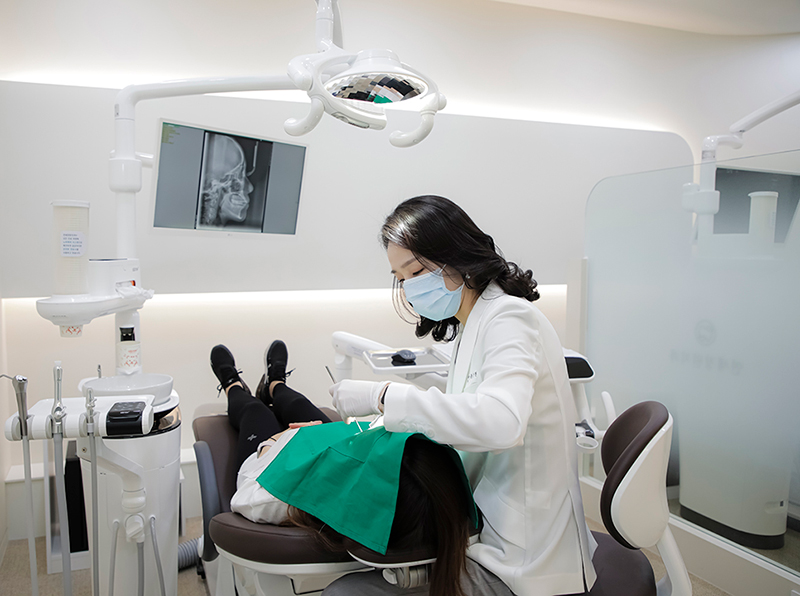
How should I manage oral hygiene, such as using interdental brushes and floss, during orthodontic treatment?
When the orthodontic appliance is attached, we provide a thorough explanation about oral hygiene management during orthodontic treatment on the first day. There is a separate V-shaped orthodontic toothbrush, and you should carefully brush the surfaces of the teeth and around the appliance with it. An end-tuft toothbrush is bent at a 90-degree angle and is used between the back teeth on the inside; it can also be used to thoroughly clean around the appliance. In addition, interdental brushes can be used, and super floss can be used to smoothly remove plaque between teeth by inserting the stiff end between the teeth.
Do self-ligating appliances straighten teeth faster than conventional appliances?
According to several papers, there is no evidence that self-ligating appliances have less friction between the appliance and the wire than conventional appliances, that treatment time is shorter, that teeth align faster, or that there is less pain. However, when using self-ligating appliances, the time needed to insert and remove the wire during treatment is reduced, which can be used as more time to focus on treatment.
At Yonsei Jeongwon Dental Clinic, orthodontic treatment includes the cost of the detailed diagnosis and monthly visits (excluding the cost of retainers), so you do not need to worry about additional expenses. In addition, since general dentistry is available at the same clinic, all necessary orthodontic treatments such as extractions and cavity treatment can be done in one place, and installment payment plans are available to reduce the burden of paying a large amount at once, making it even more attractive.
The director in charge of the orthodontics department, Yoon Jeongwon, has specialized only in orthodontics for 16 years of clinical experience and has extensive experience with many high-difficulty cases. Therefore, effective treatment is possible for various orthodontic cases such as malocclusion, protruding mouth, and underbite.
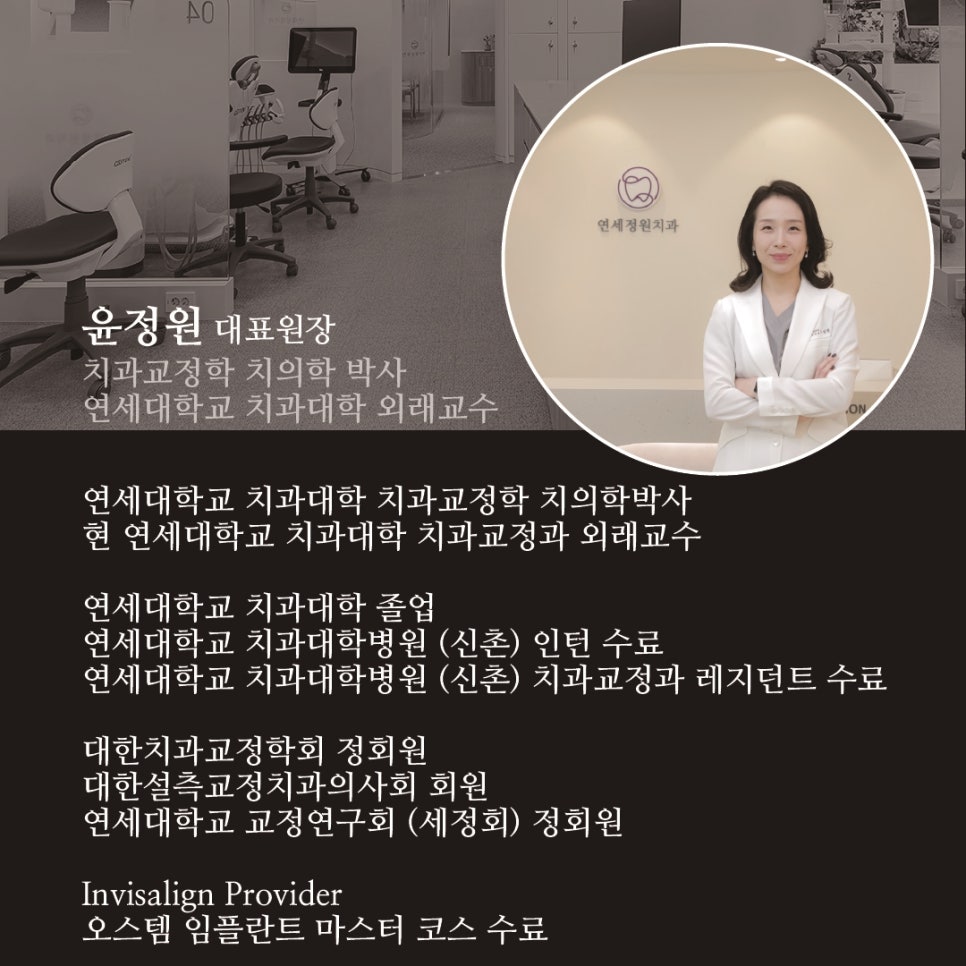
If you visit Yonsei Jeongwon Dental Clinic, a specialized orthodontic clinic in Daechi-dong, you can accurately understand your current condition through a simple oral examination at no additional cost, and you can also hear explanations about various orthodontic appliances during orthodontic consultations, so please feel free to contact us for an appointment.
At Yonsei Jeongwon Dental Clinic, we have all the latest equipment needed for orthodontic treatment, including the iTero Lumina 3D oral scanner, growth plate examination, and pre- and post-treatment simulation through the Morpheus facial scanner, allowing for more precise and systematic orthodontic treatment.
Perhaps those who are considering orthodontic treatment due to protruding mouth, crowded teeth, malocclusion, underbite, and similar concerns have already gathered a lot of information through search. Even so, comparing the different appliances in person and hearing detailed explanations will be very helpful in making a decision.
During consultations, you can compare various appliances such as Clarity, Clippy C, and Invisalign with your own eyes and hear detailed explanations of their pros and cons, so we encourage you to call or visit for a consultation without hesitation.
Yonsei Jeongwon Dental Clinic is close to Samseong Station, Hakyeoul Station, Daechi Station, and Hanti Station, making it very convenient to visit from Samseong-dong, Daechi-dong, and Gaepo-dong.
Building next to BMW at the Woori Apartment intersection in Daechi-dong
(Across from Starbucks / Samsung Store)
Daechi-dong Orthodontic Clinic Yonsei Jeongwon Dental Clinic
Parking is convenient and free
Consultation and inquiries: 02-501-2879