Criteria for Extraction vs. Non-Extraction, Yonsei Jeongwon Dental Clinic
Hello, I am Yoon Jeongwon, the chief director of Yonsei Jeongwon Dental Clinic, an orthodontic clinic in Daechi-dong.
Orthodontic treatment is not simply a treatment to make your smile beautiful. Irregular teeth alignment, crowded teeth, and protruding teeth are malocclusions that affect not only appearance but also chewing, pronunciation, and oral hygiene. If the malocclusion is severe, it can make it difficult to chew food properly, putting a strain on digestion and even causing periodontal disease or jaw joint problems, which is why early diagnosis is important.
Orthodontic treatment is a procedure that improves the positions of the teeth and jawbones, improves the bite between the upper and lower teeth, and creates a balanced alignment. According to the American Association of Orthodontists (AAO), orthodontic treatment uses appliances that gradually move the teeth into alignment to correct various malocclusions such as crowding, crowded teeth, protruding teeth, and open bite. The key is to create a customized plan that takes into account each individual's tooth and jaw structure, facial shape, and oral function. In other words, orthodontic treatment is not merely a form of “cosmetic dentistry” for the teeth, but a comprehensive treatment that considers functional, structural, and aesthetic aspects.
One of the most common questions many patients have before starting orthodontic treatment is, “Is extraction absolutely necessary?” Extraction is performed when the dental arch is very crowded or the protrusion is severe, and it is not required for every patient. In recent years, non-extraction orthodontic techniques have advanced significantly, and many cases that previously required extraction can now achieve satisfactory results without removing teeth. Various methods such as tooth movement using mini-screws and arch expansion appliances have been introduced, making them applicable to children and adults alike, and they can also be used in complex cases such as protruding teeth, open bite, and asymmetry.
On the other hand, extraction orthodontics has the advantage of effectively improving severe crowding and protruding teeth. However, because healthy teeth must be extracted and extraction cannot be reversed once performed, the decision should be made only after comprehensively evaluating the patient's dental alignment, jaw structure, facial shape, and orthodontic goals.
So, what are the criteria for deciding between extraction and non-extraction?
Criteria for Extraction vs. Non-Extraction
-
Space to align crowded teeth
-
Whether the face is protrusive
-
The angle of the front teeth
-
The bite
-
Whether there are implants
The first criterion is whether there is enough space to align crowded teeth. Before the development of various orthodontic techniques as we have now, a shortage of about 4–7 mm of space was considered to be on the borderline between extraction and non-extraction. Since one premolar is usually about 7–8 mm in size, when that much space was lacking, orthodontic treatment was performed after extracting a premolar. However, today, with the advancement of various orthodontic appliances such as mini-screws, even when space is lacking by about 8–9 mm, treatment without extraction has become sufficiently possible. When there is a shortage of more than 10 mm, premolar extraction is considered.
The second criterion is whether facial protrusion is present and should be evaluated. One of the most well-known standards for assessing protrusion is the esthetic E-line. From the side, if the lips protrude beyond the line connecting the tip of the nose and the chin, it is generally considered that the mouth protrudes significantly. The angle between the nose and the philtrum, called the nasolabial angle, is also sometimes used to assess protrusion. Mild protrusion can often be improved sufficiently with non-extraction treatment alone. However, to achieve a clearly noticeable improvement in protrusion, extraction orthodontics is needed to retract the mouth.
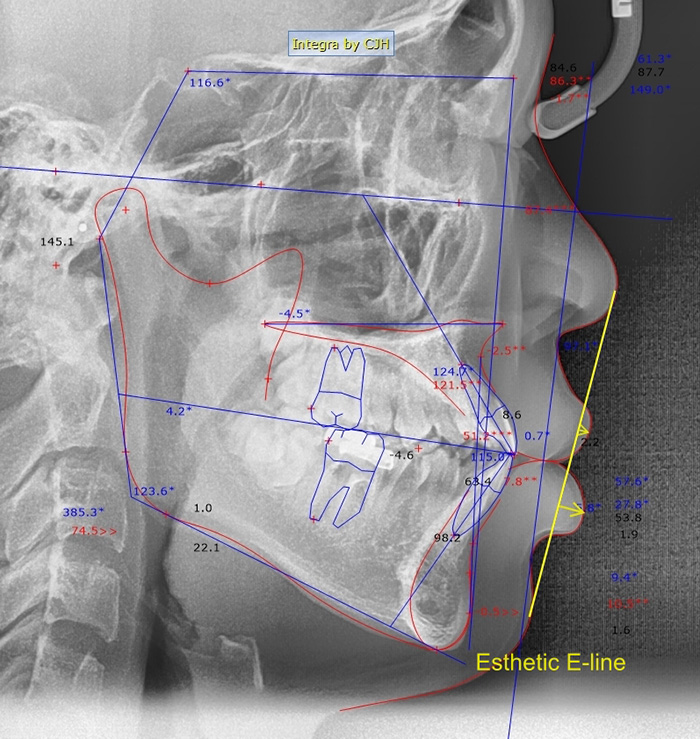
Esthetic E-line
The third diagnostic criterion is to consider the angle of the front teeth. If the front teeth are excessively flared, the amount of backward movement needed for the teeth increases, making extraction more likely.
The fourth diagnostic criterion is to look at the bite. A bite in which the lower teeth are barely visible from the front is called deep bite. In such cases, if teeth are moved backward after extraction, they may get caught on the lower teeth and the space may not close well. For this reason, non-extraction treatment is usually performed. Conversely, when the upper and lower front teeth are separated by a gap when biting down, this is called an open bite. In this case, extraction orthodontics may be somewhat more advantageous because as the extraction space closes, the front teeth slightly tip inward from their original angle and the space closes.
"In compliance with the Medical Service Act and guidelines on medical advertising, this was removed to avoid being mistaken for an advertising act that emphasizes or highlights treatment results through before-and-after photo comparisons or that may entice patients."
The fifth diagnostic criterion is that when teeth cannot move forward or backward, such as when implants are in place, treatment is generally performed without extraction. Because the implant is completely fixed in the alveolar bone and the position of the tooth cannot change, orthodontic treatment that relies on using extraction space to move the teeth forward and backward to adjust the bite is not possible. In cases where extraction is absolutely necessary, such as severe protrusion, the implant may be removed before orthodontic treatment is performed.
The success of orthodontic treatment depends greatly on the orthodontist's experience and skill. If the teeth, jaw structure, and soft tissues are analyzed precisely through the latest equipment such as panoramic X-rays, 3D imaging, and CBCT scans, it becomes possible to establish a more accurate treatment plan not only for whether extraction is needed but for the entire orthodontic process. If the extraction/non-extraction treatment plan is not properly established, the mouth shape may become excessively retracted or may not improve enough, leading to lower satisfaction. Therefore, it is important to choose a clinic where the attending dentist can take responsibility for managing the treatment from the planning stage through completion.
Building next to BMW at the Wusung Apartment intersection in Daechi-dong
(Across from Starbucks/Samsung Store)
Yonsei Jeongwon Dental Clinic, an orthodontic clinic in Daechi-dong, offers convenient and free parking.
Consultation and inquiries: 02-501-2879