
Orthodontic floss use, Yonsei Jeongwon Dental Clinic
�
The importance of flossing
When starting orthodontic treatment, many people ask, “Do I really need to floss?” or “The brackets make it hard to get floss in, so how should I take care of my teeth?” During orthodontic treatment, food can easily get stuck between the teeth and brackets, and in many cases brushing alone is not enough to remove it, which is why flossing is much more important than usual.
Once orthodontic treatment begins, you will receive education on oral hygiene management during treatment on the first day the appliance is attached.
Usually, you will receive a kit that includes an orthodontic toothbrush, interdental brush, floss, wax (used to apply to orthodontic appliances or irritating areas), and mouth rinse.
Before starting orthodontic treatment, you will have a cavity check, and any areas that need treatment will be treated before the appliance is attached. However, if oral hygiene is not properly maintained during the orthodontic period, cavities can develop over the long treatment span of 1 to 2 years.
In a previous post, I introduced various oral hygiene products.
For an orthodontic toothbrush (a V-shaped toothbrush), first hold the brush vertically so that the brackets sit within the V-shaped groove, then clean the entire tooth surface and around the brackets. After that, tilt the toothbrush 45 degrees and carefully and gently clean both the upper and lower areas around the orthodontic appliance.
Because orthodontic toothbrushes can wear out faster than regular toothbrushes, you should check their condition regularly and replace them with a new toothbrush.
An end tuft toothbrush is bent at 90 degrees and is used between the back molars. The head of the brush is smaller than a regular toothbrush, the tip is bent at 90 degrees, and the bristles have a pointed triangular shape.
Because the tip is pointed, it is useful for cleaning between appliances, and it was designed to clean the inner areas of the rearmost molars that are difficult to reach with a regular toothbrush. Since the wire runs through that area, a regular toothbrush cannot fit between the molars, making brushing difficult. Therefore, an end tuft toothbrush bent at 90 degrees is used to clean the inner areas.
Why is floss needed?
- Removal of plaque between teeth
When you have orthodontic appliances, there are many gaps that the toothbrush bristles cannot reach well, so plaque tends to remain between the teeth. If this plaque accumulates for a long time, it can lead to cavities, gum inflammation, and even bad breath.
- Prevention of white spots
The most common side effect seen during orthodontic treatment is the white demineralized areas that appear on the tooth surface (white spots). Thorough interdental care alone can prevent a significant portion of this.
- Maintaining gum health
Using floss allows you to clean all the way to the gumline, greatly reducing the risk of gum swelling, bleeding, and periodontitis.
Superfloss that can be used during orthodontic treatment
Superfloss is a type of floss with stiff ends and a sponge-like, thicker middle section, allowing the firm end to be slipped between the teeth so plaque between the teeth can be removed gently. For reference, according to a paper, flossing before brushing resulted in much less plaque between the teeth and a higher fluoride concentration between the teeth than brushing first and flossing afterward. It is recommended to floss at least once a day before going to bed.
Using these oral hygiene products to prevent cavities is one way to help finish orthodontic treatment more quickly!
This is because if cavities develop during orthodontic treatment, the bracket attached to the tooth that needs treatment must be temporarily removed, the tooth must be treated, and then the bracket must be reattached, making it difficult to provide sufficient orthodontic force during that period.
The final goal of orthodontic treatment is not simply straight teeth, but teeth that are healthy and can be used for a long time.
Just by brushing correctly and flossing, the quality of the treatment result can change significantly, so please take 3–5 minutes a day and continue to manage your oral hygiene consistently.
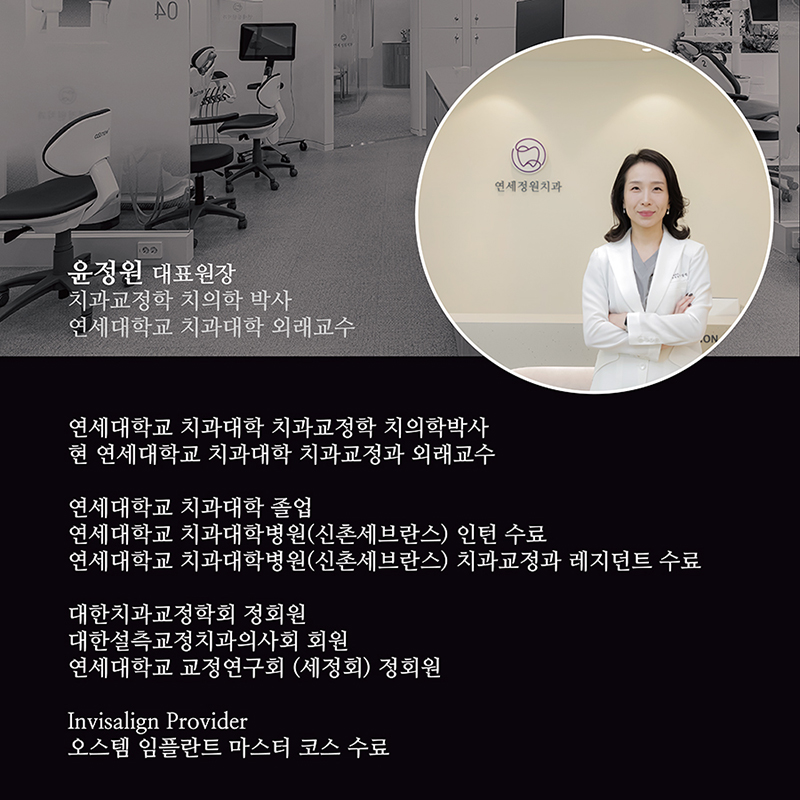
Yoon Jeong-won, Chief Director of Yonsei Jeongwon Dental Clinic
Yonsei Jeongwon Dental Clinic, an orthodontic clinic in Daechi-dong, has all the latest equipment needed for orthodontic treatment, including the 3D oral scanner iTero Lumina, growth plate testing, and pre- and post-treatment simulations using the Morpheus facial scanner, allowing for more precise and systematic orthodontic care.
Many people considering orthodontic treatment for protruding mouth, crowded teeth, malocclusion, underbite, and similar concerns have probably already gathered a lot of information through online searches. Even so, comparing the different appliances in person and hearing detailed explanations can be very helpful when making a decision.
During consultations, you can directly compare various appliances such as Invisalign, Clarity, and Clippy C, and receive detailed explanations of their pros and cons. We encourage you to call or visit for a consultation without hesitation. Yonsei Jeongwon Dental Clinic is conveniently close to Samseong Station, Hakyeoul Station, Daechi Station, and Hanti Station, making it very convenient for visitors from Samseong-dong, Daechi-dong, Gaepo-dong, Dogok-dong, Ilwon-dong, Yeoksam-dong, Jamsil, and nearby areas.