Seoulob Dental Hospital Jamsil
4th and 5th Floors, 196 Baekjegobun-ro, Songpa-gu, Seoul, Republic of Korea
Hello! This is Seoulob Dental Hospital!
When it comes to protecting dental health, many people
only pay attention to cavities, but in fact, the
gums that hold the teeth in place are even more important.
Even if the teeth are strong, if the gums are not healthy,
you may eventually lose your teeth.
Today, we will organize the basic information you need to know
about gum treatment.
What is gum disease?

An inflammatory disease that occurs
between the teeth and gums
Gum disease is an inflammatory disease that occurs when
bacteria accumulate between the teeth and gums.
In the early stage, it is called gingivitis,
and symptoms such as swollen gums or bleeding may appear.
If not properly treated, the inflammation can
progress to the jawbone and worsen into periodontitis.
Main symptoms of gum disease

- Gums bleed when brushing
- Gums become swollen and turn red
- Sensitivity to cold or hot food
- Bad breath gets worse
- Teeth begin to feel loose
These symptoms are easy to dismiss in the early stage,
but if left untreated, they can lead to tooth loss.
How is gum treatment done?

The treatment method varies depending on the stage of gum disease.
-
Scaling
Scaling is a treatment that removes tartar and plaque attached to the tooth surface
-
Root planing
A procedure that removes tartar or bacterial film
attached to the root surface of the tooth inside the gums,
and smooths the roughened root surface
-
Curettage
A treatment that scrapes away inflamed tissue or bacterial deposits
in the inner part of the gums, in the space between the tooth and gums
(the periodontal pocket)
Why gum treatment is important
Gum disease progresses quietly even without severe pain,
which is why it is called a “silent disease.”
If the treatment timing is missed, the bone
that supports the teeth decreases, and it can eventually
lead to a situation where the teeth must be extracted.
Therefore, early detection and regular
gum treatment are more important than anything else.
How to prevent gum disease
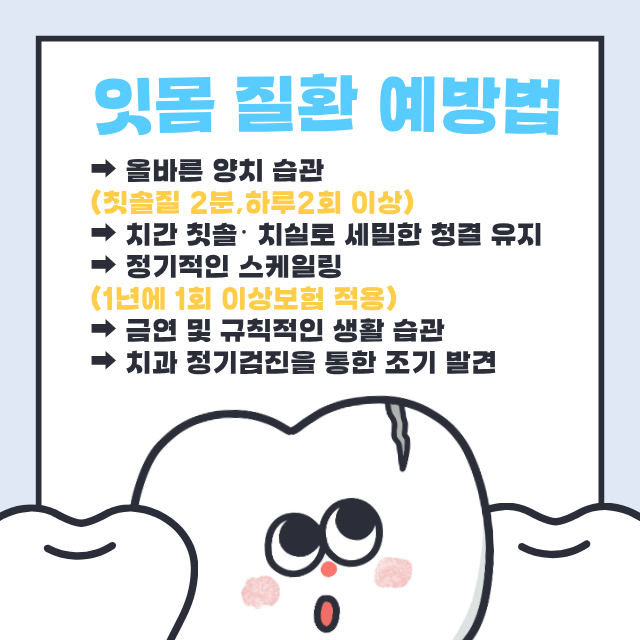
✅ How to prevent gum disease
Proper brushing habits (brush for 2 minutes, at least twice a day)
Maintain thorough cleanliness with interdental brushes and dental floss
Regular scaling (covered by insurance once a year or more)
Quit smoking and maintain regular 생활 habits
Early detection through regular dental checkups
Gum treatment and daily care
Just because you have received gum treatment
does not mean your health will immediately recover.
Proper care must continue after treatment as well.
-
For a few days after treatment, it is better to avoid hard or
chewy foods.
-
Stimulating foods (spicy food, alcohol, cigarettes) can
hinder recovery.
-
Visiting the dentist regularly to
check the condition of your gums is
the most reliable way to prevent problems.
Teeth can be used for a long time
only when their roots are strong.
Protecting gum health, which is not easily visible,
is ultimately the way to protect your teeth.
Even if you have no symptoms, you need the habit of preventing problems
through regular checkups and scaling.
Please remember that small care leads to lifelong dental health.