Seoul Aube Dental Hospital Jamsil
4th and 5th Floors, 196 Baekjegobun-ro, Songpa-gu, Seoul

Hello.
This is Seoul Aube Dental Hospital,
Today, I’d like to talk about how to care for implants after treatment.
Implants are a representative treatment method
that replaces damaged or missing teeth.
But placing an implant
is not the end.
Just like natural teeth, they need consistent care
in order to stay strong and last a long time.
Implants do not get cavities,
but the surrounding gums and bone are still
affected by bacteria, so poor care can
cause them to loosen or shorten their lifespan.
Initial implant care (right after surgery)

Bleeding management
After surgery, bite on gauze and apply pressure
until the bleeding stops.
A small amount of blood may mix with saliva,
but this is mostly a normal reaction.
Food intake precautions
On the day of surgery, avoid hot or hard foods,
and soft, non-irritating foods such as rice porridge or soft porridge are recommended.
Brushing
Do not brush the surgical area too hard directly;
brush the teeth on the opposite side as usual.
Use mouthwash if needed.
No smoking or drinking
Avoid smoking and alcohol for at least 2 weeks.
This has a major effect on wound healing and the success rate of bone grafting.
Implant stabilization period care (after the prosthesis is placed)
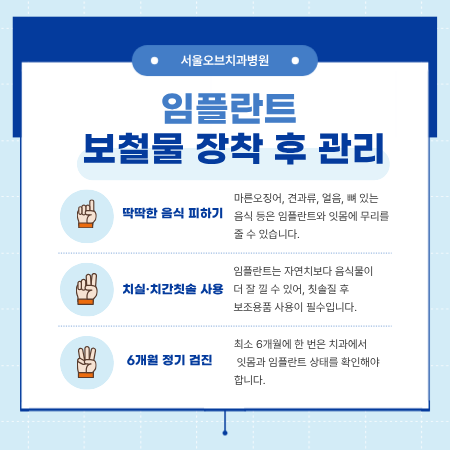
After the prosthesis is placed,
it can be used the same way as a regular tooth,
but lifestyle management is important.
- Avoid hard foods
Dried squid, nuts, ice, and bone-in foods can
place strain on the implant and gums.
- Use dental floss and interdental brushes
Food can get stuck around implants more easily than around natural teeth,
so using auxiliary cleaning tools after brushing is essential.
- Regular checkups
Once every 6 months, you should visit the dental clinic
to check the condition of the gums and the implant.
Common questions about implant care

Q. Can implants get cavities too?
The implant itself does not get cavities,
but the surrounding teeth and gums can still develop cavities or gum disease.
Q. Do implants also need scaling?
Yes. TartAR can also build up around implants,
so regular scaling is essential.
Q. How long do implants last?
With good care, they can last more than 10 years,
and in some cases more than 20 years.
Their lifespan varies greatly depending on care habits.
Summary of key implant care points
Right after surgery → manage bleeding, food, and smoking carefully
After the prosthesis is placed → meticulous hygiene with floss and interdental brushes
Lifestyle habits → avoid hard foods and excessive force
Regular checkups → at least once every 6 months
Preventing implant complications

If care is insufficient,
peri-implantitis can develop.
This is a condition in which the gums swell and bleed,
and in severe cases, the bone is damaged,
which can cause the implant to loosen.
For prevention, above all else,
home care + regular checkups are needed at the same time.
Implants are important to treat,
but what matters even more is how they are cared for afterward.
When supported by proper lifestyle habits and regular dental visits,
implants can be used for a long time,
just like natural teeth.
Start regular checkups and care now.