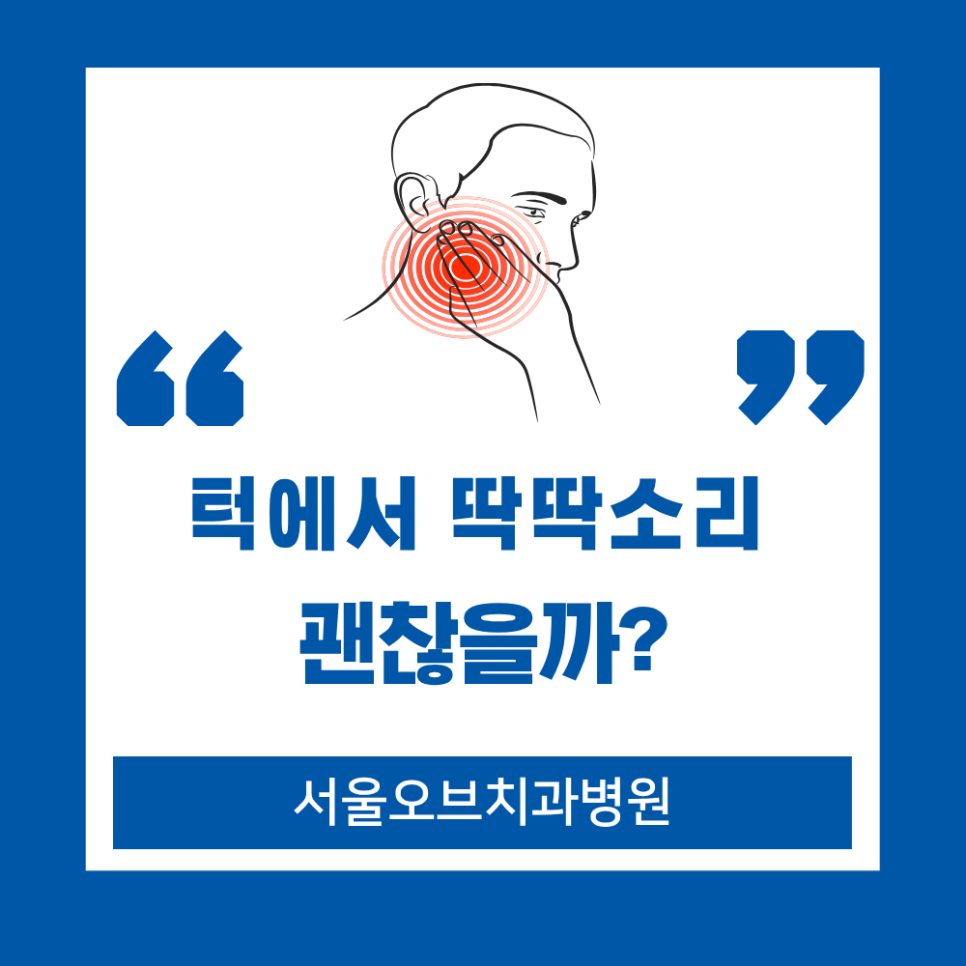
Hello! This is Seoulove Dental Hospital.
When winter arrives, many people especially notice clicking sounds from the temporomandibular joint.
In the morning when yawning,
when opening your mouth during meals,
even when speaking,
it is common to feel anxious when a clicking sound comes from the jaw.

You may worry, “Why is my jaw suddenly doing this?”
but in fact, there are several reasons why temporomandibular joint clicking happens more easily in winter.
In this post, we will clearly summarize the causes of winter temporomandibular joint clicking,
self-care methods, and the treatment direction needed at the dental clinic.
Not every jaw clicking sound is a major problem,
but if it is left untreated, it can lead to pain, headaches, and difficulty chewing,
so it is better to manage it early.
Why temporomandibular joint clicking gets worse in winter
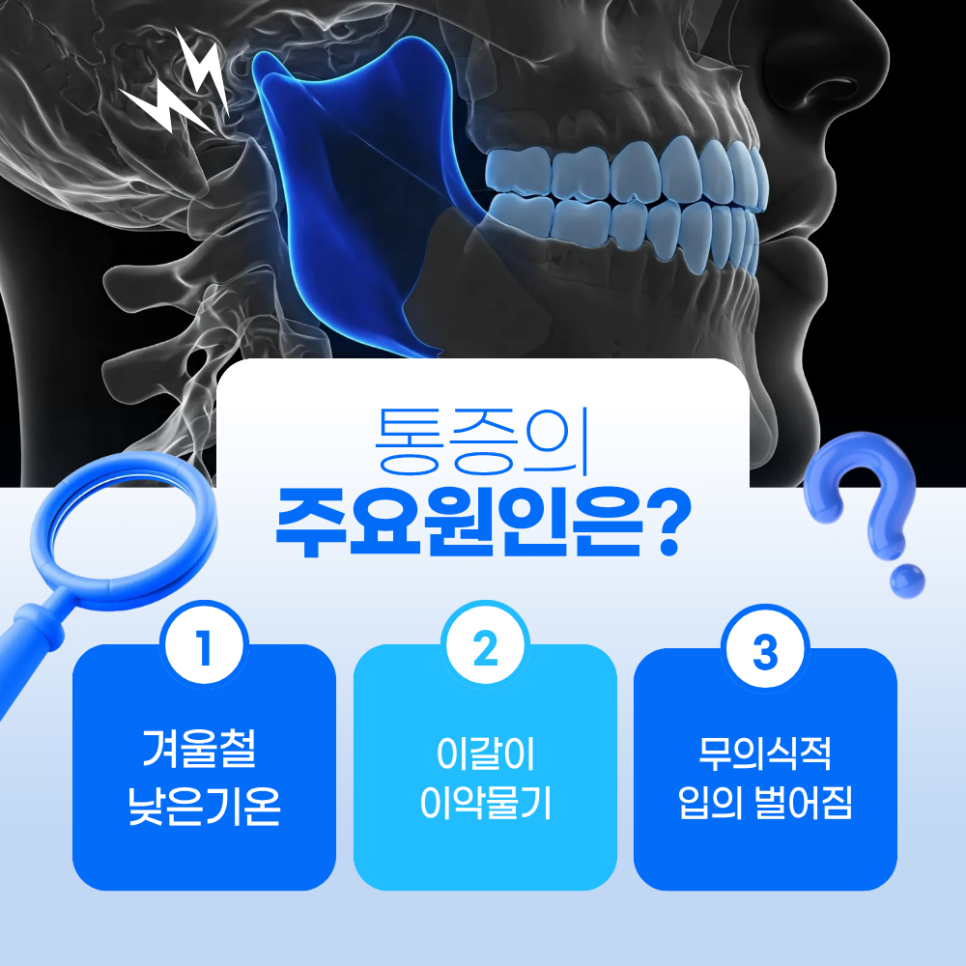
- Reasons why temporomandibular joint clicking gets worse
✅ 1) Cold weather stiffens the muscles and limits movement
In winter, as body temperature drops,
the muscles and ligaments around the jaw become tense.
At this time, the jaw cannot move smoothly,
so clicking sounds or a catching sensation occur more easily.
✅ 2) Involuntary teeth grinding and clenching increase
When it is cold, just as people hunch their shoulders, tension also builds in the jaw.
Because of this, teeth grinding at night may become worse,
and the habit of clenching the teeth tightly during the day increases,
placing strain on the temporomandibular joint.
✅ 3) Reduced blood circulation
In cold environments, blood circulation decreases,
which increases the tension around the temporomandibular joint
and becomes a cause of clicking sounds.
✅ 4) Dry air leads to frequent mouth opening
In winter, the mouth dries out easily,
and the amount of time spent unconsciously keeping the mouth open increases.
When the jaw moves in this unstable state,
a clicking sound can occur.
How to manage winter temporomandibular joint clicking

- How to manage the temporomandibular joint
① Warm compresses are essential
If you place a warm towel or heat pack
next to the jaw,
the muscles relax and
temporomandibular joint clicking is gently eased.
10 minutes a day × 2 to 3 times is the most effective.
② Release stiff muscles with jaw stretching
Opening the mouth wide is not recommended,
and only do gentle stretches like the ones below.
-
Gently open and close the mouth only enough to fit 1 to 2 fingers
-
Slowly move the jaw left and right
-
Place the tip of the tongue behind the front teeth and open the mouth
These kinds of “gentle movements” are very helpful for managing temporomandibular joint clicking.
③ Avoid hard and chewy foods
In particular, winter snacks such as dried squid, taffy, and peanuts
place stress on the jaw.
When the temporomandibular joint is sensitive,
it is better to avoid them temporarily.
④ Check your sleep posture and overall posture
-
Sleeping on your side or face-down puts pressure on the jaw
-
Exercising while clenching your jaw tightly at the gym can make it worse
-
The habit of resting your chin on your hand while working is also not good
Posture is one of the most basic factors
in reducing temporomandibular joint clicking.
⑤ Avoid opening the jaw excessively
When yawning, washing your face, or brushing your teeth,
please remember not to open your mouth “as wide as possible.”
If the temporomandibular joint clicking continues?
It should be checked at a dental clinic.
- If joint sounds continue for more than 2 weeks, visit a dental hospital
Clicking sounds from the temporomandibular joint are common,
but professional evaluation is absolutely necessary in the following cases.
-
When the sound continues for more than 2 weeks
-
When there is pain along with the clicking sound
-
When the mouth does not open well or there is a feeling of catching
-
When the jaw feels stiff in the morning
and there is also a headache
In these cases, it may be more than simple tension
and could be an abnormal position of the temporomandibular joint disc.

At Seoulove Dental Hospital,
-
Evaluate the position of the temporomandibular joint disc with panoramic equipment
-
Examine joint sounds using a stethoscope
-
Diagnose comprehensively, including jaw muscles, occlusion, and posture
Through this, we identify the exact cause of temporomandibular joint clicking
and provide treatment tailored to the patient.

- What is different about
Seoulove Dental Hospital’s temporomandibular joint treatment?
The hospital director of Seoulove Dental Hospital
is a specialist in oral and maxillofacial surgery from Seoul National University,
and for temporomandibular joint treatment,
non-surgical and conservative treatment is the first principle.
✔ Non-surgical treatment centered on medication + physical therapy
To reduce temporomandibular joint clicking,
muscle relaxation treatment,
heat-based physical therapy,
light Botox (if necessary),
and other methods are used to support stable recovery.
✔ Comprehensive analysis of occlusion, posture, and muscles
The temporomandibular joint is not simply a joint problem.
Because chewing force, how the teeth fit together, and daily posture
all have an effect,
the cause is analyzed accurately to prevent recurrence.
✔ University-hospital-level equipment and collaborative care system
-
Panoramic imaging capable of capturing the temporomandibular joint disc
-
Precise diagnosis based on oral endoscopy
-
Dedicated management by professional dental hygienists
-
In-house dental laboratory for fast prosthetic fabrication
Because the hospital is equipped with all of these,
the accuracy and system of temporomandibular joint treatment are different.
Temporomandibular joint clicking is not just a matter of “sound”
but a signal that shows the balance of the jaw and the condition of the muscles.
In winter, the muscles stiffen even more,
so management becomes even more important.
-
Warm compresses
-
Gentle stretching
-
Food adjustments
-
Posture management
Even these basic measures alone can greatly reduce temporomandibular joint clicking.
But if pain is accompanied by it or it continues for a long time,
an accurate diagnosis by a specialist is needed.

Seoulove Dental Hospital
provides treatment with 4 specialists from Seoul National University,
all staff members are dental hygienists,
an in-house dental laboratory,
advanced equipment such as an oral scanner and oral endoscope,
care for foreign patients,
and free parking support,
allowing for more precise management of temporomandibular joint problems.
If winter temporomandibular joint clicking is bothering you,
please feel free to contact us anytime.
A healthy temporomandibular joint makes the rhythm of your day more comfortable.
Seoulove Dental Hospital
4th and 5th Floors, 196 Baekjegobun-ro, Songpa-gu, Seoul, Republic of Korea
Phone inquiry: 02 - 418 -2275
Seoulove Dental Hospital
For the younger you. We will be your partner for patients’ healthy and beautiful oral health and facial care.
pf.kakao.com