
If your mouth keeps feeling dry
and you feel like you are not producing much saliva,
it may not be simple thirst,
but rather “dry mouth.”

Saliva is continuously produced in the mouth without being visible,
and it plays an important role in protecting the teeth, tongue, and oral mucosa.
So when saliva is insufficient,
cavities, bad breath, swallowing difficulties, and gum disease
are more likely to occur together.
Today, I will explain the causes, symptoms, and daily care methods for dry mouth
in a way that is easy for the general public to understand.
What Is Dry Mouth?

Dry mouth refers to a condition in which the amount of saliva itself decreases,
or saliva becomes sticky while still being produced,
leaving the mouth feeling dry.
The salivary glands are located in several areas, including under the jaw, beside the ears, and under the tongue,
and they produce 1 to 1.5 liters of saliva per day.
When this saliva decreases, the mouth’s natural
defense ability weakens, leading to various oral problems.
Why Does the Mouth Become Dry?

Dry mouth is caused by
a combination of factors rather than a single cause.
- Aging
As people get older, salivary gland function naturally declines.
It is especially common in patients in their 50s and older.
- Medication use
Blood pressure medication
Antihistamines (for allergies)
Medication related to depression or anxiety
Diuretics
Cold medicine
These are the most common causes.
These ingredients can temporarily suppress salivary gland function.

- Stress and lack of sleep
When tension continues, the sympathetic nervous system becomes more active,
reducing saliva production.
- The habit of breathing through the mouth
If you have rhinitis or snoring, you may breathe through your mouth,
which makes the mouth dry easily.

- Autoimmune diseases
Conditions such as Sjögren’s syndrome are diseases in which the salivary glands
themselves lose function,
and persistent dryness is a typical symptom.
- Alcohol, caffeine, and smoking
Alcohol and nicotine dry out the mucous membranes
and make saliva more viscous and sticky.
Typical Symptoms of Dry Mouth

If you have two or more of the items below, dry mouth is more likely.
- A dry feeling in the mouth in the morning
- Sticky saliva and a small amount of saliva
- A cracked or burning tongue
- Increased bad breath
- A feeling that the tongue sticks to the roof of the mouth when speaking
- Needing to drink water frequently
- Difficulty swallowing food
- Frequent cavities and gum inflammation
The longer symptoms continue,
secondary problems such as cavities, oral inflammation, and tongue pain
may also appear.
What Problems Can Occur If Dry Mouth Is Left Untreated?
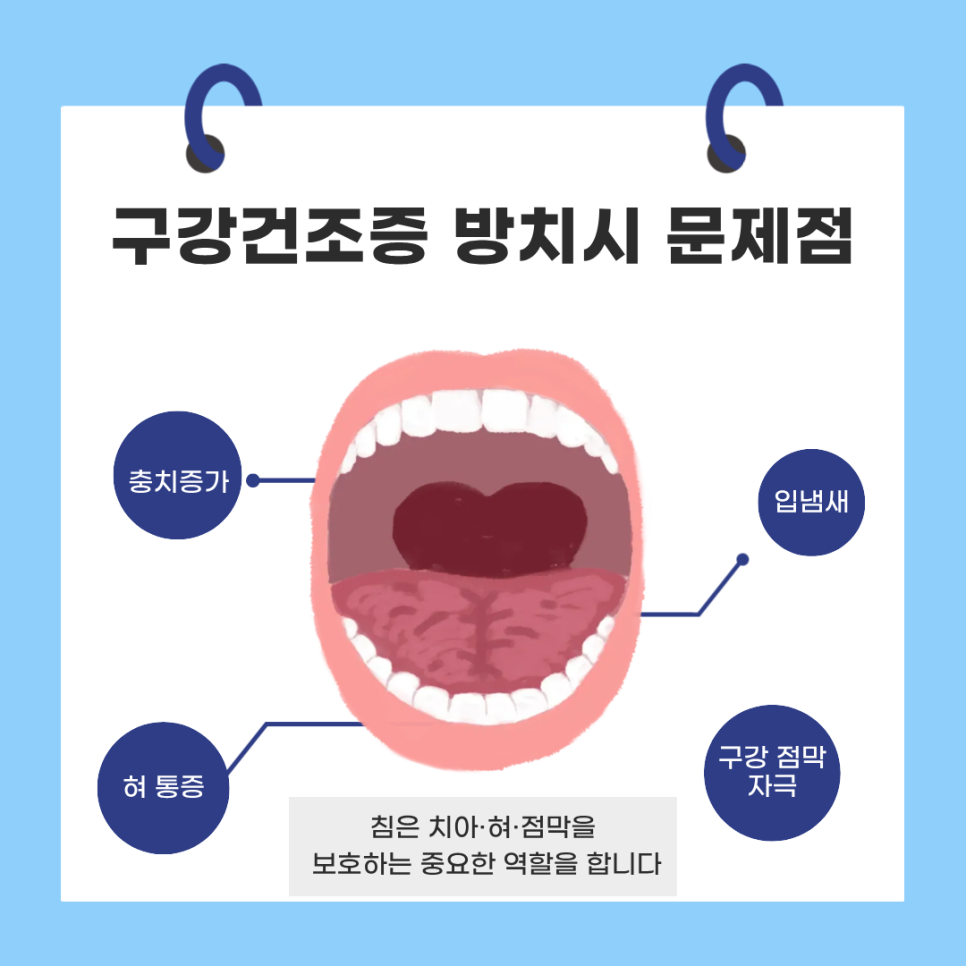
✔ Increased cavities
Saliva helps neutralize the acidic environment
that causes cavities.
If there is not enough saliva, cavities progress more quickly.
✔ Increased gum inflammation
Bacteria multiply easily, so gum swelling and bleeding occur more often.
✔ Worse bad breath
The drier the mouth, the more volatile sulfur compounds increase,
which can worsen halitosis.
✔ Tongue pain and irritation of the oral mucosa
The tongue may crack or feel sore,
and the oral mucosa can become easily irritated.
How to Manage Dry Mouth at Home
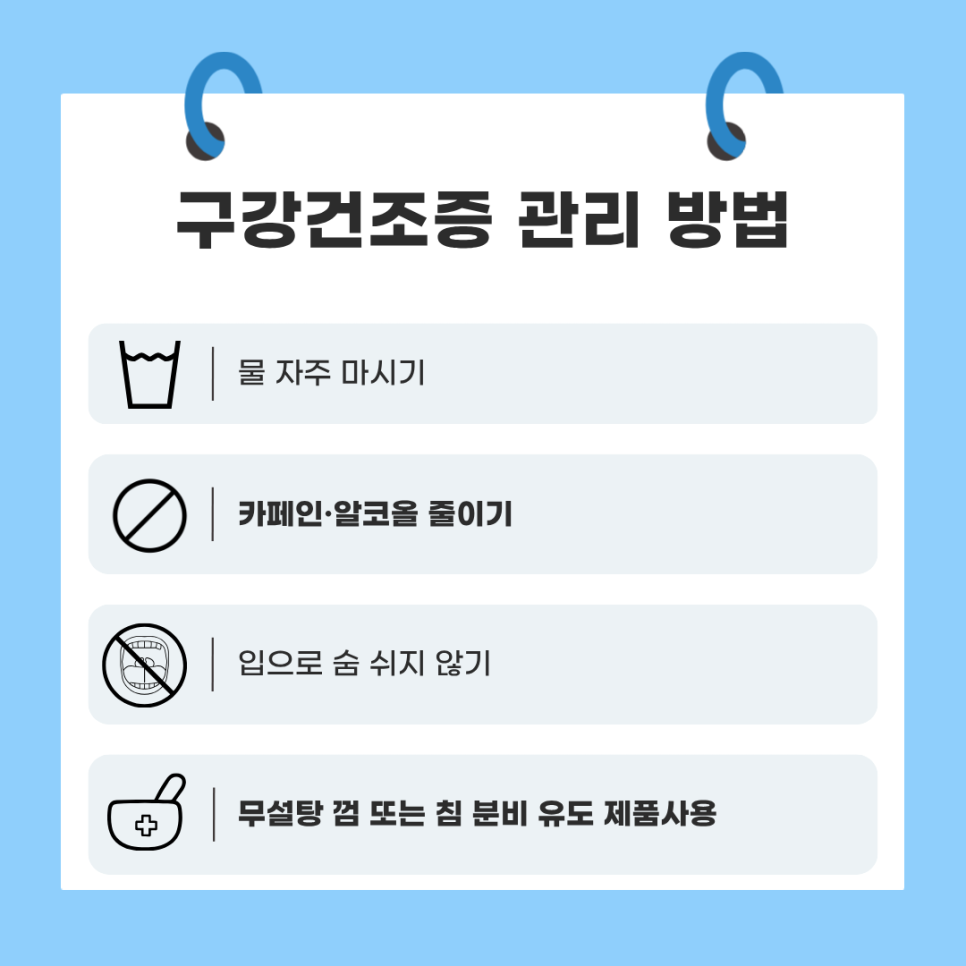
✔ Drink water often
Drinking small amounts frequently is more effective
than drinking a large amount at once.
✔ Reduce caffeine and alcohol
Coffee, energy drinks, and alcohol dry out the mucous membranes.
✔ Sugar-free gum or saliva-stimulating products
Chewing helps stimulate the salivary glands.

✔ Use a humidifier indoors
Keeping humidity at 40–60% is effective in relieving mouth dryness.
✔ Do not breathe through your mouth
If you have rhinitis or nasal congestion, those issues should also be managed.
✔ Manage bacteria with floss and interdental brushes
The less saliva you have, the faster bacteria stick,
so more thorough oral care than usual is necessary.

Dryness in the mouth is not just a simple discomfort;
it can be the beginning of various problems such as cavities, gum disease, and bad breath.
However, if you identify the cause and make small adjustments to your daily habits,
many patients do experience improvement.
Just by drinking water regularly, managing stress, and taking care of your gums,
dry mouth can be sufficiently relieved.
Seoul Ob Dental Hospital
4th and 5th Floors, 196 Baekjegobun-ro, Songpa-gu, Seoul, Republic of Korea
Phone inquiry: 02-418-2275
<Inquiry via Kakao Channel>
Seoul Ob Dental Hospital
For the younger me. We will be a partner for our patients’ healthy and beautiful oral health and face.
pf.kakao.com