
Some people feel self-conscious because just one tooth has turned noticeably dark.
In particular, when a front tooth becomes grayish or brownish,
it can make the entire impression look darker, which often causes a lot of stress.
In these cases, the treatment that is commonly considered is internal bleaching.
Internal bleaching is a treatment that brightens the inside of a tooth whose nerve has died,
and it works in a completely different way from ordinary teeth whitening,
which only whitens the outer surface.
Patients who visit because of front tooth color changes continue to come in regularly.
In particular, after past trauma or root canal treatment,
the tooth color often gradually becomes darker over time.
Today, I will explain what internal bleaching is,
why tooth color changes,
and how naturally it can actually improve.
What Is a Non-vital Tooth?

A non-vital tooth simply means a tooth whose internal nerve is no longer alive.
This usually happens in cases such as the following.
-
When a front tooth is injured by falling or being hit
-
When deep decay requires root canal treatment
-
When there has been an old crack or inflammation
-
When there has been internal bleeding after a past treatment
When the nerve is damaged like this, over time
the blood components or proteins inside the tooth oxidize and the color
can gradually darken.
At first, it may look slightly yellow,
but over time it can become gray, brown, or in severe cases
even appear dark reddish-black.
In particular, when just one front tooth has a different color,
it becomes very noticeable when taking photos or smiling.
How Is Internal Bleaching Different from Regular Whitening?
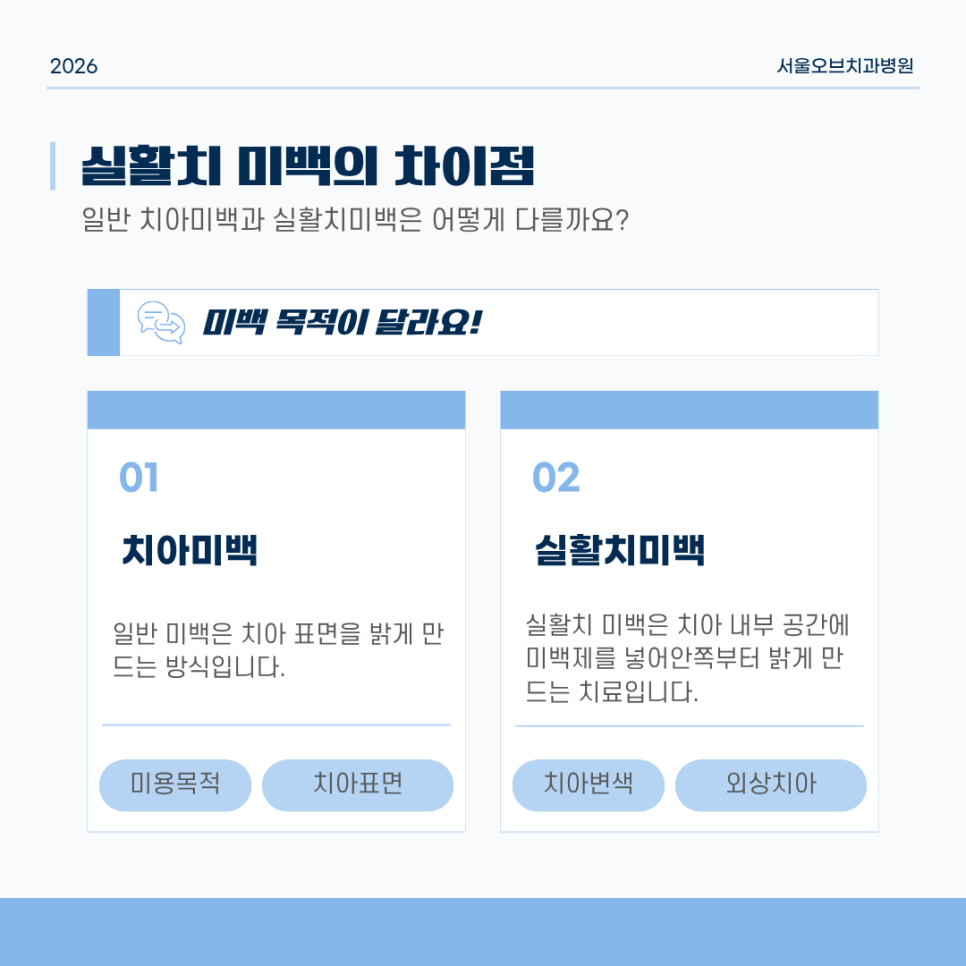
Many people ask, “Can’t I just whiten it?”
but internal bleaching and regular teeth whitening
are completely different approaches.
Regular whitening brightens the surface of the tooth.
In contrast, internal bleaching involves placing whitening agents into the inner space of the tooth
to brighten it from the inside.
In other words, you can think of it as a method that directly improves the cause of discoloration by accessing the inside of the space that has undergone root canal treatment.
That is why internal bleaching can also help with discoloration
that cannot be resolved with simple scaling or regular whitening.
In These Cases, Internal Bleaching May Be Considered
One front tooth is especially dark
Color changed after root canal treatment
You do not want to take photos because of grayish teeth
You want to preserve natural teeth
You want improvement without removing tooth structure
In particular, younger patients often feel burdened by treatments that require shaving down healthy teeth.
In such cases, internal bleaching has the advantage of improving color while preserving as much of the natural tooth as possible.
How Is the Internal Bleaching Process Carried Out?

At Seoulobe Dental Hospital, we first check the tooth root condition and the status of any previous root canal treatment using CT and X-ray images.
Internal bleaching is not simply a treatment that involves placing medication;
it is very important to check for any existing inflammation or the sealing condition inside the tooth.
If the internal root canal treatment is incomplete or inflammation remains,
retreatment of the root canal may be necessary first.
After organizing the internal space,
the internal bleaching agent is placed and the response is checked over a certain period.
In many cases, one treatment may be enough, but depending on the tooth condition,
multiple sessions may be needed.
Are There Cases Where Internal Bleaching Alone Is Not Enough?
Yes, there are.
Internal bleaching is a very good treatment,
but not all discoloration becomes 100% equally brighter.
In particular, in the following cases,
additional esthetic treatment may also be necessary.
-
When the discoloration has been present for too long
-
When there is severe damage to the internal structure of the tooth
-
When there is a crack or chip in the tooth
-
When the range of color change is very severe
In such cases,
esthetic prosthetic treatments such as laminate veneers or crowns
may also be considered together.
Rather than recommending prosthetics unconditionally,
we first explain the direction that can preserve the natural tooth as much as possible.
Post-Treatment Precautions After Internal Bleaching Are Also Important

After internal bleaching,
the tooth may temporarily feel sensitive.
Also, to stabilize the color,
it is better to be careful for a certain period with foods that cause strong staining and with smoking.
In particular, coffee, wine, and curry
can affect early color stabilization, so caution is needed.
Most importantly, because the non-vital tooth itself may be weakened,
it is important to receive regular checkups as well.
Don’t Worry About Front Tooth Color Changes Alone
Internal bleaching is
not a treatment that simply removes a discolored tooth.
Think of it as a treatment that keeps the natural tooth as much as possible while making the tooth itself bright again.
In particular, if you have been stressed for a long time because of the color of just one front tooth,
you may find the satisfaction level higher than expected.
If you have been self-conscious about smiling because of front tooth discoloration,
it may be a good idea to get an accurate check to see whether internal bleaching is possible.
#SongpaDentalClinic #JamsilDentalClinic #SamjeonStationDentalClinic #InternalBleaching #FrontToothDiscoloration #RootCanalTreatedTooth #TeethWhitening #FrontToothWhitening #SongpaDistrictDentalClinic #SeoulobeDentalHospital