Hello.
This is 서울오브치과병원.
“I don’t want my veneers to look too white.
Please make them look natural. I don’t want them to be noticeable.”
These are the words we hear most often
from people who visit us for veneer consultations these days.
The overall mood has definitely changed.
In the past, “as white as possible” was popular,
but these days, “as natural as possible” is the prevailing preference.
We live in an era when 4K and 8K video are commonplace, after all.
As image quality improves,
unnatural-looking teeth are easier to notice.
That is why even celebrities are increasingly
choosing veneers that are “not excessive.”
But there is one point I would like to address here.
Many people tend to think of “naturalness”
in overly simplistic terms.
Today, I would like to explain this in more detail.
“Less white = more natural”—is that really true?
Many people understand it this way:
“If the teeth are not too white
and the shade is lowered slightly, they will look more natural.”
Of course, this is not entirely wrong.
Reducing the shade is indeed one element of a natural appearance.
However, it is only a very small part of what makes something look natural.
Simply lowering the color does not make veneers look like natural teeth.
In fact, there are many cases where the teeth have been made “less white,”
yet they still look somewhat unnatural or artificial.
Why is that?
It is because the “details”
found in natural teeth are missing.
Natural teeth are more complex than you might think
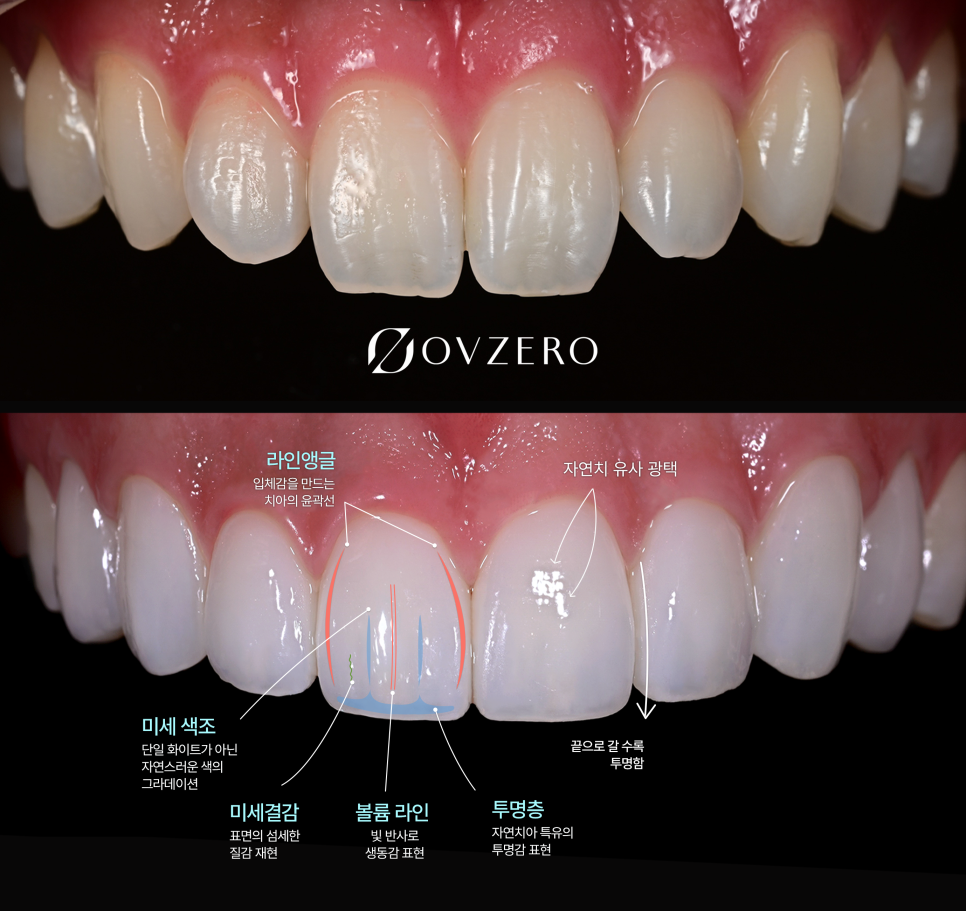
Six details that determine natural-looking veneers (OVZERO)
▲ Six details that determine natural-looking veneers
(OVZERO)
Take a moment to picture your own natural teeth.
They are not simply “white plates.”
When they receive light, different areas reflect it differently,
some areas are slightly translucent, and the surface has a fine texture.
These elements come together at once to create what we
perceive as “natural.”
Therefore, to create natural-looking veneers,
it is not enough simply to lower the shade;
these details must be brought back one by one.
The veneer brand of 서울오브치과병원,
오브제로 (OVZERO), focuses precisely on these details.
We have organized the key elements that determine
a natural appearance into six categories.
Six details of natural-looking veneers
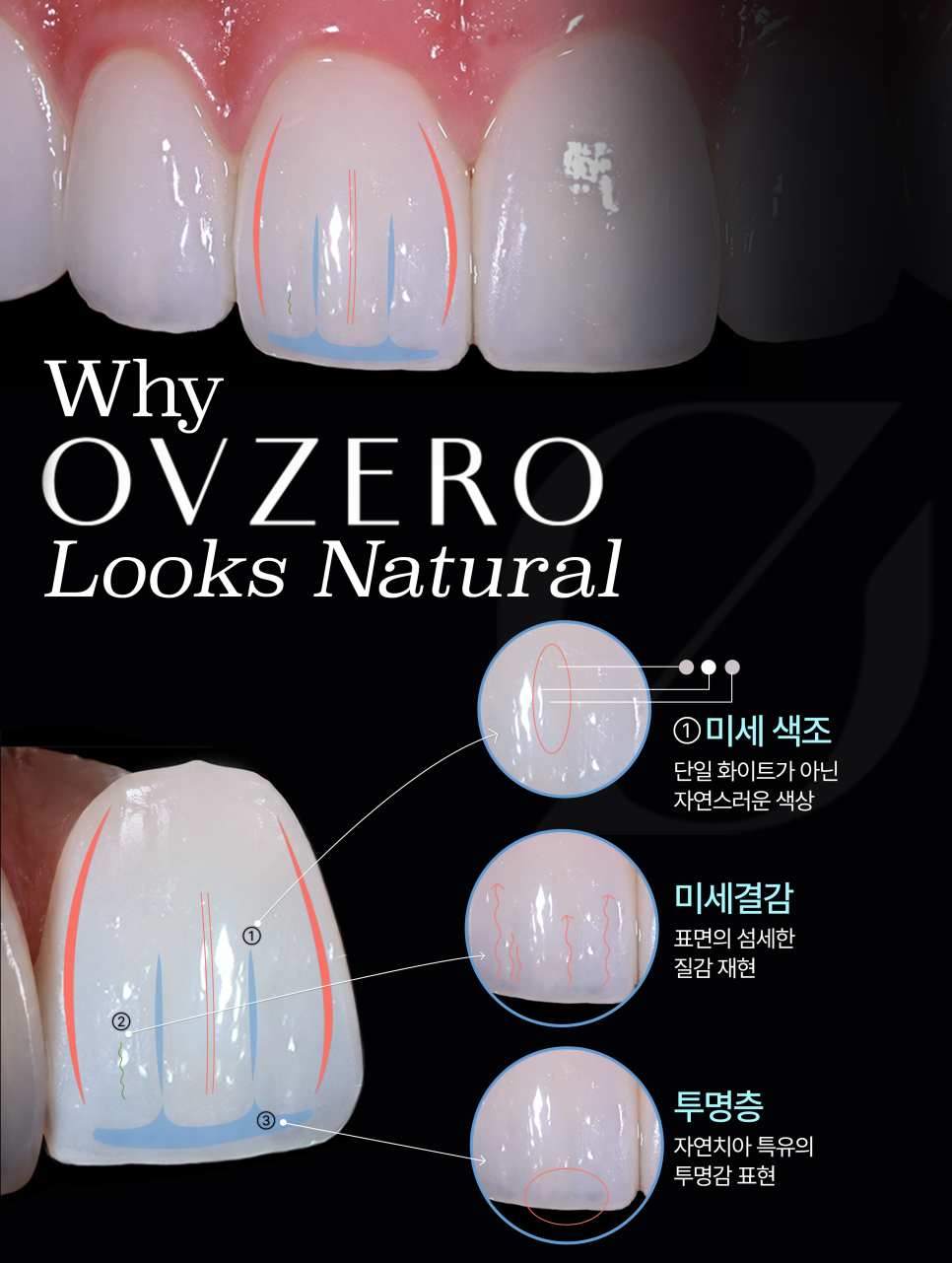
- Line angles — contours that create a three-dimensional appearance
Natural teeth are not flat plates.
They have subtle curves and contours, known as line angles.
These contours divide the light and give the teeth a three-dimensional appearance.
When line angles are ignored, the teeth look flat and like one solid mass
when viewed from the front.
No matter how good the color is, an artificial impression remains.
- Translucent layers — translucency that increases toward the edge
Natural teeth have a translucent layer through which light
slightly passes toward the edge, or incisal edge.
However, if veneers are made only with a single opaque white color,
this translucency disappears.
That makes them look flat and dense.
OVZERO aims to reproduce the semitranslucent layers
unique to natural teeth and bring out a sense of depth.
- Volume lines — vitality created by light reflection
Volume lines that flow along the tooth surface
reflect light and add vitality to the teeth.
Rather than having monotonous, sharply defined surfaces,
the teeth need an appropriate sense of volume to look like
“living teeth,” rather than static artificial objects.
- Subtle color variation — a gradient rather than a single white shade
The color of natural teeth changes subtly even across a single surface.
They may be whiter toward the top and more translucent toward the bottom. Rather than a uniform, single white shade,
this natural color gradient needs to be preserved
so the veneers blend naturally with the surrounding natural teeth.
- Fine surface texture — delicate texture on the surface
The surface of real teeth has fine lines and textures
that are difficult to see with the naked eye.
If this subtle texture is not reproduced, the surface becomes
too smooth, making it easier for the teeth to look artificial.
Delicately recreating the surface texture—
this is one of the hidden conditions for a natural appearance.
- Natural-tooth-like luster — the way light is reflected
The luster of natural teeth is not a uniform reflection
that looks as though the surface has been smoothly coated.
It is closer to a reflection in which light is subtly scattered.
OVZERO aims to reproduce this luster pattern unique to natural teeth,
creating light reflection closer to that of natural teeth under lighting,
rather than the characteristic “glossiness” of dental restorations.
How are these details brought to life?
This leads to the most important question:
“How can all these details
be incorporated into a single thin veneer?”
The key lies in whether it is made with “one layer”
or “multiple layers.”
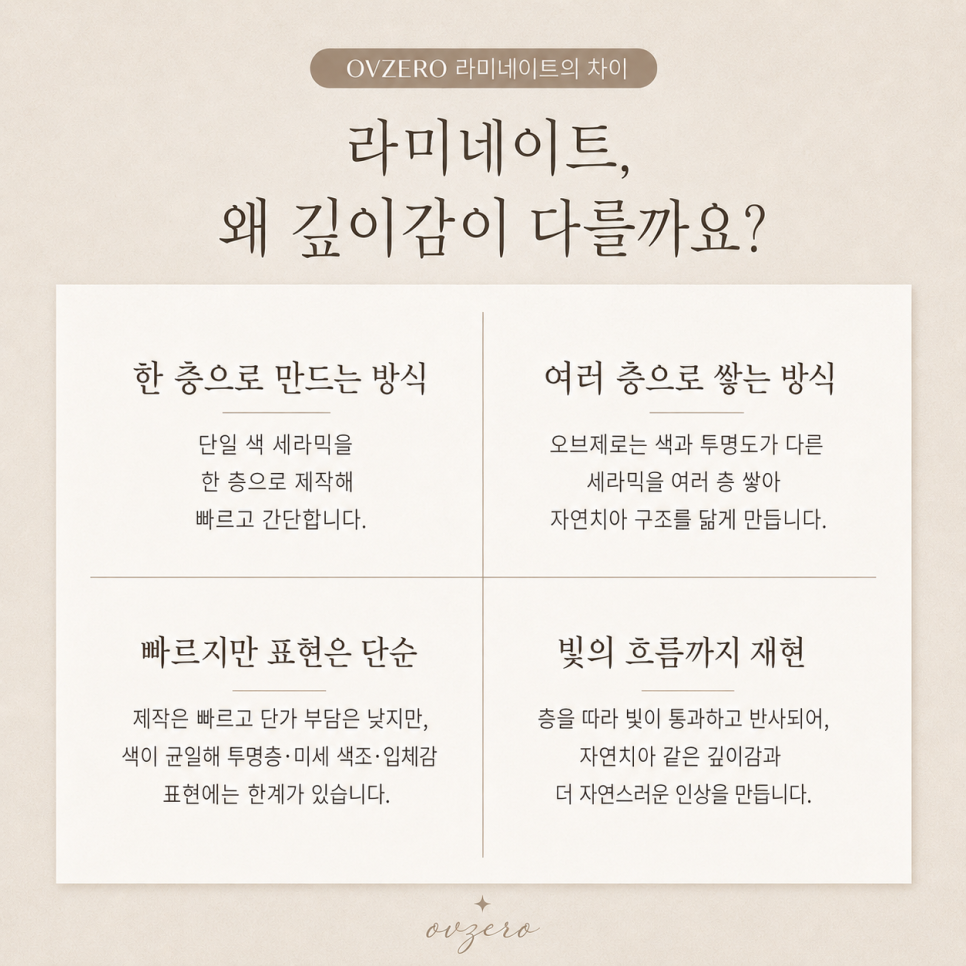
The single-layer approach
In many cases, veneers are made by quickly fabricating a single layer of single-color ceramic and attaching it to the tooth.
✅ Production is fast.
✅ The cost per unit is low.
However, because the color is uniformly flat,
details such as translucent layers, subtle color variation, and three-dimensionality
are difficult to bring out.
As a result, they can easily leave an impression of being
“bright white, but somehow artificial.”
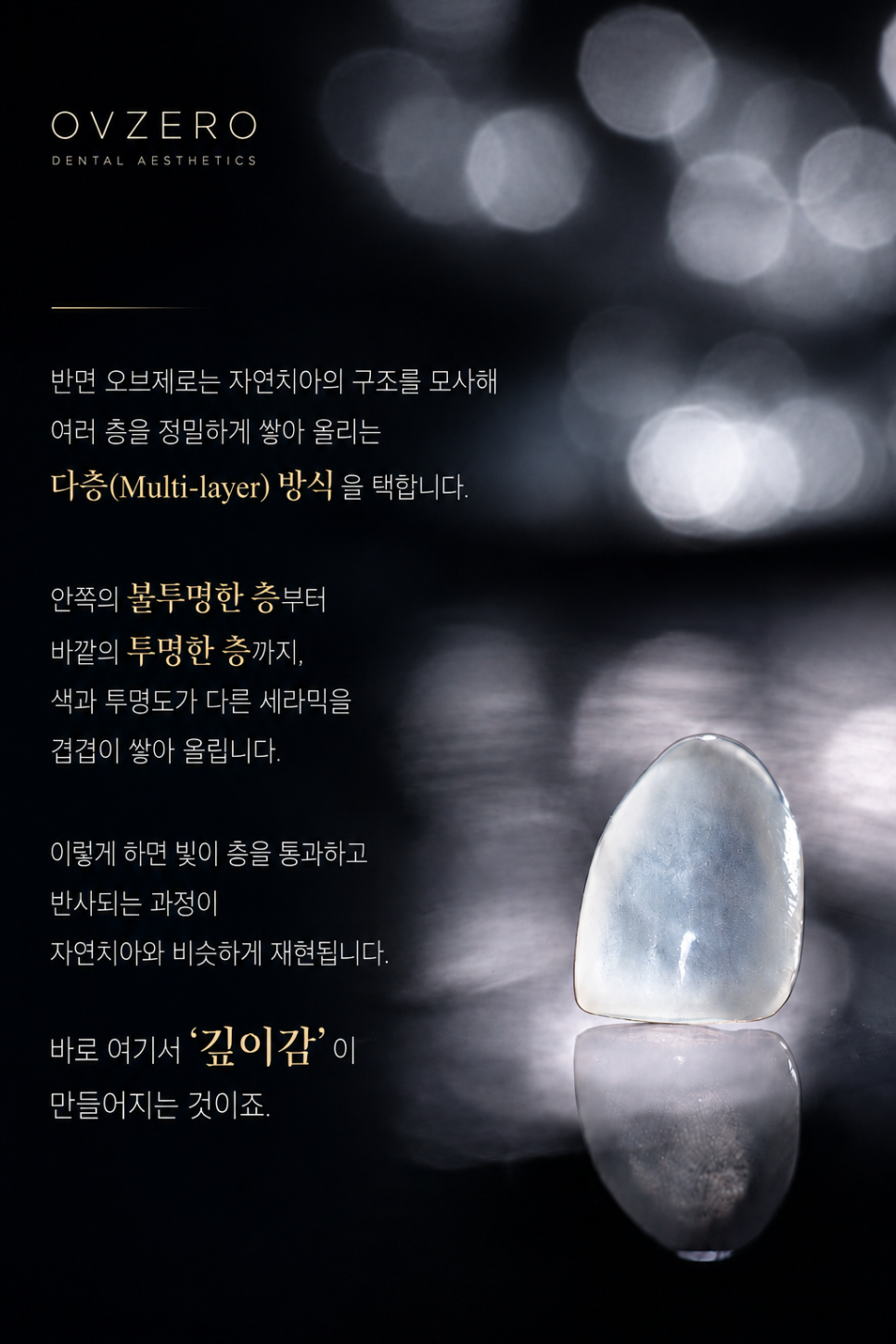
The multilayer approach (OVZERO)
By contrast, OVZERO uses a multilayer approach,
carefully building up multiple layers to replicate
the structure of natural teeth.
Ceramics with different colors and levels of translucency are built up layer by layer, from the opaque inner layer to the translucent outer layer.
This allows the process by which light passes through and
reflects off the layers to be recreated similarly to natural teeth.
This is where a sense of “depth” is created.
By comparison with semiconductors
Does this multilayer structure sound familiar?
We sometimes compare it to semiconductors.
Modern HBM semiconductors improve performance by
precisely stacking thin chips in multiple layers.
Veneers work in a similar way.
Within a thin thickness of less than 0.3 mm, color, layers, and translucency
must be stacked and carefully adjusted in multiple levels
before they can produce depth like that of natural teeth.
Veneers made by fabricating a single piece and veneers made by stacking multiple layers differ in their results beginning with the invisible “design of the layers.”
Naturalness is not so much about removing something
as it is about adding details with precision.
It is not “subtraction” by lowering the shade, but “addition” by building up the details.
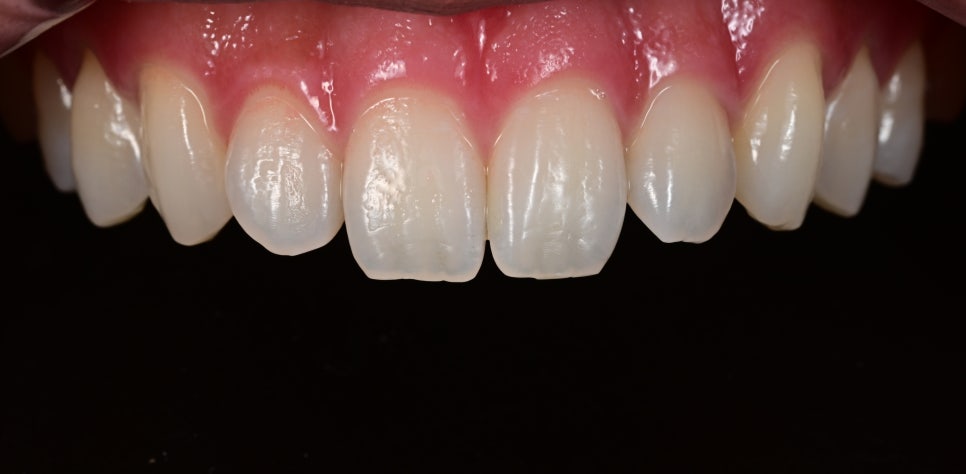
When choosing a dental hospital, check this in the before-and-after photos
<Before the OVZERO procedure>
<After the OVZERO procedure>
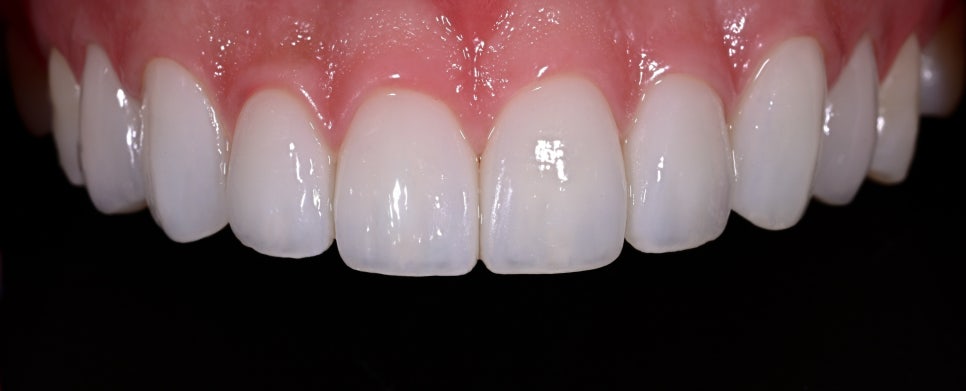
OVZERO veneers
If you have read this far,
you should now have a better idea of what to look for
when comparing dental hospitals for veneers.
When looking at before-and-after photos,
do not simply think, “The teeth became whiter.”
Check whether the details have been preserved.
Here are the key points to check:
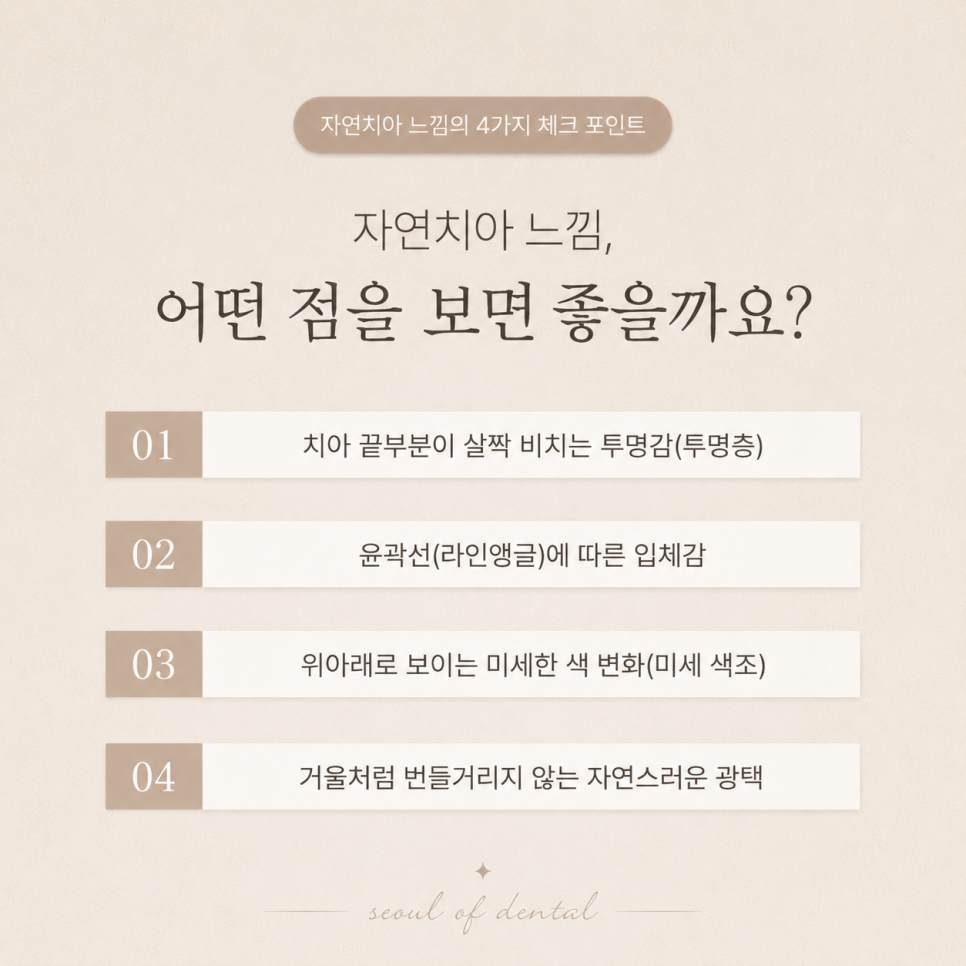
✅ Whether translucency (the translucent layer)
is visible at the edges of the teeth
✅ Whether the teeth have a three-dimensional appearance
from their contours (line angles), rather than looking flat and like one solid mass
✅ Whether subtle changes in color from top to bottom (subtle color variation) are visible
✅ Whether the surface has a luster like natural teeth,
rather than reflecting uniformly with a mirror-like gloss
If all the teeth in the before-and-after photos look identical,
bright white, and flat,
the color may have been matched, but the key details of naturalness
may have been overlooked.
A good standard is to see whether the teeth in the photos
respond differently to light and give that kind of
“lively feeling.”
“Less white” is only the starting point for a natural appearance,
not the destination.
True naturalness depends on how fully the details
of light have been brought to life.
OVZERO minimizes tooth reduction (to approximately 0.01–0.3 mm)
while preserving as much of the natural enamel as possible,
and carefully adjusts these multilayer details one by one
through in-house collaboration with a dental laboratory.
Of course, the same approach does not apply to everyone.
The available methods and designs vary depending on the condition of the teeth, so a detailed examination and sufficient consultation should come first.
If you are considering natural-looking veneers,
please feel free to contact us. 😊
서울오브치과병원
196 Baekjegobun-ro, Songpa-gu, Seoul, B1, 4th, and 5th floors
One-minute walk from Samjeon Station Exit 3
02-418-2275
💬 Kakao Channel inquiries
─────────────────
- The procedure method and whether it is applicable vary depending on the individual condition of the teeth,
and side effects may occur depending on individual differences.
Please be sure to receive a thorough consultation with a medical professional.
#Veneers #NaturalLookingVeneers #NoPrepVeneers #OVZERO #OVZEROVeneers #FrontToothVeneers #CosmeticDentalTreatment #CosmeticDentistry #JamsilVeneers #SamjeonStationDentist #SongpaDentist #서울오브치과병원 #MultilayerVeneers #BeforeAndAfterPhotos #TeethWhitening