Scientific technology is advancing so much,
so when will a hair loss treatment method
come along that gives me confidence?
Hair loss is a concern
for many people.
Still, these days,
there are more options,
including treatments for male crown hair loss.
Among them, the method
attracting attention is
autologous cell therapy.
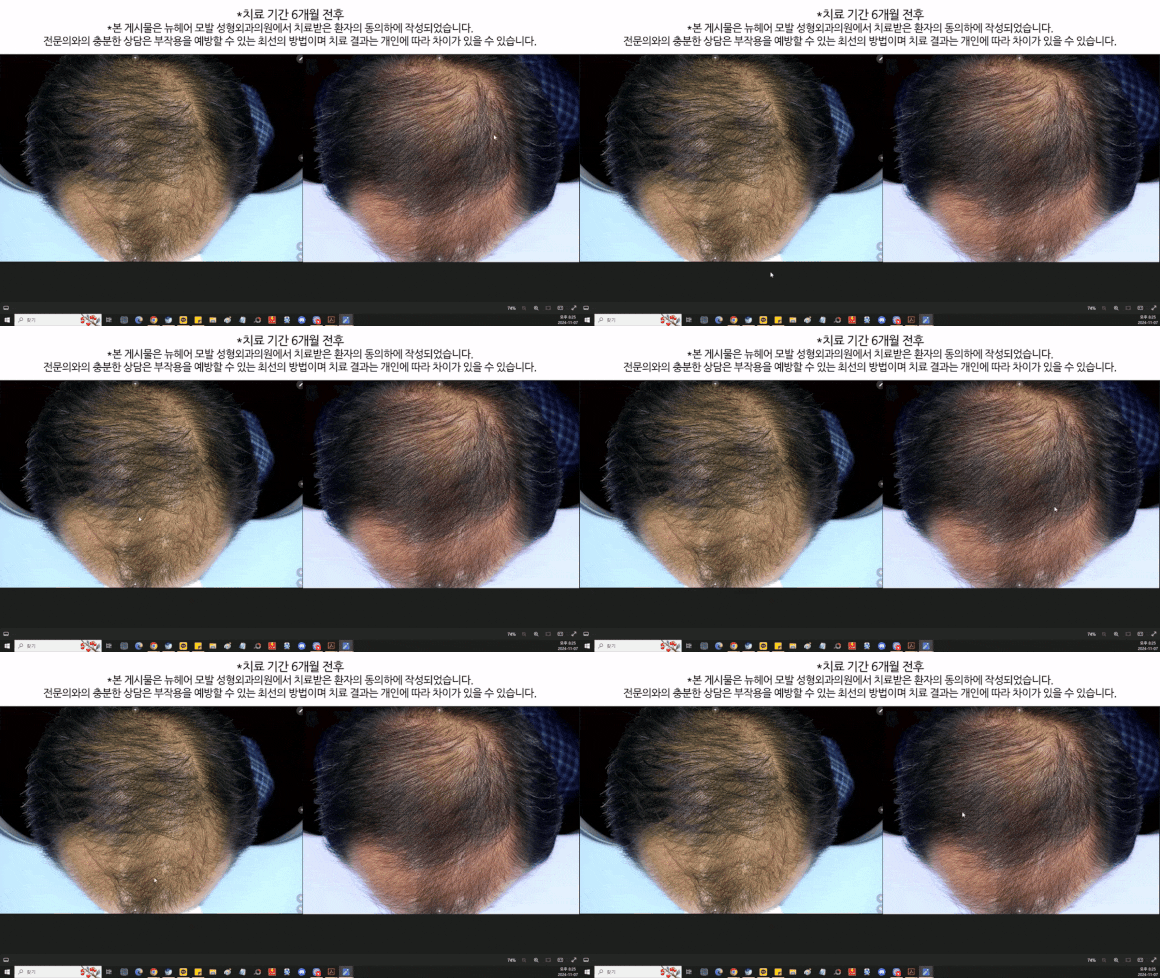
In this article, I will explain how autologous tissue
is used in treating male crown hair loss,
and what effects can be expected.
Autologous cell therapy
uses the patient’s own cells,
so the risk of side effects is low.
This safety is opening up
new possibilities for hair loss treatment.
There are also many research findings
showing that combining it with hair transplantation
can increase its effectiveness.
If you read to the end, you will clearly
understand how autologous tissue can be used
to treat male crown hair loss.
- What Is Autologous Cell Therapy?
Autologous cell therapy uses basic cells
that can turn into various cells in our body.
These cells divide on their own
and have the ability to restore damaged tissue.
Hair loss treatment methods using autologous tissue collection
make use of this regenerative ability.
They help restore damaged hair follicles
and promote hair growth,
which can help prevent hair loss.
The reason it is especially notable
is that it uses the patient’s own cells.

Because the patient’s own cells are used,
there is almost no immune rejection
or risk of side effects, which is a major advantage.
This level of safety is appealing
compared with methods that use conventional drugs
or external substances.
- Hair Loss Treatment Method?
First, autologous tissue is extracted
from the patient’s fat tissue or hair follicle tissue.
Then these cells are injected
into the male crown hair loss area.
The injected autologous tissue secretes growth factors
and helps hair growth.
Especially when combined with hair transplantation,
the effectiveness of this method can increase.
This is because the survival rate of transplanted hair follicles increases,
and recovery becomes faster.
Side effects such as swelling or inflammation
are also reduced, allowing for satisfactory results.
- Synergistic Effect with Hair Transplantation
Autologous cells maximize their synergistic effect
when used together with hair transplantation.
This is because they help restore the tissue
around the transplanted hair follicles
and increase the survival rate.
As a result, improvements in hair density
and thickness can be expected.
Autologous cells also relieve inflammation
and swelling that may occur after transplantation.
This shortens the recovery period,
allowing patients to return to daily life relatively quickly.
For these reasons, autologous cells
are increasingly being used as a treatment method
for male crown hair loss.
- Research Cases on Autologous Cells
Research on hair loss treatment methods
using autologous tissue collection
is also actively underway.
For example, in a study in Singapore,
autologous cell therapy was performed
on identical twins.
One side was prescribed only general medication,
while the other side received autologous cell injections as well.
As a result, the side that received the injections
showed better hair growth effects.
Many studies in the United States have also found
that autologous cell therapy improves hair density
and scalp coverage ability.
These cases show how much potential
autologous cell therapy has for hair loss.
Hair loss treatment methods for male crown hair loss
using autologous tissue are receiving
more and more attention.
This method can provide both safety and effectiveness,
which increases patient satisfaction.
When combined with hair transplantation,
it can significantly improve the survival rate
and recovery speed, and hair density and thickness
can also improve further.
Because its effectiveness has been proven
through various research cases,
I cautiously expect that many male crown hair loss patients
will choose this method in the future.
If you are struggling with hair loss,
consider a method that uses autologous cell therapy.
As a new hair loss treatment method,
it may help you regain your confidence.
[This post is written directly by the director to provide information in accordance with Article 56, Paragraph 1 of the Medical Service Act. Hair loss surgery and treatment may have side effects, and please make a careful decision through consultation with a specialist.]