Recently, more and more people have been receiving filler treatments.
However, unexpected hair loss can occur after filler treatment.
This happens when blood vessels become blocked or compressed, cutting off the oxygen and nutrient supply needed for hair growth.

In this paper, three cases of hair loss that occurred after filler treatment were analyzed.
Hair loss cases after filler treatment
Case 1 (38-year-old woman)
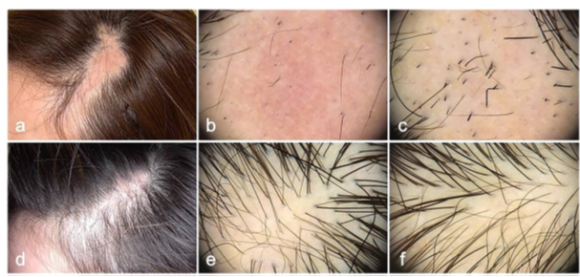
Photo source: Yutong Xie, Xi Chen & Aihua Wei (2025) Cosmetic filler-induced hair loss: case series and literature review, Journal of Dermatological Treatment, 36:1, 2443111, DOI:10.1080/09546634.2024.2443111
-
Treatment area: forehead
-
Filler used: hyaluronic acid (HA)
-
Symptoms: hair loss appeared in the temple area 50 days after the procedure
-
Treatment: 2 injections to dissolve the filler (hyaluronidase), minoxidil use
-
Result: complete hair recovery after 4 months
Case 2 (29-year-old woman)
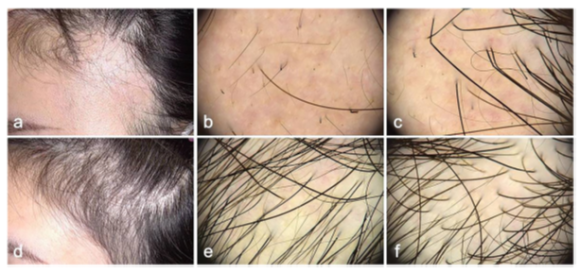
Photo source: Yutong Xie, Xi Chen & Aihua Wei (2025) Cosmetic filler-induced hair loss: case series and literature review, Journal of Dermatological Treatment, 36:1, 2443111, DOI: 10.1080/09546634.2024.2443111
-
Treatment area: forehead
-
Filler used: hyaluronic acid (HA)
-
Symptoms: triangular-shaped hair loss appeared 40 days after the procedure
-
Treatment: 1 steroid injection, minoxidil use
-
Result: complete hair recovery after 4 months
Case 3 (37-year-old woman)
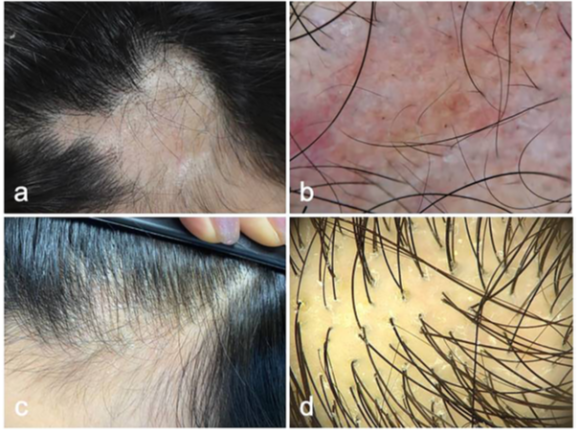
Photo source: Yutong Xie, Xi Chen & Aihua Wei (2025) Cosmetic filler-induced hair loss: case series and literature review, Journal of Dermatological Treatment, 36:1, 2443111, DOI: 10.1080/09546634.2024.2443111
-
Treatment area: facial fat grafting
-
Symptoms: hair loss started 10 days after the procedure, resembling alopecia areata
-
Treatment: steroid injections, minoxidil, microneedling 10 sessions
-
Result: complete hair recovery after 8 months
Major blood vessels that can trigger hair loss
If filler blocks or compresses a blood vessel, blood flow can be cut off and hair loss may occur.
In particular, the following blood vessels should be watched closely.
Blood vessels to be careful with
- Superficial Temporal Artery (STA)
→ blood vessel around the temple
If filler blocks this vessel, hair loss may occur in the temple and forehead areas
- Supraorbital Artery (SOA)
→ blood vessel in the center of the forehead
If blocked, there is a risk of hair loss in the central forehead and vision impairment
- Supratrochlear Artery (STA)
→ blood vessel around the glabella
If blocked, hair loss may occur around the glabella and central forehead
- Dorsal Nasal Artery (DNA)
→ blood vessel connecting the bridge of the nose and the forehead
If blocked, necrosis of the tip of the nose and glabella, as well as forehead hair loss, may occur
Safe filler treatment methods
- Choose a safe layer when receiving filler
Injecting into a layer just beneath the epidermis (a superficial layer) or near the bone (a deep layer) is safer.
Injecting into the middle layer increases the likelihood of blocking blood vessels.
- Avoid areas where blood vessels are located
When receiving filler in the temples, forehead, or glabella, blood vessel locations must be carefully considered.
- A negative pressure test is essential before filler injection
Before injecting filler, a process is needed to check whether the injection is intravascular.
This can reduce the risk of blood vessel injury compared with a regular injection needle.
- Inject filler slowly and with low pressure
Injecting too quickly or forcefully increases the risk of blocking blood vessels.
Hair loss can occur after filler treatment, but if treated early, recovery is possible.
If the blood vessels in the temple (temporal region) and forehead are blocked, the likelihood of hair loss increases.
An injection that dissolves the filler (hyaluronidase) and minoxidil are effective for treatment.
The injector’s anatomical knowledge and safety precautions are essential.
It is now time to grow hairhair, Kim Jin-oh.
Pilsaengsinmo (必生新毛).
[This post is written directly by the director for informational purposes in accordance with Article 56, Paragraph 1 of the Medical Service Act. Hair loss surgery and treatment may have side effects, and you should make a careful decision after consulting with a specialist.]