Female hair loss can occur at various ages as a symptom of hair thinning or hair loss in the center part of the scalp.
A recently published paper compared medications for female hair loss and examined the effects of oral finasteride, which is used as a male hair loss medication, and topical minoxidil.
Oral finasteride was tested in two doses: 5 mg, the dose used for treating benign prostatic hyperplasia, and 2 mg, about half that amount. Another group used topical minoxidil, which is widely used for treating female hair loss, and the results were reviewed. What stands out is that a 5% male-pattern dose was used.
This appears to reflect recent research trends showing that, in women as well, using 5% once a day may be better than applying a 2% to 3% female concentration twice a day.
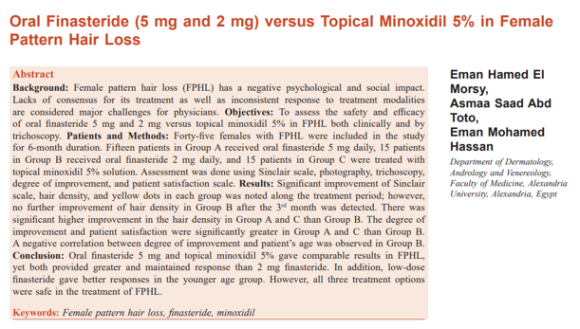
A 6-month study of 45 women with hair loss was conducted in three groups:
- Group A: Oral finasteride 5 mg.
- Group B: Oral finasteride 2 mg.
- Group C: Topical minoxidil 5% (once daily, 1 mL).
The patients' treatment outcomes were evaluated using the Sinclair Scale, hair density, yellow dots, and patient satisfaction.
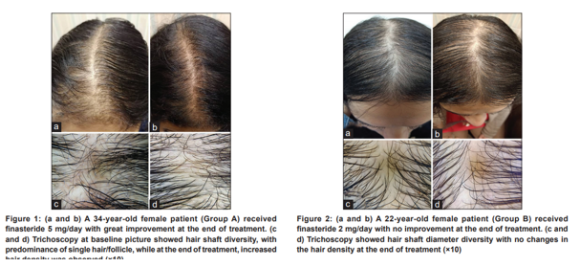
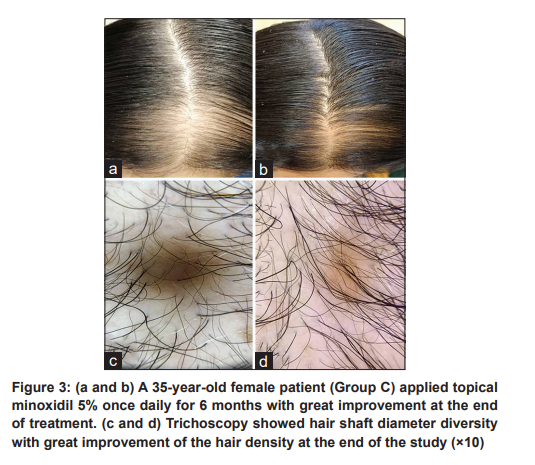
Figure: Treatment patient photos of groups A, B, and C
Example: Source: El Morsy EH, Toto AS, Hassan EM. Oral finasteride (5 mg and 2 mg) versus topical minoxidil 5% in female pattern hair loss. Clin Dermatol Rev 2025;9:45-52.
- Treatment efficacy
- Oral finasteride 5 mg (Group A) and topical minoxidil 5% (Group C) showed similarly high efficacy.
Both groups achieved better results than oral finasteride 2 mg (Group B) in hair density and patient satisfaction.
- Oral finasteride 2 mg (Group B) showed no further increase in hair density after 3 months and differed significantly from the other two groups.
- Patient satisfaction
- More than 60% of patients in Groups A and C reported satisfactory results, whereas Group B recorded relatively low satisfaction.
- Side effects
-
Oral finasteride 5 mg (Group A): headache, menstrual irregularity, increased urination (20% of patients).
-
Topical minoxidil 5% (Group C): headache, skin irritation, hypertrichosis (20% of patients).
-
Oral finasteride 2 mg (Group B): almost no side effects.
- Age and efficacy
- Finasteride 2 mg showed better effects in younger patients, but did not produce meaningful improvement in older patients.
Comparing the Effects of Oral Finasteride and Topical Minoxidil in Female Hair Loss
Conclusion
-
Oral finasteride 5 mg and topical minoxidil 5% showed very effective treatment outcomes for female hair loss.
-
Oral finasteride 2 mg was relatively less effective, but it had fewer side effects and may be a suitable option for younger patients.
-
All treatment options were safe, and side effects were mild and manageable.
This study may serve as important evidence for establishing personalized treatment plans by providing clinical support through a comparison of oral finasteride and topical minoxidil in the treatment of female hair loss.
It especially noted that an approach considering differences in treatment response between younger and older patients is necessary.
It is also notable that this study found 5 mg finasteride, the dose used for prostate treatment, to be more effective than 2.5 mg finasteride, which had previously been regarded as the dose for women.
The finding that 5% minoxidil, the dose used for male hair loss treatment, also produced better results in women reflects recent research trends.
Now it is time for hair hair, Kim Jin-oh.
필생신모(必生新毛).
Reference: El Morsy EH, Toto AS, Hassan EM. Oral finasteride (5 mg and 2 mg) versus topical minoxidil 5% in female pattern hair loss. Clin Dermatol Rev 2025;9:45-52.
[In accordance with Article 56, Paragraph 1 of the Medical Services Act, this post is written directly by the clinic director for informational purposes. Hair loss surgery and treatment may have side effects, and you should make a careful decision after consulting a specialist.]