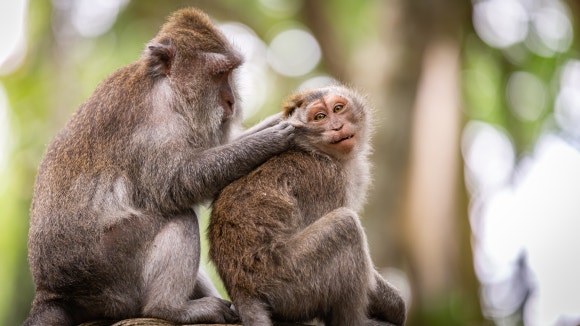

Among mammals, only humans grow long hair.
You probably have never seen a monkey or a dog whose hair grows long only on the head, right?
The hair on the human scalp, that is, hair, is not just decoration but serves an important biological function.
According to research, scalp hair evolved to protect the brain from the sun’s intense heat and to regulate body temperature.
Thanks to this function, our ancestors were able to survive even in hot desert environments.
However, long human scalp hair did not serve only a protective role.
As the ancestors of modern humans appeared about 300,000 years ago, hair was also used as an important signal of sexual maturity, health, and social status.
At that time, long hair carried symbolic meaning beyond being a simple biological structure.
The key to maintaining this long hair lies in the duration of the anagen phase.
Unlike other animals, humans have a very long growth phase, which allows us to maintain abundant hair.
For example, in dogs, short-haired breeds such as Jindos have a short growth phase, so their hair grows a little, falls out, grows a little, falls out again, and the length stays the same even if it is not trimmed.
They do not need much grooming, but they shed a lot. On the other hand, long-haired breeds have a long growth phase, so if you do not cut their hair, it keeps growing.
If you do not trim it, it becomes tangled and messy.
The average number of scalp hairs for Koreans is about 50,000 to 80,000, and losing about 50 to 70 hairs a day is normal.
However, when genetic factors, stress, and environmental factors interact, it can lead to pathological hair loss.
Fortunately, modern science continues to advance in order to overcome hair loss.
Recently, new drugs such as JAK inhibitors are opening up new possibilities for hair loss treatment.

Modern hair loss treatment technology can be seen as part of humanity’s effort to overcome genetic limitations, going beyond simply restoring appearance.
If hair once played a role in survival and signaling, today it has become a means of regaining confidence and starting a new life.
From the past, when long hair functioned as an evolutionary signal, to today, when technology is finding solutions, hair remains an important element that connects our lives and history.
Hair contains the story of human evolution, survival, and the desire to regain confidence.
If we think again about the meaning contained in a single strand of hair, we may be able to look at our existence and health in a new way.
Now it is time for hairhair, Kim Jino.
May new hair be born.
[In accordance with Article 56, Paragraph 1 of the Medical Service Act, this post is written directly by the clinic director for the purpose of providing information. Hair loss surgery and treatment may have side effects, so please make a careful decision after consulting with a specialist.]