Hair is more than just a physical feature; it is an important element that greatly affects our self-esteem and social perception.
As hair loss progresses, many men experience anxiety, depression, and low self-esteem,
and some actively seek solutions.
Recent studies have shown that hair loss can increase perfectionistic tendencies and symptoms of Body Dysmorphic Disorder (BDD).
The Relationship Between Hair Loss and Body Dysmorphic Disorder (BDD)
Body Dysmorphic Disorder (BDD) is a mental disorder in which a person becomes excessively preoccupied with their appearance and believes they have flaws that are far more severe than they actually are.
According to research, men who wanted hair transplants showed higher BDD symptoms than men who did not.
This is associated not simply with stress caused by hair loss, but with the phenomenon in which obsession with a perfect appearance and a self-critical attitude further intensify stress about hair loss.
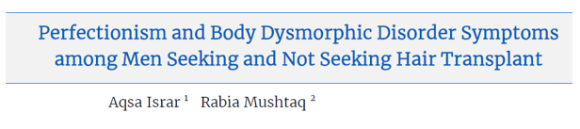
The study analyzed that perfectionism may act as a major factor that triggers BDD symptoms.
Among the 150 men with hair loss who participated in the study, 75 (50%) were
considering hair transplantation, and their average perfectionism score was 184.53 points (standard deviation 19.92), while their BDD symptoms were 14.37 points (standard deviation 10.11).
By contrast, in the group not considering hair transplantation, the perfectionism score was lower at 180.16 points (standard deviation 22.75), and BDD symptoms were 11.25 points (standard deviation 7.89).
In other words, men considering hair transplantation had higher anxiety and obsession about appearance even with a similar degree of hair loss.
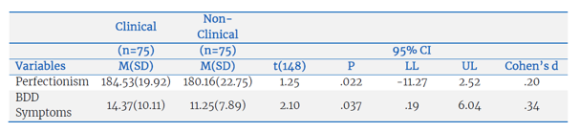
In addition, the study found a tendency for BDD symptoms to increase as perfectionism scores increased.
This suggests that the issue is not simply hair loss itself, but rather that high expectations for appearance and fear of social judgment are factors that further intensify anxiety about hair loss.
Men who want hair transplants are not simply trying to regain their hair,
but want to restore their confidence and have a better image socially.
However, the problem is that if a person has a high tendency toward BDD, dissatisfaction may continue even after a hair transplant.
Some studies report that people with BDD remain dissatisfied even after cosmetic procedures
and tend to seek repeated procedures.
In other words, even if they receive hair loss treatment, they may continue to experience anxiety and depression if they do not achieve the "perfect appearance" they expect.
So, what should people considering hair transplants do?
- Check your psychological state
It is important to objectively look at whether this is simply dissatisfaction with appearance
or whether psychological factors such as BDD are influencing it.
- Combine it with psychological counseling
If psychological counseling is combined before and after a hair transplant,
it can increase satisfaction after treatment
and reduce unnecessary anxiety.
- Set realistic expectations
Rather than aiming for a perfect appearance,
it is necessary to aim for an improved version of your current appearance.
- Recognize hair loss treatment not as a purely cosmetic approach,
but as a process of restoring self-esteem
Hair loss is closely related not only to appearance but also to mental health.
If psychological support is provided throughout the treatment process,
a healthier change can be experienced.
This study emphasizes that hair loss treatment goes beyond simple cosmetic improvement and has an important effect on psychological health and self-esteem restoration.
Rather than pursuing a perfect appearance, it is important to accept yourself as you are and maintain a positive attitude toward an improved appearance.
If you are considering hair loss treatment, remember that it is not simply about regaining hair,
but about creating a healthy change for yourself.
And caring for your psychological state during that process will lead to more satisfying results.
It is now time to let your hair hair, this was Kim Jino.
Pilsaengsinmo (必生新毛).
[This post is written directly by the director for information-sharing purposes in accordance with Article 56, Paragraph 1 of the Medical Service Act. Hair loss surgery and treatment may have side effects, and you should make a careful decision through consultation with a specialist.]