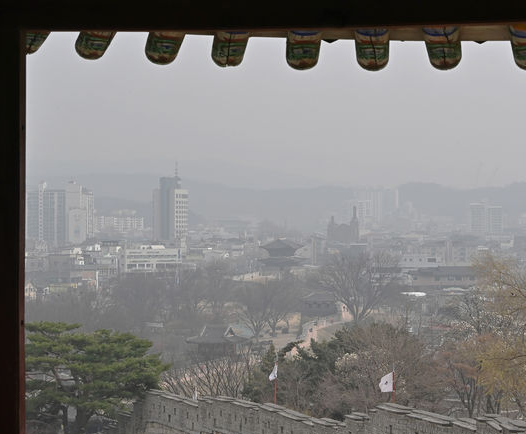
Source - Newsis
Poor fine dust concentration
When spring arrives, the sky in our country inevitably turns hazy and gray.
Yellow dust, fine dust, and all kinds of unidentified particles drift through the air.
On days like these, we naturally reach for a mask, but then a question comes to mind.
This bad air—what effect could it possibly have on our hair?
Have you ever heard that air pollution can affect hair loss?
In the past, it was considered somewhat unconvincing, but a recently published study provides strong evidence for this hypothesis.
The paper titled "Short-term effects of air pollutants on daily outpatient visits for hair loss," published in April 2025, examines the short-term relationship between airborne pollutants and the number of hair loss outpatients.

The pollutants that are central to this study are PM2.5 and PM10.
Here, "PM" is short for "Particulate Matter," which simply means very small dust particles.
The number indicates the particle diameter, and PM10 refers to particles with a diameter of 10 micrometers or less.
PM2.5 refers to ultrafine particles with a diameter of 2.5 micrometers or less.
Particles of this size can pass beyond the nose and throat and reach deep into the lungs.
Some can even circulate through the body along the bloodstream.
If they come into contact with the scalp, they may cause various problems related to hair loss, such as inflammation or clogged pores.
The study analyzed a total of 95,535 hair loss outpatient records from 21 cities in Sichuan Province, China, from 2017 to 2019.
At the same time, it also examined concentrations of PM2.5, PM10, nitrogen oxides from vehicle exhaust, and sulfur dioxide from factory smoke in the air.
(This kind of massive dataset has real power when analyzing causation. It allows us to see recurring patterns rather than random coincidence.)
The results were as follows.
-
After PM2.5 concentration increased, the average number of hair loss outpatients increased by 1.7% within up to 7 days
-
When PM10 increased, it rose by 1.2%
-
When nitrogen oxide concentrations increased, it rose by 5.4%
Sulfur dioxide did not show a significant effect, but the other three substances all showed a clear correlation with an increase in the number of hair loss outpatients.
The effect was especially pronounced among men and the 19–59 age group.
On days when fine dust is severe, it is common to cover your neck and wear a mask.
But the scalp is relatively exposed and unprotected.
Airborne pollutant particles can directly come into contact with the scalp, cause inflammation, and combine with sebum to block pores, potentially threatening the health of hair follicles.
In laboratory studies as well, scalp cells exposed to fine dust or diesel emissions were found to show increased inflammatory substances.
This is not just speculation, but a result that is close to scientifically proven fact.
Many people think, "Hair loss is genetic."
That is true, but not everyone with a genetic predisposition experiences hair loss at the same time or at the same rate.
Environmental factors can accelerate or bring forward genetic factors.
In particular, air pollution can further worsen an already weakened hair condition.
That is why, just as you check the fine dust index every morning, you should also pay attention to scalp health.
Habits such as wearing a hat, using a scalp-specific cleanser, and using an air purifier are important.
On days when warnings are issued for severe yellow dust or fine dust, I think I should definitely wear a hat too.
Now it is time to hairhair, this was Kim Jin-oh.
Filsaengsinmo (必生新毛).
[This post is written directly by a board-certified plastic surgeon for the purpose of providing information in accordance with Article 56, Paragraph 1 of the Medical Service Act. Hair transplant surgery and treatment may have side effects, and they should be carefully decided upon through consultation with a specialist.]