"Mom, can I watch a little more YouTube before bed!"
My daughter has recently been spending a lot more time watching YouTube.
In particular, short, stimulating Shorts videos meant that what she planned to watch as just one clip would somehow turn into three or four.
Dance challenges by idols, mature-sounding speech, and videos with sexy concepts keep appearing one after another.
When I notice that my elementary school daughter is gradually changing her expression and speech to sound like an adult,
I can’t help but worry.
But recently, a study result even more surprising from a parent’s perspective was announced.
It said that if children are frequently exposed to sexually stimulating content from an early age, hair loss may begin earlier.
In other words, it could affect not only education or emotional development, but also a child’s hair health.
We often think of hair loss as a genetic issue.
We say, "My father was bald, so I probably will be too."
Of course, genetics has an important influence on hair loss.
However, modern medicine and biology generally agree that genetics is only the blueprint, and what actually makes that blueprint work is the surrounding environment and daily habits.
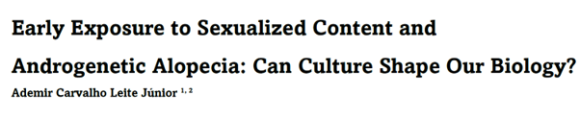
Dr. Júnior of Brazil recently presented a new perspective through his research.
He focused on how cultural factors and repeated psychological stimulation change the brain and hormonal system,
and in particular analyzed the physiological responses of children repeatedly exposed to sexual images.
The analysis found that inducing early puberty and increasing stress can ultimately bring forward the timing of hair loss.
When children are repeatedly exposed to stimulation they cannot handle, our bodies recognize it as "stress."
The hormone released at this time is cortisol.
Cortisol is originally a response that protects the body in crisis situations, but when it is excessively secreted over a long period, it becomes a factor that disrupts the hair growth cycle.
Hair can gradually become thinner and fall out more easily.
If children are frequently exposed to sexually stimulating content, their brains may misunderstand it as a sign that puberty should begin earlier than it really should.
The DHT (dihydrotestosterone) released in this process is a hormone known as a major cause of hair loss.
If a child’s body responds to DHT at an early stage, then if there is a genetic predisposition, the clock of hair loss can start running faster.
In other words, if an immature child’s brain and body react like an adult’s, the effects may first appear in the scalp and hair.
The impact that stimulating video content, such as YouTube Shorts or dance videos, has on a child’s inner world is much greater than we may think.
It does not stop at changes in language or behavior; it can also shake the body’s internal hormonal balance, which is why the parent’s role has become even more important.
In particular, the brains and bodies of children in their growth years are much more sensitive to external stimulation.
Repeated exposure can create a biological foundation that may affect them not only temporarily, but even into adulthood.
In the end, it may not be an exaggeration to say that YouTube’s algorithm is changing a child’s brain structure and even scalp physiology.
Hair loss is a complex issue that cannot be explained by genetics or body type alone.
We live in an age that calls for reflection on the content environment we consume every day and expose our children to, and on how the cultural codes contained within it affect children’s health.
When children show early maturity and act or speak like adults, we often say,
"Why are kids these days so precocious?"
But it may not be the children’s fault; it may be the digital environment we created.
Providing a healthy content environment for the digital generation is not simply a matter of regulation.
It is an investment in emotional development, physical health, and ultimately the quality of life in the future.
If your child’s hair is thinning rapidly, do not blame only genetics for the cause.
First ask, "What videos is my child watching, and how much does he or she watch in a day?"
In the digital age, especially today when video content has become part of everyday life, even hair can be an indicator affected by the social environment.
Children repeatedly exposed to stimulating videos experience psychological and physiological maturation much faster than expected.
That change may begin very small, very quietly, in the scalp.
It is time for hairhair, Kim Jino.
Pilsaengsinmo (必生新毛).
References
Leite Júnior, A.C., 2023. Sexual content exposure and its epigenetic effects on early-onset androgenetic alopecia. Trichology International, 12(3), pp.145–152.
[In accordance with Article 56, Paragraph 1 of the Medical Service Act, this post is being written directly by a board-certified plastic surgeon to provide information. Hair loss surgery and treatment may have side effects, and please make a careful decision through consultation with a specialist.]