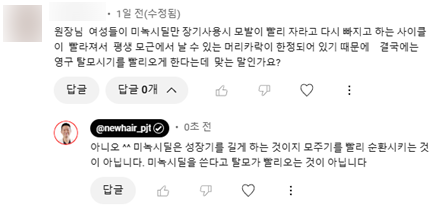
These days, it is common to come across claims on the internet or in online communities that “if you use minoxidil for a long time, hair actually falls out faster and, as a result, the lifespan of your hair becomes shorter.”
Hearing such claims can naturally make you worry about whether continuing to use the medication is really safe,
or whether your hair loss might actually get worse.
However, these claims are not scientifically proven facts, and most of them come from misunderstandings.
In this article, I will explain minoxidil’s mechanism of action, the parts that are often misunderstood, and the proper way to use it in an easy-to-understand way.
About the claim that minoxidil shortens hair lifespan
Some people claim that minoxidil makes hair grow faster, advances the growth cycle, and eventually uses up the number of times it can grow over a lifetime.
However, there is insufficient scientific evidence for this.
In fact, minoxidil is a medication that helps new hair grow by inducing hair follicles that are in the telogen phase to enter the anagen phase.
This is simply an action that stimulates the follicles and promotes hair growth; it does not “use up” the follicles.
How minoxidil works
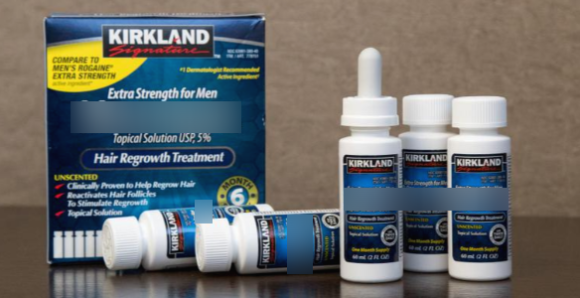
Minoxidil improves blood flow by dilating the blood vessels in the scalp and acts on potassium channels in hair follicle cells to induce the growth phase.
The growth phase induced in this way continues normally and creates an environment where hair can grow more healthily.
At the beginning of use, an initial shedding phenomenon may occur, in which existing weakened hairs fall out and new hairs begin to emerge.
This is a natural process as the medication starts to work, and it may even be a positive response.
Is the number of hair cycles fixed?
Hair has a cycle that repeats the growth, catagen, and telogen phases.
The length of this cycle and the speed of repetition vary from person to person, and it is generally known that the cycle repeats about 25 to 30 times, although more research is needed.
Hair follicles are stem-cell-based tissues, and if the environment is appropriate, they can maintain their function for a long time.
The key cause of hair loss is follicular miniaturization caused by hormones (such as DHT), not exhaustion of the number of cycles.
Is long-term use of minoxidil safe?
Research results on long-term use are positive.
In a representative study, men who used minoxidil for more than 4 years showed continued suppression of hair loss and maintenance of hair, and most side effects were mild and temporary.
In addition, several studies conclude that long-term use of minoxidil does not cause toxicity to hair follicles and can be used safely.
Shedding after stopping minoxidil
Many users experience hair loss after stopping minoxidil.
This is because, as the medication’s action stops, the follicles that had been activated transition back into the telogen phase.
In other words, the improved state simply returns to its original condition; no new damage is created.
Therefore, continued use is necessary to prevent hair loss from progressing again.
If we compare the hair cycle to farming
-
Growth phase : The period when seeds sprout and grow
-
Catagen phase : The period when crop growth stops
-
Telogen phase : The period when the field is rested
Minoxidil acts like fertilizer, helping the resting field (hair follicles) grow crops again.
It does not force growth; it induces the follicles to recover their original function.
Precautions when using minoxidil in women
- Continuous use: It must be used consistently for at least 3 to 6 months for
effects to appear.
If use is stopped midway, the effect may decrease or hair loss may
progress again.
- Timing with hair products: After applying minoxidil, waiting a certain amount of time (at least 30 minutes) before using other products can help improve
absorption.
Conclusion
Minoxidil is not a medication that shortens the lifespan of hair.
Rather, it helps follicles that have remained in the telogen phase switch back to the growth phase so that hair can grow healthily.
Initial shedding or shedding after discontinuation is temporary and can be seen as a result of the medication’s action.
If you move beyond such misunderstandings and use it consistently based on accurate information,
minoxidil can be a very effective tool in managing hair loss.
Please do not let misinformation make you anxious, and continue hair loss treatment based on a specialist’s explanation and accurate medical information.
It’s time to let hair grow, this was Kim Jino.
Let new hair be born (必生新毛).
References
• Blume-Peytavi, U., Hillmann, K., Dietz, E., Canfield, D., Garcia Bartels, N. and Ghannam, S. (2011) ‘A systematic review of topical minoxidil in the treatment of androgenetic alopecia in men and women’, Journal of the European Academy of Dermatology and Venereology, 25(5), pp. 563–567.
• Olsen, E.A., Dunlap, F.E., Funicella, T., Koperski, J.A., Swinehart, J.M., Tschen, E.H. and Trancik, R.J. (2002) ‘A 5-year clinical study of the efficacy and safety of topical minoxidil in the treatment of androgenetic alopecia in men’, Journal of the American Academy of Dermatology, 47(3), pp. 377–385.
• Ramos, P.M. and Miot, H.A. (2020) ‘Minoxidil: mechanisms and clinical indications in dermatology’, Anais Brasileiros de Dermatologia, 95(5), pp. 541–555.
[This post is written directly by a board-certified plastic surgeon for informational purposes in accordance with Article 56, Paragraph 1 of the Medical Service Act. Hair loss surgery and treatment may have side effects, and please make a careful decision after consulting with a specialist.]