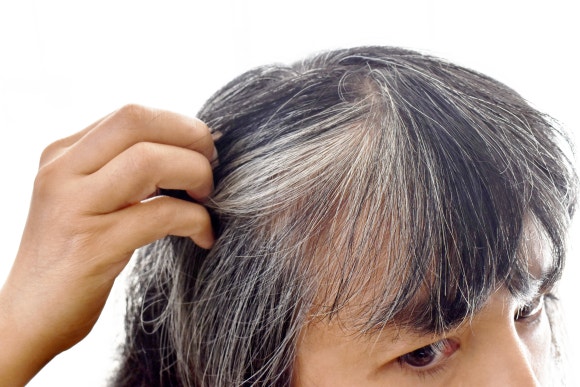
Today, I’d like to talk about “gray hair,” something many people are curious about.
When you see gray hair, many of you probably feel your heart sink, right?
You may even find yourself lingering in front of the mirror, thinking,
“Have I already gotten this old?”
But is gray hair really caused only by “aging”?
To get straight to the point, gray hair is not simply a matter of age.
Genetics, stress, nutritional status, lifestyle habits, and even the shampoo we use can all have an effect.
Why does gray hair appear?
Hair color exists thanks to a pigment called “melanin.”
This melanin is produced in cells called “melanocytes” within the hair follicle.
When these cells decrease or their function declines, melanin production stops, and hair gradually turns gray and then white.
In particular, stress is a major cause of the depletion of melanocyte stem cells (MSCs).
As a result, melanin production can stop, and in some cases, the color never returns.
The saying that stress can turn hair white is, to some extent, scientifically accurate.
Genetics and gray hair

If your parents had a lot of gray hair at a young age, you may show the same tendency.
In fact, genetics has a very strong influence on when gray hair begins and how quickly it progresses.
However, even if you have a genetic predisposition, good lifestyle habits and nutritional management can help slow the progression of gray hair.
Lifestyle habits that can bring on gray hair
The following lifestyle habits can accelerate the appearance of gray hair.
-
Smoking: Reduces blood flow to the hair follicle and interferes with nutrient supply.
-
Excessive drinking: Hinders the absorption of vitamins and minerals.
-
Frequent dieting: Deficiencies in protein, iron, zinc, and vitamin B12 can cause gray hair.
-
Exposure to ultraviolet rays: Damages follicle cells and interferes with melanin production.
-
Irregular sleep and chronic stress: Leads to hormonal imbalance and abnormalities in the autonomic nervous system.
How can gray hair be prevented?
There is still no treatment that can completely reverse gray hair, but there are definitely ways to prevent it or slow it down.
- Nutritional management
-
Vitamin B12, D, folate, iron, zinc, copper, and similar nutrients are essential for melanin production.
-
Make sure to consume enough antioxidant foods such as blueberries, green vegetables, dark chocolate, nuts, and garlic.
- Stress management
-
Reduce stress through meditation, yoga, and regular sleep habits.
-
It is also important not to push yourself too hard and to allow yourself some breathing room.
- Scalp protection
-
When going outside, block ultraviolet rays with a hat or parasol.
-
It is better to use products that are less irritating to the scalp rather than shampoos with strong chemical ingredients.
Latest treatments?
With the advancement of medical technology, various possibilities are being studied.
-
Low-level laser therapy (LLLT): May stimulate hair follicles and help melanin production.
-
Autologous cell therapy: Research is underway with the goal of restoring melanocyte function.
-
Antioxidant cosmetic products: Products containing ingredients that induce melanin production are being introduced.
-
Hormone therapy: It may be effective for gray hair associated with hypothyroidism and similar conditions.
Most of these methods are still at a stage closer to “improvement” than a “cure,” but
there is significant potential for future development.
Is hair dye okay?
Many people dye their hair to hide gray hair.
However, using dye too often or using strong hair-coloring agents can instead negatively affect scalp and follicle health.
These days, there are many hair dyes based on natural ingredients and mildly acidic hair-coloring products available,
so it is best to get advice and choose a product that suits you.
Gray hair: Why does it happen? Simple aging vs. a sign of changes in the body
Conclusion
Gray hair may not simply be a “trace of aging,” but rather a signal from our body and mind.
It makes us reflect on whether we have been under too much stress, whether we have been lacking nutrition, or whether we have been getting enough sleep.
If you find gray hair in the future, try not just to hide it, but to use it as an opportunity to look back at your body.
That small white strand may even point your life in a healthier direction.

It is now time to hairhair, this has been Kim Jino.
Filsaengsinmo (必生新毛).
References
Herdiana, Y. (2025). Gray Hair: From Preventive to Treatment. Clinical, Cosmetic and Investigational Dermatology, 18, pp.1475–1494. https://doi.org/10.2147/CCID.S526263
[This post is written directly by a board-certified plastic surgeon for informational purposes in accordance with Article 56, Paragraph 1 of the Medical Service Act. Hair transplant surgery and treatment may have side effects, and please make a careful decision after consulting with a specialist.]