Recently, consultations related to hairlines among female patients have been increasing.
The hairline is the area where the forehead and hair meet, and it is the part where the width and curve of the forehead, as well as the thickness and
direction of the hair, are observed.
The shape of this area varies from person to person, and it is being studied as one of the factors used to evaluate facial proportions and harmony.
- Things to Check Before Hairline Hair Transplantation
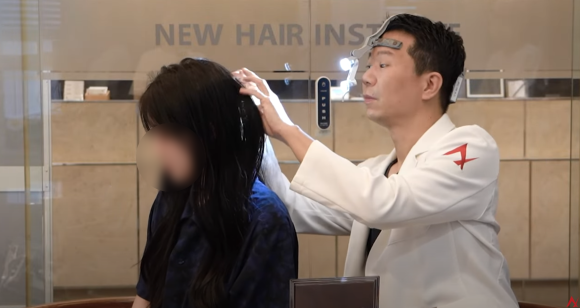
Before a hair transplant, it is necessary to carefully check the condition of the individual’s scalp and hair.
This is not simply a matter of looking at the amount of hair, but a procedure that comprehensively evaluates the overall hair structure and scalp environment.
Hair thickness and density: The amount and thickness of hair that can be harvested are checked to plan the scope of the design.
Hair direction: The direction and flow of hair growth are analyzed so that it can blend naturally even after transplantation.
Presence and degree of hair loss: In rare cases, if there is early-stage hair loss,
a management plan should be established along with the transplant design.
For women, the width of the forehead and the shape of the hairline vary from person to person.
Before a hair transplant, examinations are performed to check the current hair condition and whether hair loss is progressing, and through this, a surgical plan can be established.
- Key Points in Design Planning
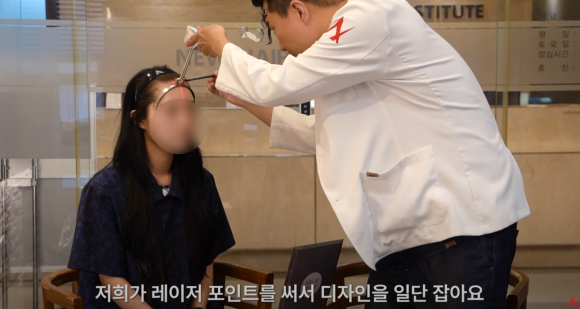
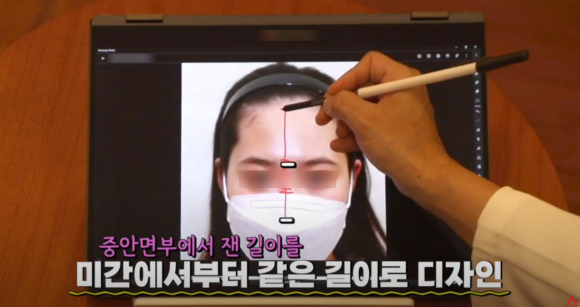
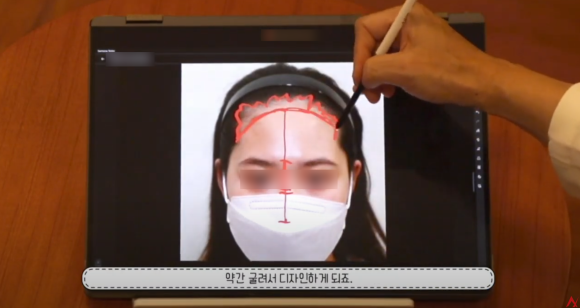
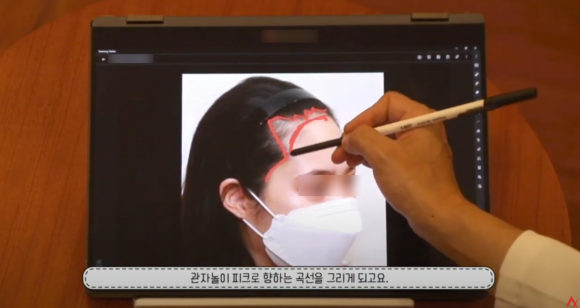
Proportion adjustment: Balance is achieved by considering the harmony of the forehead line, face shape, cheekbones, jawline, and facial features together.
Hair growth design: To remain natural, 1:1 customized transplantation should be performed in line with the direction and texture of hair growth.
Hair placement: If fine hair like baby hairs is placed in the front and thicker, stronger hair is placed toward the back to create layers, a softer and
more natural impression can be created.
Curve treatment: By creating a curve that extends toward the temples and
tidying irregular lines, the face can appear softer.
Hairline correction is not simply about filling in areas without hair, but
a design process that considers facial proportions and harmony.
In this process, precise design is needed to reflect curves and proportions tailored to the individual’s facial shape.
- How Hairline Design Is Performed
In the design stage, customized planning is carried out by considering each individual’s facial features and overall proportions, and the follicle harvesting and transplantation process is carried out in detail based on the medical team’s experience and skill.
After surgery, a systematic program is operated so that shampoo care, scalp care, and regular follow-up observation needed during the recovery stage can be carried out together.
Through this step-by-step management, the transplanted area can settle stably
and the scalp environment can be maintained in a healthy condition.
Hairline correction is not simply a matter of adding hair,
but a process that combines customized design and management reflecting an individual’s face shape and hair characteristics.
When preoperative condition assessment, design planning, and postoperative care are carried out together, a more
stable recovery can be expected.