Scarring after a wound is something many people worry about.
It is not just an appearance issue; it can also lead to inconveniences in daily life, such as itching, reduced sensation, and contracture.
Recent studies show that hair cells, especially hair follicles, may be an important key to wound recovery and scar improvement¹.
In this post, we will answer the questions patients often ask in a Q&A format and look at the scientific basis for hair and scar treatment, as well as its clinical potential.
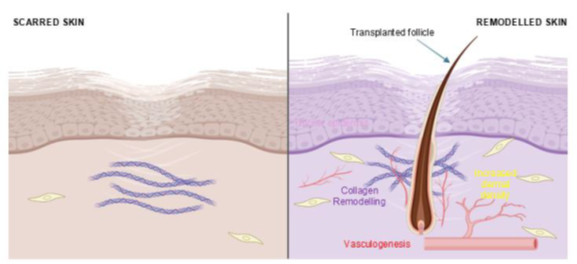
Scar remodeling by hair follicles
(Figure source: Chew, E. et al. (2025) ‘Hair follicle inspired therapies for wound healing and scar remodelling’, Journal of Plastic, Reconstructive & Aesthetic Surgery, 78, pp. 1–15)
Q1. Why do wounds on the scalp heal better than those in other areas?
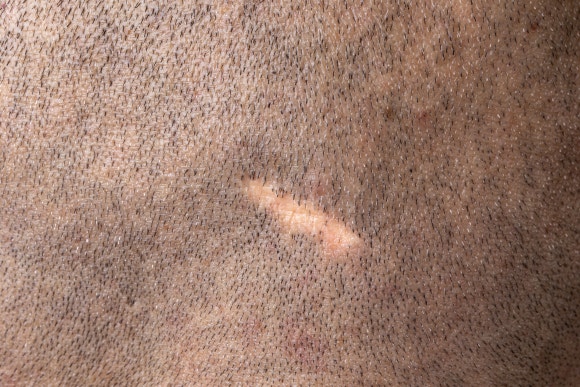
The scalp is densely packed with hair follicles, and these follicles are rich in epithelial cells and stromal cells.
When a wound occurs, these cells quickly help re-epithelialization and actively work during the inflammatory stage to promote granulation tissue formation.
In addition, the area around hair follicles has a denser network of blood vessels and nerves, which helps recovery happen faster.
In fact, there are reports that when scalp skin is grafted onto burn patients, the healing speed is only about half that of other areas¹.
Q2. Is hair follicle transplantation effective for scar treatment as well?
Yes. In a clinical study, when scalp hair follicles were transplanted into patients with chronic lower-limb ulcers,
after 18 weeks the wound area had clearly decreased compared with the control group, and punch grafts containing hair follicles healed more than twice as fast as non-hair-follicle punch grafts.
In addition, the blood vessel density and collagen arrangement around the grafted area were observed to recover to a level close to normal skin¹.
Q3. How does scar tissue change after hair follicle transplantation?
Hair follicle transplantation does more than simply cover the skin; it changes scar tissue in the direction of healthy skin.
-
The epidermis becomes thicker
-
In the dermis, thick collagen decreases and fibrotic tension is reduced
-
Inflammatory cytokines decrease
These changes help reduce the firmness of scars and contribute to restoring flexibility and function¹.
Q4. Are there any treatments derived from hair besides hair follicles?
Yes. Recent studies have shown that hair follicle cells, exosomes, and hair-derived keratin hydrogels are effective for wound recovery.
-
In diabetic wound models, re-epithelialization and angiogenesis were promoted
-
Even in radiation-injured skin, inflammation decreased and recovery was faster¹
Not only simple transplantation, but also treatment strategies that use biological resources obtained from hair are being studied.
Q5. What does the future of scar treatment using hair follicles look like?
Most studies are still at a small-scale stage, but hair follicles are considered small organs that are easy to access and can regenerate cells, blood vessels, nerves, and fat tissue at the same time.
In the future, possibilities include hair follicle transplantation after fat tissue and cell pretreatment
exosome-derived substances
development of hair-derived biomaterials
These approaches are likely to develop into standardized protocols.
Large-scale clinical validation remains an important challenge¹.
What Role Do Hair Cells Play in Wound Healing and Scar Recovery?
Key summary table
| Category | Content |
|---|
| Problem situation | Skin wounds close quickly, but functional decline and cosmetic defects remain |
| Advantages of hair follicles | Promote re-epithelialization and blood vessel and nerve regeneration through epithelial cells and stromal cells |
| Clinical evidence | Improved healing speed and tissue recovery with hair follicle transplantation in chronic ulcers and mature scars |
| Mechanistic changes | Epidermal thickening, collagen reorganization, reduced inflammation, and recovery of healthy skin patterns |
| Adjunct strategies | Potential use of fat tissue, cell pretreatment, exosomes, and keratin hydrogels |
| Future tasks | Large-scale clinical validation and development of standardized treatment protocols |
Now it's time for hairhair, this was Kim Jin-Oh.
Pilsaengsinmo (必生新毛).
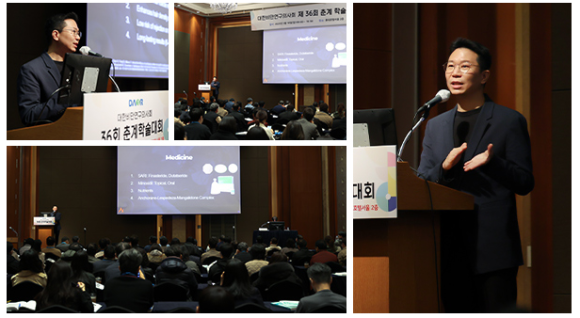
Written by: Kim Jin-Oh, New Hair Plastic Surgery Clinic (Public Relations Director, Korean Society of Plastic and Reconstructive Surgeons / Academic Director, Korean Hair Research Society)
References
Chew, E. et al. (2025). Hair follicle inspired therapies for wound healing and scar remodelling. Journal of Plastic, Reconstructive & Aesthetic Surgery, 78, pp. 1–15.
[This post is written directly by a board-certified plastic surgeon for informational purposes in accordance with Article 56, Paragraph 1 of the Medical Service Act. Hair loss surgery and treatment may have side effects, and you should make a careful decision after consulting with a specialist.]