The most common questions about hair loss treatment are similar.
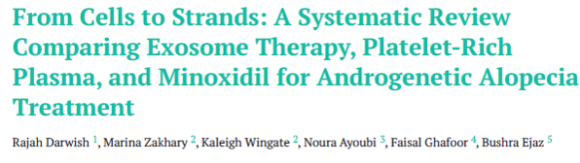
“Do I have to use minoxidil for life?” “What is the difference between PRP and exosomes?” In this post, I’ve gathered these questions and organized them based on the latest research¹ and clinical experience.
Q1. Do I really have to apply minoxidil for the rest of my life?
A. Minoxidil is a representative topical treatment that increases blood flow and extends the growth phase of hair follicles.
The problem is that its effect drops quickly when use is stopped.
In other words, consistent use is needed to help prevent hair loss from progressing.
However, rather than saying “for life,” it is more accurate to understand it as a medication used long term as maintenance therapy while hair loss is progressing.
In actual clinical practice, some reports have shown that the response may be somewhat better in female patients than in male patients¹.
Q2. Is PRP treatment more effective than minoxidil?

A. PRP (platelet-rich plasma extracted from autologous blood) contains abundant growth factors and can stimulate the environment around hair follicles.
However, its effectiveness varies greatly depending on the preparation method, an individual’s platelet concentration, and the experience of the practitioner.
Studies often show that the synergistic effect is more pronounced when PRP is used together with minoxidil than when PRP is used alone¹.
On the other hand, there are also studies in female patient groups showing no significant difference from placebo, so individual response must be considered.
Q3. Is exosome really the “next-generation hair loss treatment”?
A. Exosomes are extracellular vesicles derived from autologous cells and others, and they contain various proteins and microRNAs, so they are being actively studied in regenerative medicine.
In the field of hair loss as well, positive results have been reported in several clinical trials¹.
In particular, some studies have shown data indicating that even a small number of injections can meaningfully improve hair density and thickness.
However, since the number of studies is still limited and the follow-up period is short,
it is appropriate to evaluate it as promising for now.
It is encouraging that few side effects have been reported, but more long-term data are still needed.
Q4. Then how can the three treatments be compared?
Based on the research review¹, the main features can be summarized as follows.
| Treatment | Mechanism and advantages | Limitations | Patient satisfaction/safety |
|---|
| Minoxidil | Increases blood flow, extends the growth phase / good accessibility and affordable price | Must be used continuously to maintain results / returns to baseline if stopped | Relatively stable, better response in women |
| PRP | Direct delivery of growth factors / actively stimulates hair follicles | Variability depending on preparation method and practitioner / unclear effect in women | High safety, satisfaction above average |
| Exosome | Regenerative signaling through extracellular vesicles / short-term improvement reported | Few studies / high cost / lack of long-term data | Few side effects, high satisfaction |
Q5. Which treatment is the best choice?
A. There is no absolute answer for the “best treatment.”
-
If you can manage treatment consistently → minoxidil is suitable
-
If you want a more active treatment → consider combining PRP
-
If you are interested in newer treatments and can afford the cost → an exosome-based option may be considered based on research
The important thing is a strategy tailored to each patient’s situation.
Also, for now, both exosomes and PRP are best approached as adjunctive treatments.
Above all, it is necessary to receive an accurate diagnosis first and choose the treatment that is right for you.
Q6. What direction will future research take?
Future attention is likely to focus on combination therapy with exosomes and minoxidil, as well as differences in response according to genetic variants.
For example, there are reports that the SULT1A1 enzyme variant, which is common among Asians, affects the response to minoxidil, so there is a strong possibility that this will expand into personalized treatment¹.
Hair loss treatment: What are the differences according to research on minoxidil, PRP, and exosomes?
Conclusion
The world of hair loss treatment continues to evolve.
Minoxidil, PRP, and exosomes all have clear advantages and limitations, and the approach should differ depending on each patient’s situation and goals.
Please refer to the latest research, but the actual treatment direction should always be determined through expert diagnosis and consultation.
Now it’s time for hairhair, this was Kim Jino.
May new hair grow (必生新毛).

Written by: Kim Jino of New Hair Plastic Surgery (Public Relations Director of the Korean Association of Plastic Surgeons / Academic Director of the Korean Association of Laser Dermatology and Hair)
References
- Darwish R, Zakhary M, Wingate K, Ayoubi N, Ghafoor F, Ejaz B. (2025). From Cells to Strands: A Systematic Review Comparing Exosome Therapy, Platelet-Rich Plasma, and Minoxidil for Androgenetic Alopecia Treatment. Cureus, 17(7): e87875. DOI: https://doi.org/10.7759/cureus.87875
[This post is written directly by a plastic surgery specialist for informational purposes in accordance with Article 56, Paragraph 1 of the Medical Service Act. Hair transplant surgery and treatment may have side effects, and decisions should be made carefully through consultation with a specialist.]