Source - Korea Health Log
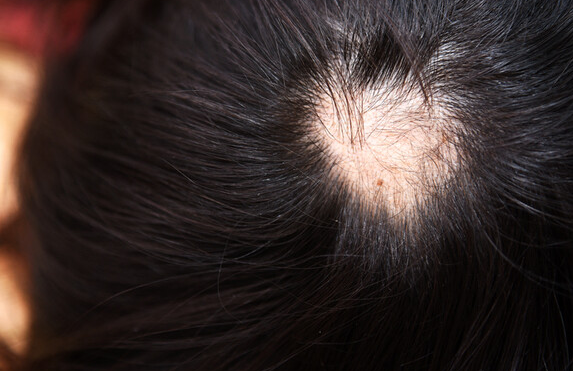
Alopecia Areata
Alopecia areata is a condition that can suddenly appear in anyone and leave them feeling bewildered.
The first question many patients ask in the clinic is, “Will it get better, or will it get worse?”
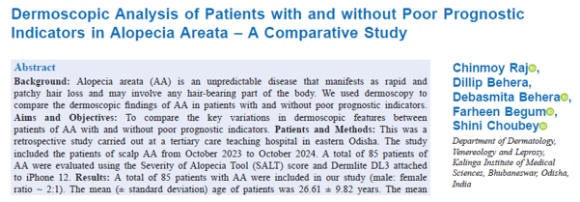
It is difficult to answer based only on how much hair has fallen out, but according to recent research, a magnified examination (trichoscopy) may be an important key to estimating a patient’s future¹.
Alopecia Areata: Can Prognosis Be Predicted in Advance with an Examination?
Conclusion
It is not possible to definitively predict the future of alopecia areata, but it is highly meaningful that a magnified examination can provide a kind of “prognostic compass.”
For patients, it offers direction amid uncertainty, and for doctors, it provides a basis for setting treatment strategies.
Above all, it reconfirms the message that active observation and treatment are necessary in the early stage of onset.
Q1. With alopecia areata, can’t we just look at how much hair has fallen out?
How much hair has fallen out is an important indicator, but by itself it is difficult to know the prognosis accurately.
In fact, some patients recover quickly even after losing a lot of hair, while others continue to have hair loss for a long time or it spreads to the entire body despite only a small area being affected.
A magnified examination shows detailed changes around the hair follicles, so it provides much deeper information than the pattern of hair loss visible on the surface.
Q2. What findings on magnified examination suggest a poor prognosis?


In a recent study of 85 patients, the following findings were identified as signs of a poor prognosis¹.
-
Yellow dots: sebum and keratin filling the hair follicle
-
Black dots: remnants of broken hairs
-
Broken hairs: observed when hair loss is actively progressing
-
Cadaverized hairs: weak hairs bent at the lower portion
In contrast, patients with a better prognosis showed many fine, newly growing vellus hairs.
This is an important sign that signals the beginning of recovery.
Q3. Does the longer the disease lasts, the worse the prognosis?
Yes. According to the study, patients whose condition had persisted for more than 3 months had a much larger affected area, and once this period had passed, the likelihood of a worse prognosis increased.
On the other hand, among patients with a duration of less than 3 months, there were many signs of ongoing hair loss (broken hairs), but the likelihood of recovery was relatively higher.
In other words, the 3-month mark after onset is an important period that separates treatment and prognosis.
Q4. Are there differences according to sex?
Interestingly, some differences between men and women were also observed¹.
Male patients: many yellow dots, black dots, and hairs that become thinner toward the root
Female patients: relatively many vellus hairs and weak hairs that are bent
However, there was no major difference in the area of hair loss itself.
Q5. How can this be used in clinical practice?
This study has practical significance that can be applied directly in the clinic.
-
At the first visit: if there are many yellow dots, black dots, and broken hairs, more active and prompt treatment is needed.
-
Mid-treatment: if vellus-like hairs appear, they can be seen as a sign of recovery.
-
Early stage of onset (around 3 months): repeated magnified examinations are useful for identifying disease progression and recovery early.
Summary Table of Prognostic Factors in Alopecia Areata
| Category | Poor prognosis | Good prognosis |
|---|
| Magnified examination findings | Yellow dots, black dots, broken hairs, weak bent hairs | Fine vellus-like new hairs |
| Disease duration | More than 3 months | Less than 3 months |
| Age at onset / history | Onset before age 10, total scalp hair loss, whole-body hair loss, occipital band-like pattern, atopic/autoimmune disease, persists for more than 1 year, nail changes | None |
| Sex tendency | Men: yellow dots, black dots, thinning at the root | Women: vellus hairs, weak bent hairs |
Now it’s time for hairhair, this was Kim Jin-oh.
Pilsaengsinmo (必生新毛).
Written by: Kim Jin-oh of New Hair Plastic Surgery (Public Relations Director, Korean Society of Plastic and Reconstructive Surgeons / Academic Director, Korean Society for Laser Dermatology and Hair)
References
- Patro, S., et al. (2025). Prognostication in alopecia areata: A trichoscopic comparison. Indian Dermatology Online Journal, 16 July 2025. doi:10.4103/idoj.idoj_1067_24
[This post was written directly by a board-certified plastic surgeon for informational purposes in accordance with Article 56, Paragraph 1 of the Medical Service Act. Hair loss surgery and treatment may have side effects, so please make a careful decision after consulting with a specialist.]