
Hair on the scalp, beard hair, and body hair all grow from hair follicles, but in clinical practice their responses and characteristics clearly differ by area.
I will summarize this based on research findings and actual clinical experience, focusing on questions patients often ask.
Summary of Hair Follicle Characteristics and Clinical Significance
| Category | Difference | Clinical significance |
|---|
| Hormonal response | Beard follicles: androgen response ↑ / Scalp follicles: response ↓³ | Thickness and texture need to be adjusted when transplanting beard hair to the scalp |
| Inflammatory response | Both scalp and beard follicles atrophy when inflamed³ | Suppressing inflammation is essential in hair loss treatment |
| Growth characteristics | Growth rate and the period during which hair is maintained differ by area⁴ | Density and treatment frequency should be customized |
| Blood supply | The more blood flow there is, the greater the hair thickness and growth¹ | Evidence for adjunctive treatments such as PRP, cell therapy, and laser |
Q1. Do scalp hair and beard hair respond to hormones in the same way?
A. Not at all. Beard follicles strongly respond to male hormones (androgens), which promotes growth, whereas scalp follicles show little response even to the same hormones³.
That is why beards become thicker during adolescence while hair loss may progress on the scalp.
If this difference is not understood, hair transplantation can produce unnatural results in thickness and texture, so it must be taken into account.
Q2. What happens differently to the scalp and beard when inflammation occurs?
A. Both atrophy.
According to multiple reports, in an inflammatory environment both scalp and beard follicles gradually atrophy, and as a result they become thinner and more likely to fall out³.
In other words, although their hormonal responsiveness differs, both are vulnerable to inflammatory damage.
That is why controlling inflammation is a key part of hair loss treatment.
In actual clinical practice, steroids injections, anti-inflammatory shampoos, and low-level laser therapy are used together to suppress inflammation.
Q3. Do hair growth speed and the duration it is maintained also
differ by body area?
A. Yes, the difference is clear.
Research shows that the growth rate and the period during which hair remains thick differ by body area⁴.
Scalp hair has a long growth phase and is maintained for a relatively long time, whereas arm and leg hair have short growth phases and fall out quickly.
Therefore, even if the same number of hairs are transplanted, the degree to which the result looks full depends on where they are placed.
This point becomes important when planning an actual procedure.
Q4. How does blood supply around the hair follicle affect it?
A. The greater the blood flow, the healthier the hair.
Research has reported that the more blood vessel distribution there is, the better the follicle thickness and growth rate¹.
In other words, good blood circulation is necessary for transplanted hair to take root well.
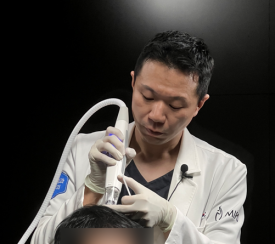
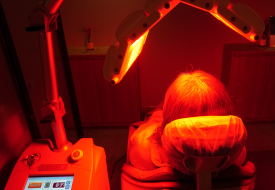
For this reason, adjunctive treatments such as PRP injections, autologous cell therapy, microneedling, and low-level laser therapy are effective.
All of these are treatments that improve the microcirculation around the hair follicle and enhance results.
Q5. Then what is the most important point when setting a treatment strategy?
A. Understanding how hair follicles respond depending on their location.
When transplanting beard hair to the scalp, differences in thickness, color, and texture must be considered.
For patients with hair loss, inflammation control must always be included.
Adjunctive treatments become essential tools for improving blood flow and the survival environment of the follicle.
Ultimately, understanding the fact that "hair follicles respond differently depending on their location" is the starting point of personalized treatment.
This has been Kim Jin-oh of Hairhair Time.
Pilsaengsinmo (必生新毛).
Written by: Kim Jin-oh of New Hair Plastic Surgery (Public Relations Director, Korean Association of Plastic Surgeons / Academic Director, Korean Society of Laser Dermatology and Hair)
References
-
Yano K, Brown LF, Detmar M. Control of hair growth and follicle size by VEGF-mediated angiogenesis. J Clin Invest. 2001;107(4):409–417.
-
Kozlowska U, Blume-Peytavi U, Kodelja V, Sommer C, Goerdt S, Orfanos CE. Expression of VEGF in various compartments of the human hair follicle. Br J Dermatol. 1998;139(6):910–915.
-
Randall VA. Androgens and hair growth. Dermatol Ther. 2007;21(5):314–328.
-
Paus R, Cotsarelis G. The biology of hair follicles. N Engl J Med. 1999;341(7):491–497.
-
Stenn KS, Paus R. Controls of hair follicle cycling. Physiol Rev. 2001;81(1):449–494.
-
Mecklenburg L, Paus R, Halata Z, Bechtold LS, Fleckman P, Sundberg JP. VEGF is essential for hair follicle development: evidence from hairless mice. Am J Pathol. 2000;157(2):679–693.
[This post was written directly by a board-certified plastic surgeon for informational purposes in accordance with Article 56, Paragraph 1 of the Medical Service Act. Hair loss surgery and treatment may have side effects, and you should make a careful decision after consulting with a specialist.]