Hair loss is a problem that affects not only appearance but also confidence.
There are representative options such as medication and hair transplantation, but they are not the right answer for everyone.
For people who find transplantation difficult or want a quick visual improvement, scalp micropigmentation is getting attention.
Scalp micropigmentation is a technique that does not implant real hair, but instead injects tiny pigment dots into the scalp so it looks like closely shaved hair.
It is regarded as a non-surgical visual solution that reduces scalp show-through and creates a natural impression.
Scalp Micropigmentation (SMP): A New Way to Help Ease Hair Loss Concerns?
Summary Table
| Item | Details |
|---|
| Study subjects | 10 people (6 androgenetic, 4 cicatricial) |
| Number of procedures | 3 total sessions (40→60→100 dots/cm²) |
| Results | Visual density 8.7 points, satisfaction 2.7/3 |
| Satisfaction | 85.7% of androgenetic alopecia patients were very satisfied |
| Advantages | Safety, quick improvement, low burden |
| Limitations | Additional research needed on long-term retention and pigment changes |
Q1. What is scalp micropigmentation (SMP)?
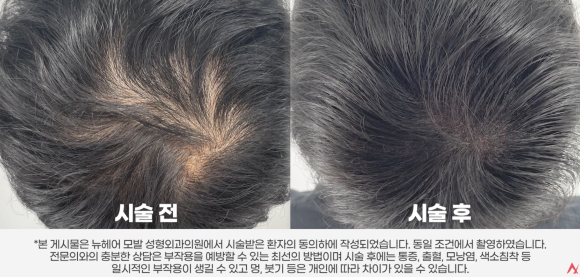
Before scalp micropigmentation: 2024-08-29 / After scalp micropigmentation: 2024-10-16
This article is a real case of a patient who received treatment at New Hair Plastic Surgery Clinic.
The before-and-after photos each indicate the time they were taken, and they were taken under the same patient and the same conditions.
We also state that the photos were disclosed with the patient's consent.
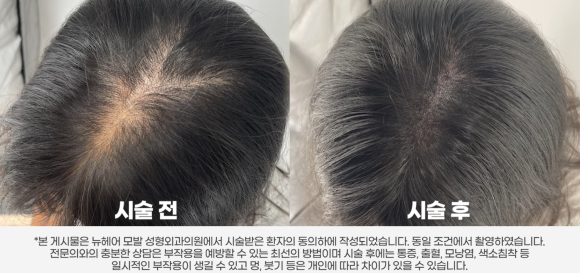
Before scalp micropigmentation: 2024-08-29 / After scalp micropigmentation: 2024-10-16
This article is a real case of a patient who received treatment at New Hair Plastic Surgery Clinic.
The before-and-after photos each indicate the time they were taken, and they were taken under the same patient and the same conditions.
We also state that the photos were disclosed with the patient's consent.
Scalp micropigmentation is not a procedure that implants real hair, but one that injects tiny pigment dots into the scalp surface
so that it looks like closely shaved hair.
In simple terms, it is not a treatment that makes hair grow again, but a cosmetic method that makes the scalp exposed by hair loss less visible.
According to research, scalp micropigmentation is evaluated as a stable and minimally invasive procedure with a high level of satisfaction¹.
In particular, it can be a practical and quick alternative for patients for whom medication or hair transplantation has limitations.
Q2. Does it really work?
In a recent clinical study of 10 hair loss patients, three scalp micropigmentation
sessions were performed.
By gradually increasing the dot density from 40 dots/cm² in the first session → 60 dots/cm² in the second → 100 dots/cm² in the third,
the researchers maximized naturalness.
As a result, the average visual density score immediately after the procedure was 8.7 points, and patient satisfaction was 2.7 out of 3².
An astonishing 87.7% of patients said they were very satisfied, and the research team found a strong correlation between visual density and satisfaction².
Scalp micropigmentation is considered a highly complete visual coverage solution even if real hair does not grow.
Q3. What is important for scalp micropigmentation to look natural?



| Factor | Description | Key Point |
|---|
| Needle thickness | If too thick, the dots look blurred | Around 0.2~0.3 mm recommended |
| Procedure depth | Too shallow and it fades easily; too deep and it may blur | Precisely in the upper dermis |
| Dot placement method | A fixed pattern looks artificial | Random distribution needed³ |
| Presence of bleeding | Bleeding may cause pigment spread and discoloration | Follow a no-bleeding protocol² |
An analysis supporting this notes that the procedure must be performed with a random distribution in which the pigment is not uniform, in order to avoid artificial evenness³.
The key technical philosophy of scalp micropigmentation is that the beauty of unevenness creates naturalness rather than uniformity.
Q4. What advantages does it have compared with medication or hair transplantation?
| Category | Scalp Micropigmentation | Hair Transplantation | Medication |
|---|
| Procedure type | Pigment injection (non-surgical) | Follicle transplantation (surgery) | Hormone and blood flow regulation |
| Speed of effect | Immediate | 6~12 months | 3~6 months |
| Recovery period | 1~2 days | 1~2 weeks | None |
| Maintenance | Touch-up procedure after 2~3 years | Some re-transplantation needed | Continuous use required |
| Burden | Low | High | Moderate |
| Suitable candidates | Those who cannot undergo transplantation, cicatricial alopecia | Hair loss with sufficient donor area | Early-stage hair loss |
In particular, for East Asians, the strong contrast between hair thickness and color can make transplantation limitations more noticeable,
and scalp micropigmentation has the advantage of supplementing low density, scars, and donor-area limitations.
There are also reports that scalp micropigmentation is an effective way to improve the appearance of cicatricial alopecia or diffuse hair loss after transplantation².
Q5. What are the aftercare instructions or precautions?

For about 3 days after the procedure, it is important to avoid water, sweat, and exposure to ultraviolet light.
Also, because the color stabilizes as 2~3 or more sessions accumulate, even if the color looks lighter in the middle, you should understand that this is a natural part of the process.
Because the pigment gradually fades over time, touch-up procedures are recommended every 2~3 years.
Before and after the procedure, it is also important to evaluate the condition of the scalp (seborrheic, dry, etc.) to prevent pigment spreading⁴.
Scalp Micropigmentation (SMP): A New Way to Help Ease Hair Loss Concerns?
Conclusion: Who is scalp micropigmentation suitable for?
-
Patients who are concerned about side effects from medication
-
Patients who do not have enough donor hair
-
It is especially useful for patients who need coverage for scars or diffuse hair loss.
Although it does not make hair grow again, it is becoming established as a visual treatment that restores confidence and allows a quick return to daily life.
In the future, scalp micropigmentation will become a scientific solution for image restoration beyond treatment for hair loss patients.
Now it is time for hair to grow, this was Kim Jin-oh.
Pilsaengsinmo (必生新毛).

Written by: Kim Jin-oh of New Hair Plastic Surgery Clinic (Public Relations Director, Korean Association of Plastic Surgeons / Academic Director, Korean Society for Laser, Dermatology and Hair)
References
-
Rassman, W. R., Pak, J. P., Kim, J., & Estrin, N. F. (2015). Scalp Micropigmentation: A Concealer for Hair and Scalp Deformities. Journal of Clinical and Aesthetic Dermatology, 8(3), 35–42.
-
Liu, Q., Sun, M., Zhang, J., & Zhao, H. (2025). Scalp Micropigmentation Is an Effective Treatment for Localized Alopecia: Technical Analysis and a Series of Ten Case Reports. Journal of Cosmetic Dermatology, 24, e70375. https://doi.org/10.1111/jocd.70375
-
Dhurat, R. S., Shanshanwal, S. J. S., & Dandale, A. L. (2017). Standardization of SMP Procedure and Its Impact on Outcome. Journal of Cutaneous and Aesthetic Surgery, 10(3), 145–149.
-
Nguyen, B., Mervis, J. S., Romanelli, P., & Tosti, A. (2022). Scalp Micropigmentation: A Clinicopathologic Correlation. Skin Appendage Disorders, 8(5), 412–414.
[This post is written directly by a board-certified plastic surgeon for informational purposes in accordance with Article 56, Paragraph 1 of the Medical Service Act. Hair loss surgery and treatment may have side effects, and you should make a careful decision after consulting with a specialist.]