※ Notice
To help with understanding, this post includes before-and-after photos of actual patients. Thank you for your understanding.
The person shown received surgery at New Hair Hair, and consent for use of the photos was obtained.
Many people considering hair transplants for the crown or part line ask the same question most often.
“Doesn’t crown hair transplantation not work?” But clinically, that is not the case.
It is just that the changes appear slowly, so it would be difficult to conclude that it has “no effect.”
Below is a summary of frequently asked questions from actual patients.
Crown Hair Transplant (Part-Line Hair Transplant),
Why Are Results Slower Than in Other Areas? Summary Table
| Category | Hairline Transplant | Part-Line, Crown Transplant |
|---|
| Procedure difficulty | Relatively simple | Requires precise placement between existing hairs |
| Visual change | Immediate | Gradual (noticeable after 6 to 12 months) |
| Patient satisfaction point | Improved appearance | Reduced scalp visibility, natural look |
| Technical core | Design planning | Angle and direction control, follicle spacing adjustment |
| Effect of combined treatment | Focus on maintenance | Focus on transplant + protection of existing hair |
Q1. Is crown hair transplantation really less effective?
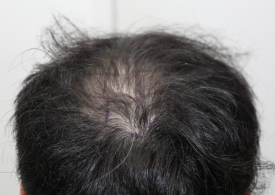
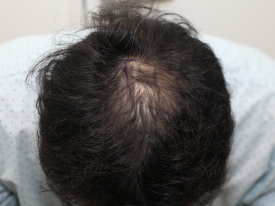
Male crown hair transplant design
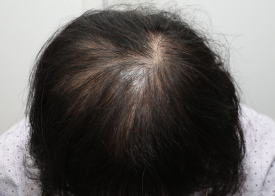
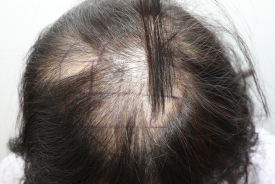
Female part-line hair transplant design
Crown transplants are an area where results appear “later” than in the hairline.
The reason is that new follicles are implanted among hairs that are already present.
After transplantation, the change is not immediate; instead, a reduction in scalp show becomes noticeable starting around 6 months to 1 year.
Even in international hair transplantation textbooks, it is explained that “the subjective improvement in the crown area appears later than in the hairline after transplantation”¹.
In other words, the claim that it does not work comes from the misunderstanding that it is “not immediately noticeable.”
In fact, comparison photos taken 10 months to 1 year later clearly show reduced scalp visibility.
Q2. Why are crown and part-line procedures more difficult?
The hairline involves placing follicles in an empty area, so it is relatively straightforward.
But the crown and part line already have hair, so follicles must be added without damaging the existing hair.
Therefore, the medical team’s skill, precision, and sense of the implantation angle and direction are the key factors in the outcome.
A study by Bernstein and Rassman also states that visual density can be improved by adding follicles between existing hairs².
In other words, although it is technically more difficult,
if it is implanted in a well-designed pattern,
it can create a natural scalp-covering effect.
Q3. When can changes from crown transplantation be felt?
Usually, there is a “shedding phase” for up to 3 months.
After that, new fine hairs begin to grow from around 4 to 6 months, and after 9 to 12 months, density improvement becomes visible even to the naked eye.
In particular, many patients say, “The part line looks less wide” when tying or combing their hair.
The key point is not an immediate change, but the difference created over time.
Q4. Do existing hairs also need to be managed?
Crown hair transplantation is not just a “planting procedure”; it is a process of managing the surrounding environment as well.
While the transplanted follicles are taking root, it is very important to maintain the existing hair so it does not fall out.
For this purpose, combining treatments such as minoxidil, finasteride, laser therapy, or follicle injection treatment can improve hair survival and density maintenance.
Therefore, postoperative care can be said to determine half of the result.
Q5. Who is it recommended for?
-
Cases where the hairline is maintained but the crown or part line is visible
-
Patients with moderate or more advanced hair loss for whom medication alone has limitations
-
People who want a natural change and a degree of “less visible scalp”
For these patients, hair transplantation can provide a sufficiently satisfying improvement.
Q6. What is actual patient satisfaction like?
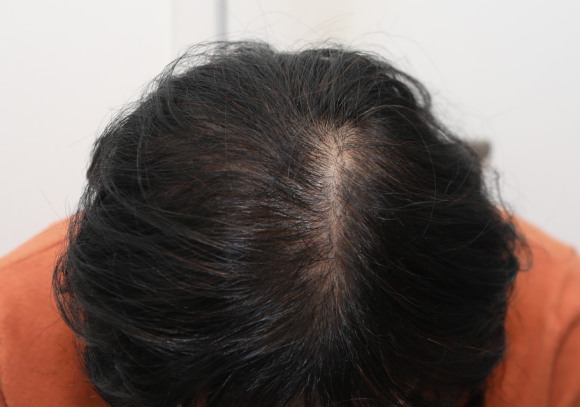
Shooting date: 2023-09-25 (before) / 2025-02-19 (after)
Photo after 1 year and 5 months
The photos above are of the same patient who started and completed the procedure at New Hair Plastic Surgery Clinic
No separate manipulation was performed on the photos
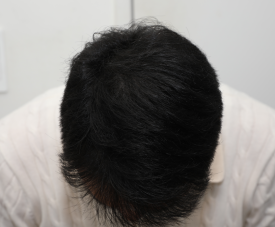
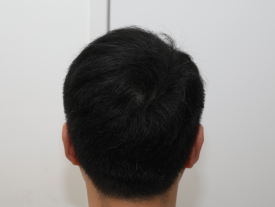
Shooting date: 2024-10-01 (before) / 2025-10-03 (after)
Photo after 1 year
The photos above are of the same patient who started and completed the procedure at New Hair Plastic Surgery Clinic
No separate manipulation was performed on the photos
The phrase heard most often in clinical practice is “the scalp shows less” and “I feel more confident when taking photos.”
Crown transplantation is a surgery focused not on dramatic changes in appearance, but on improving the impression naturally and restoring psychological comfort.
Now it’s time for hair, hair. Kim Jin-Oh.
Pilsaengsinmo (必生新毛).

Written by Kim Jin-Oh of New Hair Plastic Surgery Clinic (Public Relations Director, Korean Society of Plastic and Reconstructive Surgeons / Academic Director, Korean Society for Laser, Dermatology and Hair)
References
- Unger, W. P. & Shapiro, R. (2010). Hair Transplantation. Informa Healthcare.
— “The vertex region often shows delayed subjective improvement compared to the frontal hairline after transplantation.”
- Bernstein, R. M. & Rassman, W. R. (2012). Hair Transplantation for the Part Line and Crown: A Review of Techniques and Outcomes. Dermatologic Surgery, 38(7), 1152–1160.
— “Increasing density between existing hairs can significantly improve the cosmetic appearance of the parting line.”
[In accordance with Article 56, Paragraph 1 of the Medical Service Act, this post is written directly by a plastic surgery specialist for informational purposes. Hair loss surgery and treatment may involve side effects, and careful decision-making is recommended through consultation with a specialist.]