If you are naturally born with a wide forehead, the question that comes up most often when considering hairline correction is, “Will the transplanted hair stay well over time?”
This question is not simply answered with yes or no. It is connected to the characteristics of the donor hair, whether there is early hair loss, family history, and the biological stability of the hair follicles.
Wide Forehead Hair Transplant: What Conditions Make It Last a Lifetime? Summary
| Category | Key Points |
|---|
| Donor stability | The donor dominance principle applies: follicles from the occipital and temporal areas retain their original characteristics even after being moved¹² |
| Survival rate | More than 90% survival has been reported after non-incisional FUE transplantation³ |
| Shedding phenomenon | Hair that falls out after surgery is mostly temporary shedding, and the follicles remain and regrow⁴ |
| Naturally wide forehead | The less early hair loss there is, the more stable the long-term retention |
| With early hair loss | The surrounding native hair may gradually thin, making the overall outline look different |
| Weak donor area | If the donor area itself has diffuse hair loss, the transplanted follicles may also be affected long term |
| Main conclusion | What determines the result is not the surgical technique alone, but the accuracy of diagnosis and planning |
Q1. If you are naturally born with a wide forehead, can the transplanted hair fall out again later?
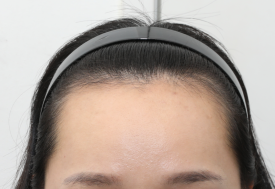
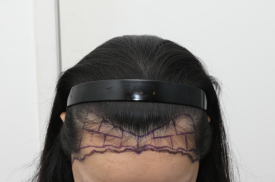
To begin with the conclusion, if the donor area is stable, it is generally maintained for a long time.
Hair in the permanent zone of the occipital and temporal areas has structural traits that make it resistant to hair-loss hormones.
Even if those follicles are moved to the forehead, temples, or frontal area, they keep their original characteristics.
This is called donor dominance¹².
If the donor hair was the type that lasts a lifetime, the transplanted hair follows the same fate.
Q2. Then what is the actual survival rate?
The numbers here are fairly clear.
In a 2024 analysis of 158 cases, follicle survival was reported at over 90%³.
This is used not only as evidence that the grafts take well, but also as evidence that the transplanted follicles maintain the characteristics of occipital hair over the long term.
Q3. Is hair that falls out after a hair transplant a failure?
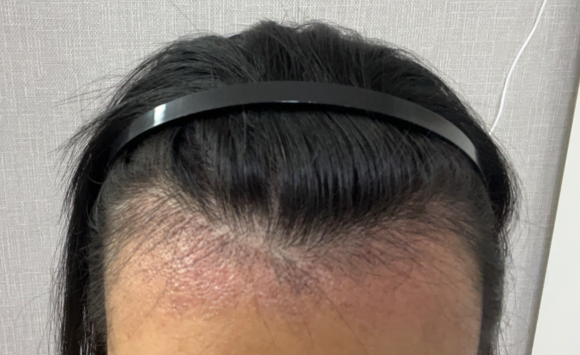
In most cases, no.
Hair that sheds 2–4 weeks after surgery is a temporary phenomenon called shock loss.
This does not mean the follicles have fallen out; it is a process in which the follicles briefly enter the resting phase.
The follicles remain in the skin, and regrowth begins gradually from around 3–4 months,
with the most noticeable changes appearing at 8–12 months⁴.
Q4. How can you distinguish a naturally wide forehead from early hair loss?
Naturally wide forehead - characteristics
-
Looking at old photos, the forehead shape remains similar
-
The M-shaped hairline and frontal hair are thick and stable
-
There is no major pattern of hair loss in the family history
-
Donor density is maintained evenly
In this case, the transplant result is very stable in the long term.
Early hair-loss-type wide forehead - characteristics
-
Compared with old photos, the hairline gradually moves upward
-
The M-shaped area slowly becomes thinner
-
Changes are also seen at the crown or frontal scalp
In this case, even if the transplanted hair grows well, the surrounding native hair may gradually weaken and make the forehead look wider again.
Q5. Why does a strong donor area make the result more stable?
People with naturally wide foreheads often have unexpectedly stable hair density, thickness, and elasticity in the donor area (occipital and temporal areas).
A strong donor area means thicker follicles can be used, the harvest amount is sufficient within a safe range, the survival rate is high, and long-term retention is also good.
In a study that corrected high foreheads and wide foreheads in East Asian women with non-incisional hair transplantation, long-term retention was reported to be excellent and facial proportion improvement continued⁵.
Q6. On the other hand, what problems can occur if the donor area is weak?
Even if it looks fine on the surface, diffuse hair loss may be hidden in the donor area.
In such cases, the occipital hair may also thin over time and density may decrease.
In this situation, the transplanted follicles may also be affected in the long term, the amount that can be harvested from the donor area is limited, and secondary or tertiary correction may become difficult.
Instead of asking, “Will the transplanted hair last a lifetime?” it is more accurate to ask, “Is the donor hair the type that will last a lifetime?”
Q7. In the end, which factors determine whether the result will last a lifetime?
- Donor area health - most important
Follicle thickness, density, resting-phase ratio, and whether diffuse hair loss is present.
- Whether it is a naturally wide forehead or early hair loss
If early hair loss is present, design must take future changes in surrounding hair into account.
- Family history pattern analysis
Hair loss patterns on the father’s side, among brothers, or on the mother’s side provide major clues for future prediction.
- Design and graft allocation
To maintain a natural look over time,
line composition, angle, and curl pattern are more important than the number of grafts.
- Long-term management plan
If early hair loss is present, medication and lifestyle management are also needed.
Wide Forehead Hair Transplant: What Conditions Make It Last a Lifetime?
Conclusion
People who are naturally born with a wide forehead often have a strong donor area, so transplanted hair is more likely to be maintained for a long time.
On the other hand, if early hair loss is hidden or the donor area is weak, it may not be the transplanted hair itself but rather changes in the native hair that alter the result.
Half of the result is determined not by surgical technique, but by accurate assessment, planning, and future prediction.
A detailed first consultation to closely evaluate the donor area and overall pattern is the key to creating a stable hairline in the long term.
| Assessment Item | When Stable | When Unstable |
|---|
| Donor area | Good thickness and density | Diffuse thinning |
| Family history | Weak hair-loss pattern | Strong genetic pattern |
| Existing hair | Thick and unchanged | M-shaped and frontal thinning |
| Long-term retention | High | Possible changes in surrounding hair |
| Recommended strategy | Strengthen follicle allocation | Combine with medication and scalp care |
Now it is time to say hair hair, this was Kim Jin-oh.
Pilsaeng Sinmo (必生新毛).

Written by: Kim Jin-oh of New Hair Plastic Surgery (Public Relations Director, Korean Society of Plastic and Reconstructive Surgeons / Academic Director, Korean Society of Laser Dermatology and Hair)
References
1.Chouhan, K & Roga, G. (2021). Hair Transplantation in Androgenetic Alopecia, CosmoDerma.
“Donor dominance… the ability of transplanted hair grafts to retain the characteristics of the donor site.”
2.Queen Dawn, et al. (2025). Hair Transplantation: State of the Art, Aesthetic Plastic Surgery Review.
“Follicular units harvested from the permanent zone demonstrate long-term growth stability after relocation.”
3.Wang, F., et al. (2024). Outcomes of FUE Hair Transplantation, Journal of Cosmetic Dermatology.
“Following FUE hair transplantation, over 90% of the hair follicles survived in 158 patients.”
4.Epstein, J. (2013). Lowering the Female Hairline: Two Options in Treatment, Hair Transplant Forum International.
“Hair regrowth usually begins at 4 months… with impressive results at 8–12 months.”
- Wu, W., et al. 2025, Hairline transplant in East Asian women with high and wide foreheads, Aesthetic Plastic Surgery.
“Hair transplantation via FUE is an effective approach for improving mid-upper facial proportions in East Asian women with high and wide foreheads.”
[This post is being written directly by a board-certified plastic surgeon for informational purposes in accordance with Article 56, Paragraph 1 of the Medical Service Act. Hair loss surgery and treatment may have side effects, and you should make a careful decision after consulting with a specialist.]