The process of starting hair loss treatment usually begins with one common concern.
“Which medication should I choose for the best results?”
However, in actual clinical practice, the first decision is an important turning point that shapes the direction of treatment, so simply comparing medication strength or price is not enough.
You need to consider the current state of the hair follicles, the speed of hair loss progression, your goals, and long-term sustainability together for the treatment process to continue naturally.
In particular, in early-stage hair loss, the presence or absence of remaining vellus hairs is repeatedly emphasized in several papers as being closely related to drug responsiveness¹.
Understanding this principle makes the criteria for choosing medication much clearer.
Hair Loss Medication: What Criteria Should You Check at the Starting Stage?
Summary
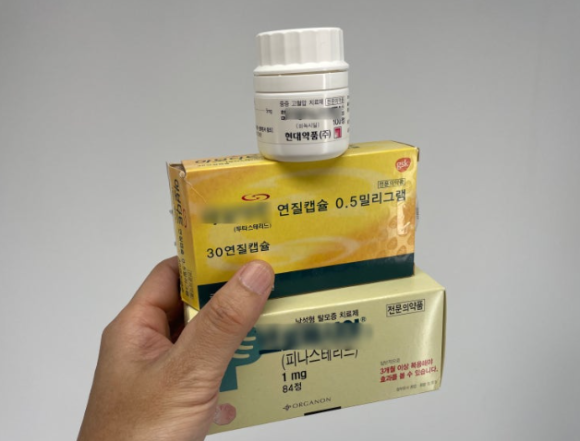
The first medication choice depends more on the current hair follicle condition, progression speed, and lifestyle pattern than on a “strength comparison”
Finasteride: a first-line medication with established safety and long-term efficacy²³
Dutasteride: inhibits both type I and type II 5α-reductase,
greater DHT reduction⁸
Minoxidil: useful for restoring the thickness of remaining miniaturized follicles,
possible skin reactions due to the topical formulation⁴
There are many studies showing that combination therapy is more effective than monotherapy⁵⁶
Sustainability, fit with lifestyle patterns, and goal setting are the decisive factors in choosing the first medication
Q1. What should you check first when choosing a hair loss medication?
The key criterion is whether the current hair follicles are still viable, rather than the medication name or strength.
Areas where follicles remain have a higher drug response, but areas where follicles have already been lost are difficult to recover with medication alone¹.
Clinically, the more follicles remain, the faster and stronger the treatment response tends to be.
Q2. Why is finasteride called a basic treatment?
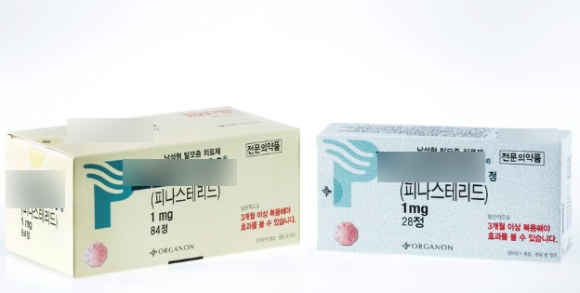
Finasteride
Source - Medipana News
Because of the long-term clinical evidence that has accumulated.
Finasteride blocks part of the process that produces the male hormone DHT, slowing the weakening of hair follicles and also helping already thinned hair become thicker again.
Clear improvement compared with placebo was confirmed in both the 12-month and 24-month evaluations², and long-term data from 523 men in Japan showed that an improvement of more than one grade, on average, was maintained over 10 years³.
Therefore, the clinical message is clear: when you start treatment matters, because it determines the extent of future recovery.
Q3. When should dutasteride be considered?
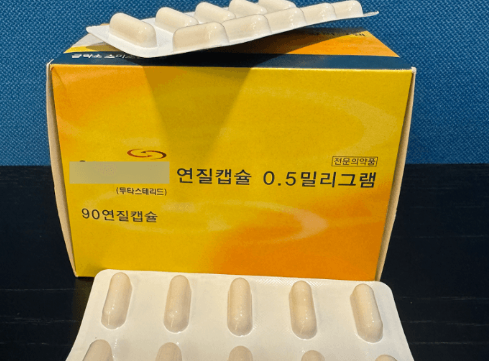
Dutasteride
Source - My Own Doctor
It is often advantageous when progression is rapid or when both the frontal area and crown are involved.
Dutasteride blocks both pathways that produce DHT, reducing male hormone (DHT) levels more than finasteride.
For that reason, it is sometimes chosen when hair loss is progressing quickly or when you need to expect visible changes a bit earlier.
However, because it has stronger suppression, you should also consider sensitivity to side effects, your goals, and whether long-term treatment can be sustained.
Q4. Who is minoxidil effective for?
It is especially good at turning remaining vellus hairs into thicker terminal hairs.
Because of its mechanism of increasing blood flow and metabolism in the hair follicle, early-stage hair loss tends to respond better, and there is a synergistic effect when it is used together with other medications.
However, because it is a topical formulation, scalp irritation and erythema have been reported in a certain proportion of users⁴, so for people with sensitive skin, choosing the right formulation is important.
Q5. Is combination therapy more effective than monotherapy?
Many studies have repeatedly confirmed the superiority of combination therapy.
Because each medication has a different mechanism, they produce complementary effects.
However, not everyone needs combination therapy from the start, and it is more important first to judge whether the regimen fits your lifestyle and whether adherence can be maintained.
Q6. Why is consistent use so important?
The biggest reason outcomes differ even when using the same medication is treatment continuity.
Even a medication with strong efficacy is easy to stop if it does not fit your lifestyle, and repeated interruptions greatly reduce the efficiency of follicle recovery.
Also, as the follicular microenvironment (sleep, nutrition, stress, scalp condition) becomes more stable, drug responsiveness becomes more apparent; this is something that is often confirmed clinically.
Hair Loss Medication: What Criteria Should You Check at the Starting Stage?
Summary Table
| Selection criterion | Finasteride | Dutasteride | Minoxidil | Combination therapy |
|---|
| Main mechanism | Type II inhibition | Type I+II inhibition | Increased blood flow and metabolism | Complementary mechanisms |
| Advantages | Strong evidence for long-term safety and efficacy²³ | Strong DHT suppression⁸ | Helps restore vellus hair thickness⁴ | Better improvement than monotherapy⁵⁶ |
| Suitable type | Stable progression or early-stage hair loss | Rapid progression, extensive involvement | Early-stage hair loss, miniaturized follicles | When response optimization is needed |
| Points to note | Consistent use is important | Consider individual sensitivity | Possible scalp irritation | Needs to fit your lifestyle pattern |
Now it’s time to let your hair grow, this was Kim Jin-oh.
필생신모(必生新毛).

Written by: Kim Jin-oh, New Hair Plastic Surgery (Public Relations Director, Korean Society of Plastic Surgeons / Academic Director, Korean Society of Laser Dermatology and Hair)
References
-
Rossi, A., Cantisani, C., Melis, L., Iorio, A., Scali, E. & Calvieri, S. (2012). Androgenetic alopecia: a review. Journal of Cosmetic Dermatology, 11(4), 289–305. cited:"androgenetic alopecia responds better in areas where miniaturized follicles remain present."
-
Kaufman, K.D., Olsen, E.A., Whiting, D., Savin, R., DeVillez, R., Bergfeld, W. et al. (1998). Finasteride in the treatment of men with androgenetic alopecia. Journal of the American Academy of Dermatology, 39(4), 578–589. cited:"significant improvement compared with placebo after 12 and 24 months."
-
Inui, S., Itami, S. & Tsuboi, R. (2012). Long-term efficacy of finasteride in 523 Japanese men with androgenetic alopecia. Dermatology, 224(3), 236–241. cited:"mean improvement of approximately one Norwood–Hamilton grade over 10 years."
-
Suchonwanit, P., Thammarucha, S. & Leerunyakul, K. (2019). Minoxidil: Mechanisms and clinical efficacy in the treatment of hair disorders. Journal of Dermatological Treatment, 30(8), 1–9. cited:"local irritation including pruritus and erythema were observed."
-
Arca, E., Akar, A., Erbil, H., Akay, C., Sayal, A. & Arca, E. (2004). An open, randomized, comparative study of oral finasteride and 5% topical minoxidil in male androgenetic alopecia. Dermatologic Surgery, 30(5), 622–628. cited:"combined therapy produced superior outcomes in hair diameter and density."
-
Johnson, H., Patel, N. & Smith, L. (2025). Effectiveness of combined oral minoxidil and finasteride therapy over 12 months in men with androgenetic alopecia. British Journal of Dermatology, 192(5), 881–889. cited:"92.4% showed improvement or stabilization."
-
Piraccini, B.M., Iorizzo, M., Starace, M., Bruni, F., Alessandrini, A. & Tosti, A. (2021). Efficacy and safety of topical finasteride spray solution for androgenetic alopecia. Journal of the European Academy of Dermatology and Venereology, 35(12), 2347–2354. cited:"systemic DHT reduction was significantly lower than with oral finasteride."
-
Clark, R.V., Hermann, D.J., Cunningham, G.R., Wilson, T.H., Morrill, B.B. & Hobbs, S. (2004). Dutasteride, a dual 5α-reductase inhibitor, reduces dihydrotestosterone in men with androgenetic alopecia. Journal of Clinical Endocrinology & Metabolism, 89(5), 2179–2184. cited:"dutasteride inhibits both type I and type II 5α-reductase, producing greater DHT suppression compared with finasteride."
[This post is written directly by a board-certified plastic surgeon for informational purposes in accordance with Article 56, Paragraph 1 of the Medical Service Act. Hair loss surgery and treatment may have side effects, and you should make a careful decision after consulting with a specialist.]