One of the most common questions asked during hair loss treatment consultations is:
“Why does one person feel that a follicular injection works while another does not, even though it’s the same injection?”
Many people think only about the ingredients, but in actual clinical practice,
where and how accurately the injection is delivered—its depth—greatly affects the result.
The scalp is thinner than many people expect, and within just a few millimeters, the key structures involved in hair growth are densely packed.
Follicular Injections: Why Is a Depth of 2–5 mm in the Scalp So Important?
Summary
The core target layer for follicular injections is about 2–5 mm below the scalp surface.
Hair follicle structures, the dermal papilla, and microvessels exist at different depths.
PN·PDRN, PDLLA, botulinum toxin, and hADM each have their own optimal depth.
Even with the same ingredient, a 1 mm difference can change the effect.
Follicular injections are precision procedures based on anatomy, not sensation.
Q1. Are follicular injections just injections into the scalp?
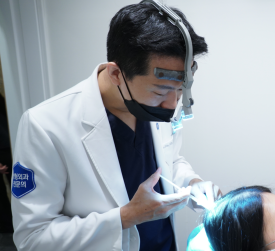
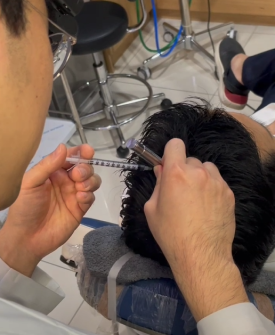
At first glance, it may look that way.
But the scalp is not just simple skin; it is closer to a small organ system that creates hair.
The epidermis and dermis are, on average, about 1.5–2 mm thick¹, and the core structures of the hair follicle begin below that.
If an injection is given without considering this structure, the medication may slip into the fat layer or fail to reach the necessary tissue, and the expected response may not appear.
In clinical practice, this difference leads to a large gap in treatment satisfaction.
Q2. Why is a depth of 2–5 mm considered so important?
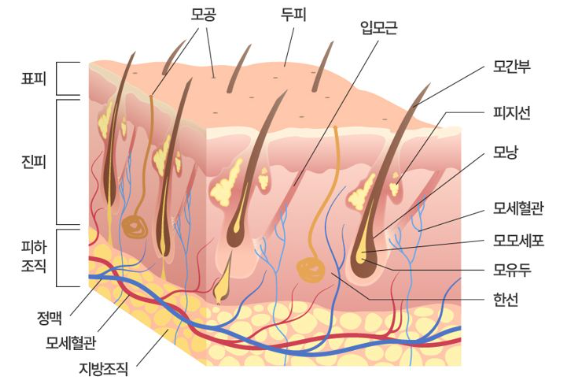
Scalp cross-section
Source - Financial News
This is because most of the structures involved in hair growth are concentrated in this range.
Only by accurately targeting these layers can stem tissue activation, growth signal transmission, and improvement of the follicular environment occur at the same time.
Outside this range, the drug is more likely to remain in a layer where it has little meaning.
Q3. Why should PN·PDRN injections be placed more superficially?
PN·PDRN are nucleic-acid-based ingredients that help reduce inflammation, promote blood vessel formation, and support tissue recovery⁶.
The targets these ingredients need to act on are the hair follicle stem-related tissue and the superficial vascular layer, which are mainly distributed at a depth of 2–3 mm¹.
In fact, studies have reported improvements in hair thickness and density when these were injected at this depth⁷⁸.
In clinical settings as well, when this layer is accurately targeted, there is a tendency for hair shedding to decrease and for hair condition to recover more quickly.
Q4. Why is PDLLA injected more deeply?
PDLLA is a microparticle ingredient that induces tissue remodeling and volume restoration⁹.
It mainly shows a stable response at the dermis–subcutaneous fat boundary, around 3–5 mm, and the dermal papilla, which is central to hair growth, is located at this depth².
Therefore, PDLLA requires depth adjustment not simply for nutrient supply, but to reorganize the environment where the hair follicle can settle.
Q5. How is botulinum toxin used for hair loss?
The role of botulinum toxin changes depending on the depth of injection.
- 2–3 mm: sebum secretion, inflammation, and microvascular regulation¹⁰
- 3–5 mm: relief of scalp tension and improvement of blood flow¹¹
A study showing that areas of male pattern hair loss overlap with scalp tension¹¹ supports the idea that this approach is not merely for cosmetic purposes.
However, if it goes deeper into the muscle layer, the effect changes, so it is important to distinguish the target layer according to the purpose¹².
Q6. What role does hADM play?
hADM is a biologic-based ingredient that reinforces the foundational structure where stem tissue and tissue can settle stably¹³.
It mainly acts at a depth of 2–4 mm, and if it goes beyond this layer, the expected effect decreases.
In clinical practice, repeated injections often show differences in scalp elasticity and environmental stability.
Follicular Injections: Why Is a Depth of 2–5 mm in the Scalp So Important?
Summary Table
| Ingredient | Main Purpose | Recommended Depth |
|---|
| PN·PDRN | Reduce inflammation, promote blood vessel formation, support follicular recovery | 2–3 mm |
| PDLLA | Tissue remodeling, improve the follicular environment | 3–5 mm |
| Botulinum toxin | Regulate sebum, tension, and blood flow | 2–5 mm (depending on purpose) |
| hADM | Reinforce the scalp’s foundational structure | 2–4 mm |
Follicular injections are a treatment in which where the material is injected matters just as much as what is injected.
Even with the same ingredient, a 1 mm difference in depth can stimulate entirely different tissues, and that difference directly leads to what patients feel in the result.
That is why follicular injections should be approached not as procedures dependent on experience alone, but as precision treatments based on scalp anatomy and clinical evidence.
Now is the time for hairhair, Kim Jin-o.
필생신모(必生新毛).

Written by: Kim Jin-o, New Hair Plastic Surgery (Public Relations Director, Korean Society of Plastic and Reconstructive Surgeons / Academic Director, Korean Society for Laser Dermatology and Hair)
References
-
de Viragh, P.A. & Meuli, M. (1995) Human scalp hair follicle development from birth to adulthood. Archives of Dermatological Research. cited: “Human scalp hair follicle development from birth to adulthood.”
-
ScienceDirect Topics (2025) Scalp Hair — Overview. cited: “Scalp hair structure and anagen depth.”
-
Morgan, B.A. (2014) The dermal papilla: an instructive niche for epithelial stem cells. Developmental Cell. cited: “The dermal papilla: an instructive niche for epithelial stem cells.”
-
Rahmani, W. et al. (2014) Hair follicle dermal stem cells regenerate the dermal sheath. Developmental Cell. cited: “regenerate the dermal sheath, repopulate the dermal papilla, and modulate hair type.”
-
Fujiwara, H. (2024) Cell–extracellular matrix interactions in hair follicle regeneration. Developmental Biology. cited: “cell–extracellular matrix interactions in hair follicle regeneration.”
-
Akaberi, S.M. (2024) Polydeoxyribonucleotide in skincare and cosmetics. Journal of Skin Stem Cell. cited: “Polydeoxyribonucleotide in skincare and cosmetics.”
-
Cho, S.B. (2016) Therapeutic Efficacy of Thulium Laser and PDRN Injections for Pattern Hair Loss. Medical Lasers. cited: “Intra-perifollicular polydeoxyribonucleotide injections for pattern hair loss.”
-
Samadi, A. (2024) Clinical Assessment of PN Gel for Hair Loss. cited: “assessment of a polynucleotide-based gel for improvement of pattern hair loss.”
-
Lee, K.W.A. (2024) Poly-D,L-lactic Acid in Dermatology. Polymers. cited: “Poly-D,L-Lactic Acid in Dermatology.”
-
Li, Y. (2023) Intradermal Botulinum Toxin A Injection for Scalp Sebum Regulation. Aesthetic Surgery Journal. cited: “Intradermal Botulinum Toxin A Injection for Scalp Sebum Regulation.”
-
Tellez-Segura, R. (2015) Mechanical stress in androgenetic alopecia. International Journal of Trichology. cited: “mechanical stress in androgenetic alopecia.”
-
Singh, S. (2017) Effectiveness of Botulinum Toxin in Androgenetic Alopecia. Plastic and Aesthetic Research. cited: “Effectiveness of Botulinum Toxin in Androgenetic Alopecia.”
-
Petrie, K. (2022) Clinical applications of acellular dermal matrices. Scars, Burns & Healing. cited: “Clinical applications of acellular dermal matrices.”
[This post is written directly by a board-certified plastic surgeon for the purpose of providing information in accordance with Article 56, Paragraph 1 of the Medical Services Act. Hair loss surgery and treatment may involve side effects, and you should make a careful decision after consulting with a specialist.]