One of the most searched terms by people considering a hair transplant is hair transplant side effects.
But there is a big gap compared with what we actually see in clinical practice.
That is because most of the changes patients worry about are often recovery reactions that settle over time, while the signs that really need attention are relatively less well known.
Today’s post will organize, based on both academic research and clinical experience,
the changes you do not need to worry about and the side effects you must distinguish from them, in a question-and-answer format.
Hair transplant side effects: are they all the same risk?
Summary of temporary changes and warning signs
Swelling, tightness, itching, and temporary shedding are mostly part of the normal recovery process
Pain, warmth, and redness that get worse over time are warning signs
The truly important side effects are infection, blood flow problems, excessive harvesting, and scarring
The key question is whether time will resolve it or whether time will make it worse
Q1. Is swelling and bruising after a hair transplant normal?
When grafts are placed mainly in the forehead or hairline area, swelling in the forehead or around the eyes is common.
This is usually due to inflammatory reactions caused by surgical irritation and fluid movement, and it generally subsides within a few days to 1–2 weeks.
A systematic literature review also found that the most commonly reported problems were temporary symptoms such as pain, swelling, and edema².
Clinically, if the pattern gradually improves over time, there is no need for excessive worry.
Q2. My hair is falling out after surgery. Did the hair transplant fail?
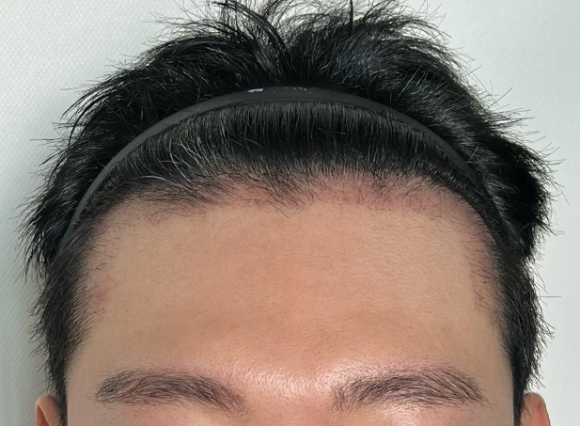
This is one of the biggest sources of anxiety for many people.
Several weeks to months after surgery, the transplanted hair or surrounding hair may shed once.
This is not because the follicles were damaged; rather, it is closer to a temporary pause in the hair growth cycle caused by surgical stress.
Research on temporary shedding after non-shaven hair transplant surgery also reports that it may appear more readily under certain conditions, but in most cases it does not lead to permanent results³.
Q3. Small bumps like pimples have appeared at the transplant site. Is that a problem?
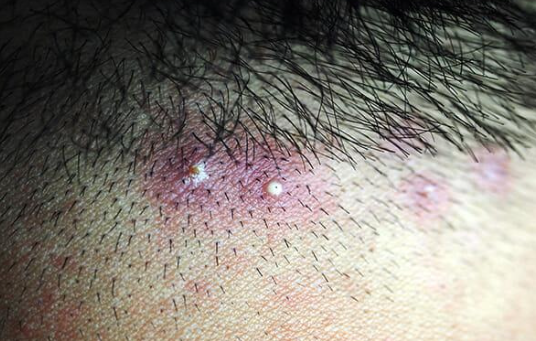
Small inflammatory lesions or changes that look like acne may appear at the transplant site.
These often occur when sebum, dead skin cells, and inflammation around the follicles overlap, and they usually improve with local care.
However, if pain becomes more severe or is accompanied by pus or warmth, it is important to consider the possibility that this is not a simple recovery reaction¹.
Q4. What are the hair transplant side effects that really require attention?
When research and clinical experience are combined, the major side effects can be summarized into the following four categories.
- Inflammation and infection
The frequency is not high, but once it occurs, the recovery period becomes longer and the outcome is affected¹.
If pain becomes progressively worse and the area of redness expands, caution is needed.
- Skin damage due to impaired blood circulation
Smoking, diabetes, nutritional status, and certain medications are known risk factors that can interfere with recovery⁴.
Excessive graft density or high skin tension may increase the risk.
- Excessive harvesting at the back of the head (overharvesting)
If follicles are taken beyond the safe harvesting range, a problem may remain over time where the back of the head looks thin and patchy⁵⁶.
- Scarring and sensory changes
All surgeries carry a possibility of scarring.
In most cases it is hidden by hair, but in some people, reduced sensation or nerve sensitivity may persist¹.
Q5. Hair transplant side effects: when should I check again with the clinic?
For the following changes, it is safer to view them as signs that need evaluation rather than something to simply watch and wait for.
-
When pain becomes worse over time
-
When warmth or redness gradually spreads
-
When the skin color becomes darker or recovery is delayed
-
When the density at the back of the head becomes noticeably uneven
Hair transplant side effects: are they all the same risk?
Summary table of temporary changes and warning signs
| Category | Main features | Course |
|---|
| Normal recovery reaction | Swelling, tightness, itching, temporary shedding | Improves over time |
| Signs requiring attention | Increasing pain, warmth, spreading redness | Needs evaluation |
| Persistent side effects | Infection, skin damage, excessive harvesting, scarring | Affects outcome |
The most realistic standard for judging hair transplant side effects is simple.
Is it a change that time will resolve, or a sign that time will make worse?
Reducing unnecessary fear while not missing the risks that must be addressed.
When this balance is achieved, the post-surgery recovery process can be managed much more stably.
Now it is time for hair hair, Kim Jin-oh.
Pilsaengsinmo (必生新毛).
Written by: Kim Jin-oh, New Hair Plastic Surgery (Public Relations Director, Korean Society of Plastic and Reconstructive Surgeons / Academic Director, Korean Society of Laser Dermatology and Hair)
References
- Liu, R.H. et al. (2024). A scoping review on complications in modern hair transplantation: more than just splitting hairs. Aesthetic Plastic Surgery.
cited:"Common complications included bleeding requiring intervention (up to 8%), persistent numbness (up to 11%), infection (up to 11%)."
- Khatib, M. et al. (2025). Complications Following Hair Transplantation: A Systematic Literature Review and Meta-Analysis. Aesthetic Plastic Surgery.
cited:"Hair transplant surgery is generally safe. Pain, swelling, and edema at the donor site were the most often reported complications."
- Okochi, H. et al. (2024). An Analysis of Risk Factors of Recipient Site Temporary Effluvium After Follicular Unit Excision. Aesthetic Plastic Surgery.
cited:"Sex was identified as a risk factor for SL (odds ratio [OR]: 30.18; 95% CI 9.43–96.55)."
- International Society of Hair Restoration Surgery (ISHRS). Hair Restoration Surgery Risk Factors.
cited:"Patient risk factors important in surgical hair restoration are those that increase risk for postoperative infection, excessive bleeding, and delayed healing."
- Garg, A.K. & Garg, S. (2021). Complications of Hair Transplant Procedures—Causes and Management. Indian Dermatology Online Journal.
cited:"The overharvesting and harvesting of hair follicles beyond safe donor area are common technical errors during follicular unit extraction."
- ISHRS (2019). FUE Clinical Practice Guidelines.
cited:"Avoid high-density excisions (greater than 10 to 15 grafts/cm²) in a single session."
[This post is written directly by a board-certified plastic surgeon for informational purposes in accordance with Article 56, Paragraph 1 of the Medical Service Act. Hair loss surgery and treatment may involve side effects, so please make a careful decision through consultation with a specialist.]