When treating hair loss, it is often difficult to explain why some people with the same genetic type of hair loss progress quickly while others remain stable for years.
This clinical difference is hard to explain by male hormone (DHT) alone, and it raises the question of whether the “environment in which hair follicles can grow” itself is an important variable.
A recently published study¹ offers an interesting answer to this question.
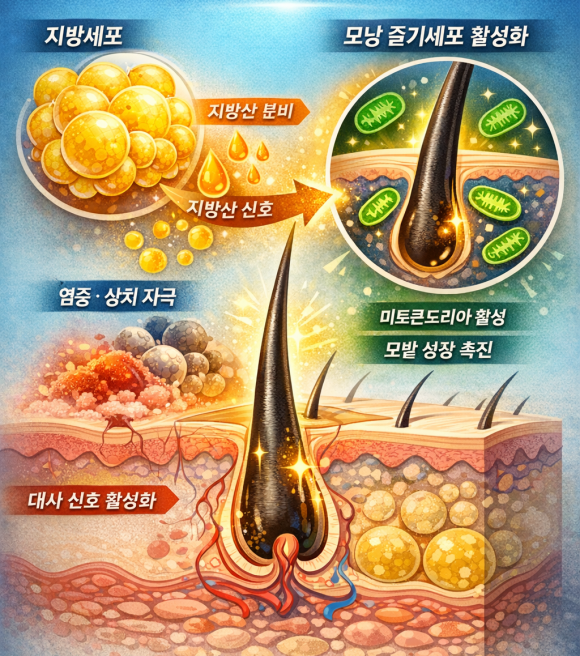
It shows that the subcutaneous adipose tissue beneath the skin is not just a storage depot, but acts as a signaling mediator that regulates hair follicle regeneration.
Now is the time to broaden the perspective on hair loss treatment from “blocking treatment” to “awakening treatment.”
Let’s take a closer look at this topic.

Do fats make hair grow? Summary of the relationship between fatty acids and hair follicle cells
| A study has been published showing that fatty acids produced by subcutaneous fat cells may awaken hair follicle stem cells and induce hair growth¹. |
|---|
| When wounds or inflammation occur, immune cells stimulate adipose tissue to release unsaturated fatty acids, which act as signals that change the energy metabolism of hair follicles¹. |
| These fatty acids increase mitochondrial activity in hair follicle cells and shift dormant follicles back into the growth phase. |
| While existing hair loss treatments have focused on “preventing shedding,” this study expands the perspective to “treatment that changes the environment that prevented growth.” |
| This is an important study suggesting that hair loss treatment may move from hormone suppression toward metabolic and environment-based regenerative therapy. |
Q1. “If you have a lot of fat, does hair grow better?”
The key is not the amount of fat, but what signals the fat sends.
Fat cells are not just a cause of weight gain; they are regulatory organs that send regenerative signals when needed.
In study¹, when inflammation occurred, fat cells broke down fat and released monounsaturated fatty acids, which acted as signals that activated hair follicle stem cells.
Clinically, having more body fat does not mean hair loss is less likely. Rather, the fat metabolism and microenvironment of the scalp are more important.
Q2. “Then if you wound or stimulate the scalp, will hair grow?”
Absolutely not.
The study looked at “metabolic signals,” not the wound itself.
Wounds or inflammation were merely the trigger that induced fatty acid release, not the goal¹.
Excessive scalp stimulation can instead worsen fibrosis, scarring alopecia, or inflammatory alopecia.
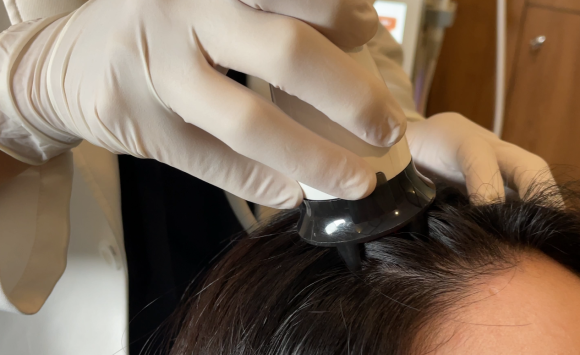
In clinical practice, approaches that regulate the metabolic environment by improving blood flow, controlling inflammation, and improving the scalp microenvironment are much safer and more effective than stimulating the scalp directly.
Q3. “If you apply unsaturated fatty acids, will hair grow?”
Possibility was confirmed in mouse experiments, but the same cannot be applied directly to humans.
In study¹, activation of hair follicle cells was also observed when unsaturated fatty acids were applied topically.
However, because the human scalp differs entirely from that of mice in structure, cycle, and absorption rate, there is currently insufficient clinical evidence to use this as a treatment.
That said, these findings open the possibility that the target of hair loss treatment may be not only hormones, but also “energy metabolism.”
Q4. “Isn’t hair loss ultimately caused by hair follicles dying?”
No. In many cases, they are not “dead,” but “asleep.”
Hair follicle cells are largely maintained,
but they often remain in a dormant state because they cannot use energy or because growth signals are blocked³.
Recent stem cell research² also emphasizes that
“what matters more than the number of cells is the condition that allows them to wake up.”
In clinical practice as well,
this is why thicker hairs are observed again after drug, laser, or injection treatments in patients with early-stage hair loss.

Q5. “What changes could this study bring to hair loss treatment?”
It expands the treatment paradigm from “suppression” to “creating a regenerative environment.”
If existing treatments were as follows,
DHT suppression, slowing the miniaturization of hair follicles
future treatments should be approached from this perspective.
Activation of hair follicle metabolism, awakening of hair follicle cells, remodeling of the scalp environment
This study¹ becomes a turning point that leads us to view hair loss not as a “disease of shedding,” but as a state in which growth has been blocked.
| Category | Existing perspective on hair loss treatment | New perspective based on fat and metabolism |
|---|
| Cause of hair loss | Hormone (DHT) | Metabolic environment, fat signaling |
| Treatment goal | Suppress shedding | Restore growth conditions |
| Approach | Drug-centered | Environment, regeneration, and metabolic regulation |
| Limitation | Maintenance-focused | Expands regenerative potential |
This study marks a turning point in hair loss treatment, shifting the direction from simply “preventing shedding” to “reexamining why growth was blocked.”
The fact that a familiar substance called fatty acids can become a signal that awakens hair follicles shows that hair loss is not simply a hormonal disorder, but a problem of metabolism, environment, and regeneration.
It will still take time before clinical application, but we can expect future hair loss treatment to develop into a more multidimensional treatment strategy that cannot be explained by a single medication alone.
It is now time for hairhair, Kim Jin-oh.
Vital new hair (必生新毛).
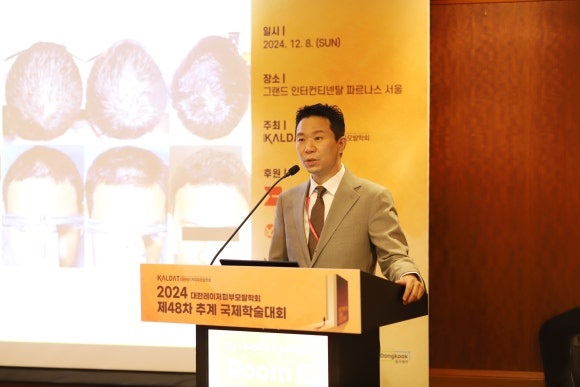
Written by: Kim Jin-oh, New Hair Plastic Surgery Clinic (Public Relations Director, Korean Association of Plastic Surgeons / Academic Director, Korean Society for Laser Dermatology and Hair)
References
-
Tai, K.-Y., Chen, C.-L., Fan, S.M.-Y., Kuan, C.-H., Lin, C.-K., et al. (2025). Adipocyte lipolysis activates epithelial stem cells for hair regeneration through fatty acid metabolic signaling. Cell Metabolism, 37(11), 2202–2219.e8. cited:"Adipocyte lipolysis activates epithelial stem cells for hair regeneration through fatty acid metabolic signaling"
-
Jackson, B.T., et al. (2024). Metabolic regulation of the hallmarks of stem cell biology. Cell Stem Cell, 31(1), 1–15. cited:"Metabolic regulation of the hallmarks of stem cell biology"
-
Greco, V., et al. (2009). A two-step mechanism for stem cell activation during hair regeneration. Cell Stem Cell, 4(2), 155–169. cited:"A two-step mechanism for stem cell activation during hair regeneration"
[This post was written directly by a board-certified plastic surgeon for informational purposes in accordance with Article 56, Paragraph 1 of the Medical Service Act. Hair loss surgery and treatment may have side effects, and you should make a careful decision after consulting with a specialist.]
Recommended related posts