The relationship between hair loss medication and depression is a topic with a very high search volume. Keywords such as “hair loss medication depression,” “finasteride side effects,” and “hair loss medication suicide risk” appear repeatedly. It is also one of the most common questions asked in the clinic before starting treatment.
�a0
Below, I will explain the frequently asked questions by combining research evidence and clinical experience.
Is There Really a Connection Between Hair Loss Medication and Depression? Summary
| Some studies have observed signals of an association between hair loss medication (finasteride and dutasteride) and depression. |
|---|
| In younger men taking the hair-loss dose (1 mg), reports of depression and suicidal thoughts were relatively more common³. |
| In long-term users taking the higher dose (5 mg) for benign prostatic hyperplasia, there was no clear increase in risk¹². |
| It is likely that the medication itself, along with age, hormonal environment, and psychological factors, all played a role. |
| If you have a history of depression or anxiety, caution is needed; if not, excessive fear is unnecessary. |
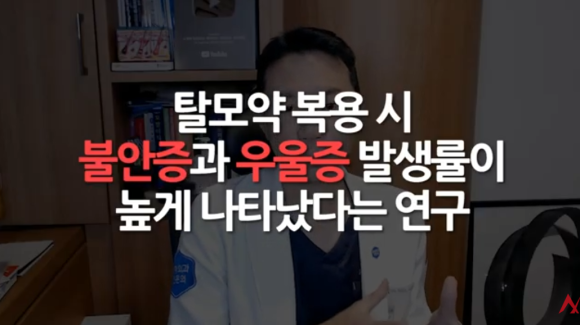
Q1. Does taking hair loss medication cause depression?
It is difficult to say definitively, “yes” or “no.”
�a0
However, it is true that warning signals have been repeatedly observed in some groups. There are analyses showing that reports related to depressed mood and suicidal thoughts appeared more often in younger patients who took finasteride 1 mg for hair loss treatment³.
�a0
On the other hand, a large-scale study found that in patient groups taking a higher dose (5 mg) for benign prostatic hyperplasia, the risk of depression and suicide did not increase significantly¹².
�a0
In other words, the difference in the characteristics of the treatment group is likely to have played a role, rather than a single effect of the medication itself.
�a0
In clinical practice as well, most patients take it stably without mood changes. However, there are indeed a small number of cases in which emotional changes occur.
Q2. Why did the prostate medication group seem okay even though the dose is higher?
This is a point that many people find confusing.
If it were simply a matter of toxicity, the problem should be greater at higher doses. However, the study results did not show that¹².
�a0
Possible explanations include the following.
�a0
-
Age difference: the hair-loss treatment group is relatively younger
-
Difference in hormonal environment: brain responsiveness differs
-
Changes in neurosteroids: 5α-reductase is also involved in the synthesis of mood-regulating substances in the brain⁷⁸
-
Psychological background: hair loss itself is a stress factor
�a0
In other words, “environment” may be a more important variable than “dose.”
�a0


Q3. Does hair loss medication directly affect the brain?
Mechanistically, it is possible.
�a0
These drugs suppress DHT production, and the same enzyme is also involved in neurosteroid synthesis. These substances are linked to anxiety, emotional stability, and stress responses⁷⁸.
�a0
However, this does not mean they directly lead to depression.
The current interpretation is that the effect may appear only in some sensitive individuals.
Q4. What do regulatory authorities say? Is it a dangerous drug?
European and UK regulatory authorities have recently strengthened warning language about psychiatric side effects⁴⁵⁶.
�a0
However, this is not a ban or restriction on use.
�a0
The key message is this.
�a0
If depressed mood, suicidal thoughts, or emotional changes occur while taking it, it is advisable to stop the medication and seek evaluation.
�a0
In other words, it has not been classified as a dangerous drug; it is more accurate to view it as a medication that requires observation.


Q5. If I have a history of depression, can I not take hair loss medication?
It is not an absolute contraindication.
However, the following should definitely be checked.
�a0
�a0
In such cases, after providing sufficient explanation before starting the medication, I recommend monitoring for the first 2–3 months and having family members or people living with the patient observe for changes.
Q6. Does this happen often in actual clinical practice?
Clinically, it is not a very common side effect.
But it should not be divided simply into “yes” or “no.”
�a0
From experience:
�a0
�a0
What matters most is detecting early changes.
| Question | Evidence-based summary |
|---|
| Risk of depression from hair loss medication | Signals observed in some younger user groups³ |
| Is higher dose more dangerous? | No clear increase in the prostate group¹² |
| Possible brain effects | Involvement of the neurosteroid pathway⁷⁸ |
| Regulatory stance | Not banned; warnings strengthened⁴⁵⁶ |
| Can it be taken? | If there is a history, use after monitoring |
The relationship between hair loss medication and depression should be approached with the assumption that individual responses differ, rather than through complete denial or excessive fear.
�a0
If you have a history of psychiatric illness, start carefully; if you are stable, treatment can proceed without excessive worry.
�a0
All medications have the potential for side effects. What matters is information, observation, and response.
�a0
It is now time for hairhair to grow, this was Kim Jino.
May new hair grow and live long (必生新毛).

Written by: Kim Jino of New Hair Plastic Surgery (Public Relations Director, Korean Society of Plastic and Reconstructive Surgeons / Academic Director, Korean Society for Laser Dermatology and Hair)
�a0
References
- Welk, B. et al. (2017). Association of Suicidality and Depression With 5α-Reductase Inhibitors. JAMA Internal Medicine.
cited:"risk of self-harm and depression were significantly increased, primarily during the first 18 months"
- Garcia-Argibay, M. et al. (2022). Association of 5α-Reductase Inhibitors With Dementia, Depression, and Suicide. JAMA Network Open.
cited:"no association between 5-ARIs and suicide… associated with an increased risk for depression"
- Nguyen, D.D. et al. (2021). Suicidality and Psychological Adverse Events in Patients Treated With Finasteride. JAMA Dermatology.
cited:"signals… associated with finasteride use in patients younger than 45 years"
- Medicines and Healthcare products Regulatory Agency (MHRA). (2024). Finasteride: reminder of the risk psychiatric side effects. Drug Safety Update.
cited:"patient alert card… to raise awareness of the risk of psychiatric side effects"
- European Medicines Agency (EMA). (2025). Finasteride- and dutasteride-containing medicinal products.
cited:"confirms suicidal thoughts as side effect of finasteride tablets"
- European Medicines Agency (EMA). (2025). Measures to minimise risk of suicidal thoughts with finasteride.
cited:"Most cases… reported in people using 1 mg finasteride tablets"
- Melcangi, R.C. et al. (2013). Neuroactive steroid levels are modified in cerebrospinal fluid. The Journal of Sexual Medicine.
cited:"showing… anxious/depressive symptomatology"
- Maguire, J.L. (2024). Neurosteroids: mechanistic considerations. Neuropsychopharmacology.
cited:"endogenous 5α-reduced neurosteroids… role in setting a baseline affective tone"
- Wang, J. et al. (2025). Finasteride Use Does Not Lead to Depression or Suicide. Journal of Cosmetic Dermatology.
cited:"does not lead to depression or suicide"
�a0
�a0
[This post is written directly by a board-certified plastic surgeon for informational purposes in accordance with Article 56, Paragraph 1 of the Medical Service Act. Hair loss surgery and treatment may have side effects, and decisions should be made carefully through consultation with a specialist.]
�a0
�a0
Related posts you may find useful
�a0