One of the questions I hear most often in the clinic is, “If it’s high density, does it automatically look fuller?”
From the patient’s perspective, it is natural to want the maximum effect from a single surgery. But in actual clinical practice, we often see cases where the results differ greatly even when the same number of follicles is transplanted.
This difference usually comes not from the “number,” but from scalp conditions and the design strategy. So in this article, I’ll organize the questions patients actually ask most often about high-density hair transplantation, along with research findings and clinical experience.
What Is the Secret to High-Density Hair Transplantation Looking Unfailingly Full? What Is the Essence? Summary
| High-density hair transplantation is not simply a surgery that increases the number of follicles. |
|---|
| The allowable density varies depending on scalp thickness, elasticity, and blood flow. |
| Even if the same number is implanted, the result can vary greatly depending on the design. |
| Excessive high density can actually reduce graft survival. |
| High-density transplantation is a design process to find the maximum density that the scalp can tolerate. |

Q1. What exactly is high-density hair transplantation?
A. It is not a surgery that simply implants a lot of grafts, but a surgery that designs the densest possible placement.
High-density hair transplantation is often misunderstood as “implanting 50–60 follicular units per 1 cm².” In fact, some studies have reported cases that theoretically achieved high density¹.
However, the important point is that such density is not possible on every scalp. High density is not a matter of numbers, but a strategy to safely approach the limit that the scalp can allow.
Q2. Then is there a numerically defined ‘safe density standard’?
A. There is a range you can refer to, but it is not an absolute standard.
In general, about 30–40 FU per 1 cm² is mentioned as a density that looks natural²³. However, a study on Korean patients found that graft survival was highest at 30 FU, and tended to decrease as the density increased to 40–50 FU⁴.
This shows that simply implanting more grafts does not always lead to better results.
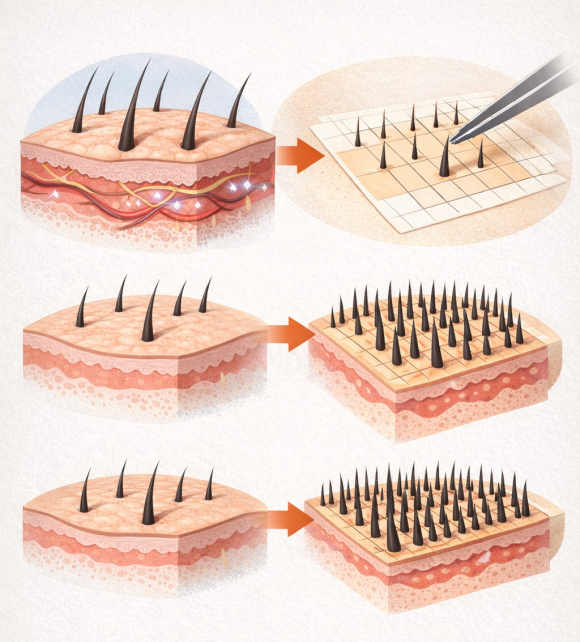
Q3. Why can graft survival decrease with high-density placement?
A. Because of interference between follicles and the burden on local blood flow.
After transplantation, follicles must receive oxygen and nutrients from the surrounding tissue for a certain period in order to survive. If the density becomes too high, the spacing between follicles becomes narrower, and they compete with one another for blood flow.
In fact, some studies have shown that the physically safe maximum density is limited depending on follicle size, insertion angle, and spacing⁵. In clinical practice, we also often experience slower recovery or partial reductions in graft survival in such cases.
Q4. Then are some people better candidates for high-density transplantation?
A. It is possible only when the scalp conditions are favorable.
Studies report that patients with thick scalps, good blood flow, and thick, dense existing hair are more suitable for high-density transplantation³.
In a study that showed graft survival rates of over 90–95% with dense-packing techniques, this was also based on a patient group with favorable scalp conditions¹. In clinical practice as well, people with good scalp elasticity and minimal inflammatory response tend to tolerate higher density more stably.
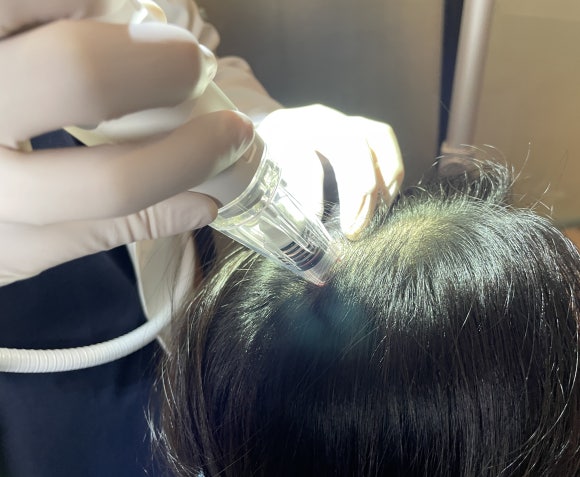
Q5. Is high-density application the same for the frontal hairline and the crown?
A. No. The strategy is completely different depending on the area.
The forehead and hairline have a greater visual impact, so even with the same number of follicles, increasing the density makes them look much fuller. On the other hand, the crown often has a radial direction and unfavorable blood flow conditions, so excessive high density can actually worsen the result.
That is why high-density transplantation is often designed as a front-focused strategy.
Q6. Isn’t visual fullness ultimately determined by numbers?
A. Hair thickness, scalp color, and remaining hair have a greater effect than numbers.
Even with the same 40 FU, hair looks much fuller if the hair is thick and the contrast with scalp color is low. On the other hand, if the hair is thin and the scalp color is light, some people may not feel the expected effect even at 50 FU.
That is why, in high-density planning, the judgment should be based on “visible density” rather than just numbers.
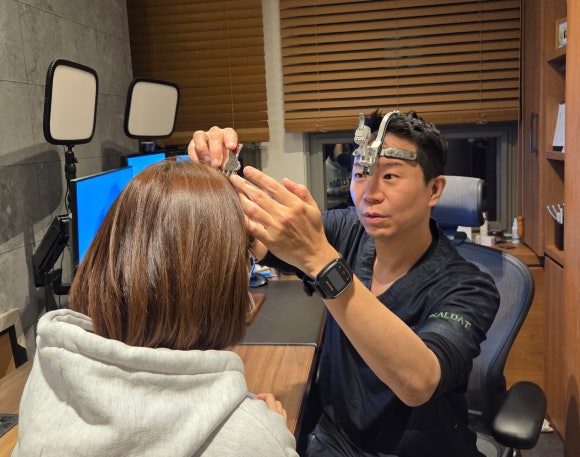
Q7. If recovery takes a long time, is that a problem?
A. Not necessarily, but it may be a sign of scalp stress.
If swelling or redness persists for a long time, it may be the scalp adapting to that density. This reaction is especially more noticeable in scalps with weaker blood flow. In clinical practice, we place greater importance on early management and follow-up observation in such cases.
| Category | General Hair Transplantation | High-Density Hair Transplantation |
|---|
| Design focus | Stable graft survival | Maximum perceived density |
| Density range | 30–40 FU/cm² | Varies depending on scalp conditions |
| Application area | Overall hair loss areas | Mainly frontal area and hairline |
| Risk factor | Low | Possible reduction in graft survival |
| Suitable candidates | Most patients | Patients with favorable scalp conditions |
High-density hair transplantation is not a procedure that simply implants as many grafts as possible. It is the process of accurately determining and designing the maximum density that the scalp can handle.
More important than numbers and technique are the scalp’s thickness, elasticity, blood flow, and the characteristics of the existing hair.
When the conditions are right, high density can be a very effective strategy, but if they are not, it can actually worsen the result. In the end, the starting point for a good outcome is not the number of grafts, but a design that reads the scalp correctly.
Now it is time for hairhair, Kim Jin-oh.
Pilsaeng Shinmo (必生新毛).
Written by: Kim Jin-oh, New Hair Plastic Surgery (Public Relations Director, Korean Society of Plastic and Reconstructive Surgeons / Academic Director, Korean Society of Laser Dermatology and Hair)
References
- Nakatsui, T., Wong, J. and Croot, D. (2008) ‘Survival of densely packed follicular unit grafts using the lateral slit technique’, Dermatologic Surgery, 34(8), pp. 1016–1022.
cited:"Examination of the most densely packed area (72 grafts/cm2) at 8 months posttransplant revealed… growth was 98.6%."
- Kayiran, O. (2018) ‘Evolution of hair transplantation’, Archives of Plastic Surgery, 45(1), pp. 1–9.
cited:"In general, the density achieved with hair transplantation is approximately 30–40 units/cm2. Higher density called as dense packing (up to 60 units/cm2)…"
- Jimenez, F., Ruifernández, J.M., Santamaria, L., Garcia-Hernandez, M.J. and Navarro, R. (2021) ‘Hair transplantation: basic overview’, Journal of the American Academy of Dermatology, 85(4), pp. 803–814.
cited:"Patients with normal-to-high FU density (≥65 FU/cm2) and thick hair… are good candidates."
- Lee, W., Ro, B.I., Hong, S.P., Bak, H. and Sim, W.Y. (2006) ‘Survival rate according to grafted density of Korean one-hair follicular units in hair transplantation’, Dermatologic Surgery, 32(6), pp. 815–818.
cited:"The survival rate of grafts at 30 grafts per template was higher than that at 40 and 50 grafts per template."
- Alhaddab, M., Alhaddab, M.M. and Alhaddab, A. (2005) ‘Effect of graft size, angle, and intergraft distance on dense packing in hair transplantation’, Dermatologic Surgery, 31(12), pp. 1610–1617.
cited:"The maximum number of grafts that can be safely implanted depends on graft size, angle, and intergraft distance."
Related articles you may also like