Are hair transplant side effects common?
Is it okay that the hair seems to fall out even more after a hair transplant?
This is the question I hear most often in the clinic. Hair transplantation is a relatively safe procedure, but saying that it has ‘no side effects at all’ would not be medically honest.
That said, the important point is that most side effects are within the range of what is predictable and manageable.
Today, I’ll organize the most common questions from real patients, along with the academic evidence and 19 years of clinical experience.

FAQ on Hair Transplant Side Effects Answered by a Doctor with 19 Years of Experience — Summary
| Most hair transplant side effects are closer to a predictable “normal course” than to true complications. |
|---|
| Shock loss is a temporary phenomenon that commonly appears 2–6 weeks after surgery.² |
| Rare complications such as skin necrosis and donor depletion are linked to excessive density demands and planning issues.¹ |
| Systematic post-operative care is more important than overusing antibiotics.⁷ |
| Hair transplant results are not just about technique, but about a system of patient selection, design, density, and care. |
Q1. Are hair transplant side effects really dangerous?
Hair transplantation is performed under local anesthesia rather than general anesthesia, and the overall complication rate is low.
However, even with the non-shaven FUE method, normal surgical reactions such as pain, swelling, bleeding, and infection can occur.¹
A 2026 paper classified FUE complications into donor-site problems (hypopigmentation, donor depletion) and recipient-site problems (necrosis, folliculitis, persistent erythema, effluvium, unnatural results).¹
In my experience, most patients mistake the recovery process for a complication.
Swelling, itching, and scabbing are part of the normal course.
Q2. My hair seems to be falling out even more after the transplant. Is the surgery a failure? (Shedding)
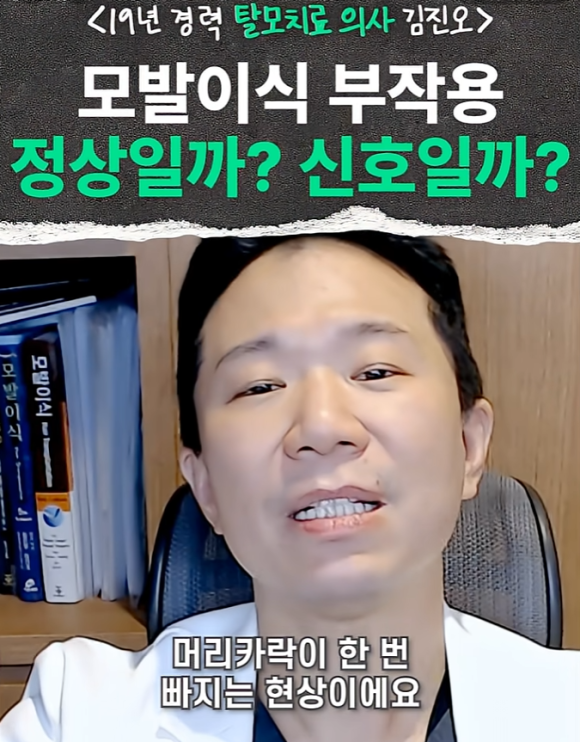
The phenomenon where existing hair appears to fall out 2–6 weeks after surgery is called shock loss.²
One study reported that this begins 2–6 weeks after surgery and explained that it occurs as follicles shift into the resting phase due to microtrauma from the procedure, swelling, and vascular stress.³
Some studies have also identified female sex and younger age as risk factors.⁴
However, in most cases it is temporary, and the hair grows back over time.²⁶
This is the most important point to distinguish from an actual failure.

Q3. How often do folliculitis or infections occur?
Folliculitis in the form of red bumps is observed relatively often.³
It usually resolves with local antiseptic care and simple treatment.
The problem is when it is left untreated. If it progresses to an infection, recovery can be delayed. However, prolonged use of antibiotics without a clear reason is not recommended.
In the end, the key is early detection and hygiene management.

Q4. Are there serious side effects such as skin necrosis?
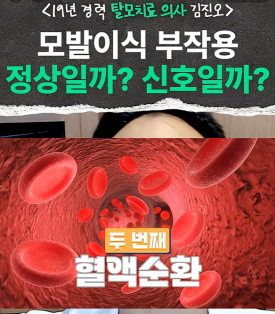
Very rarely, skin necrosis can occur if blood flow in the recipient area breaks down.¹
This is usually linked to an excessive pursuit of high density. Even if you implant 60 follicles per 1 cm², some scalps will tolerate it and others will not.
One study pointed out that FUE complications increase when basic surgical principles are not followed.⁵
In other words, more important than technique is the ability to design a density that the scalp can actually tolerate.


Q5. What is donor depletion?
Donor depletion refers to a condition where too much is harvested from the back of the head, leaving it looking sparse over time.¹
It may not be obvious in early photos, but it becomes a major limitation when considering a repeat procedure years later.
The donor area is like a savings account. Once used, it cannot be refilled.
| Category | Common reactions | Temporary complications | Rare complications | Key management point |
|---|
| Recipient area | Swelling, itching | Shock loss² | Skin necrosis¹ | Density control |
| Donor area | Pain, scabbing | Hypopigmentation¹ | Donor depletion¹ | Harvest planning |
| Infection | Mild folliculitis³ | Local infection | Deep infection | Hygiene management⁷ |
Hair transplant side effects are not a matter of luck.
They are a system issue involving patient selection, design, density control, technique, and post-operative care.
Most side effects are predictable and recoverable.²³
But rare complications begin to be prevented at the planning stage.¹
Hair transplantation is a technique, but the result is structure.
Rather than focusing only on the surgery itself, please look at the system that keeps the surgery stable.
It’s time for hair, not hair loss — this was Kim Jin-oh.
Pilsaengsinmo (必生新毛).

Written by: Kim Jin-oh, New Hair Plastic Surgery (Public Relations Director, Korean Association of Plastic Surgeons / Academic Director, Korean Society of Laser Dermatology and Hair)
References
- Romera De Blas, C., Vega Díez, D., Ricart Vayá, J.M. & Gómez Zubiaur, A. (2026) Complications in follicular unit excision hair transplantation: current evidence and practical approaches. Frontiers in Medicine.
cited:"Complications were categorized into general postoperative events… donor depletion… recipient site complications such as necrosis, folliculitis, persistent perifollicular erythema, effluvium, and unnatural results."
- Kerure, A.S., Patwardhan, N. & Naik, R. (2018) Complications in Hair Transplantation. Journal of Cutaneous and Aesthetic Surgery, 11(4), 182–189.
cited:"Shock loss… typically begins 2–6 weeks following surgery. Higher risk is for females…"
- Garg, A.K. & Garg, S. (2021) Complications of Hair Transplant Procedures—Causes and Management. Indian Journal of Plastic Surgery, 54(4), 477–482.
cited:"The effluvium occurs mostly after 3 to 4 weeks after transplant… due to… trauma… edema… vascular trauma…"
- Okochi, H. et al. (2024) An Analysis of Risk Factors of Recipient Site Temporary Effluvium After Follicular Unit Excision: A Single-Center Retrospective Study. Aesthetic Plastic Surgery.
cited:"Sex was identified as a risk factor for SL… Among female patients, age was identified as a risk factor…"
- Williams, K.L. Jr (2024) Complications with Follicular Unit Excision. Facial Plastic Surgery Clinics of North America.
cited:"FUE complications are observed when the physician fails to follow… practice standards and routine surgical precautions."
- Loh, S.H., Lew, B.L. & Sim, W.Y. (2018) Localized Telogen Effluvium Following Hair Transplantation. Annals of Dermatology, 30(1), 86–89.
cited:"localized telogen effluvium could be a cause of hair loss after hair transplantation and spontaneous recovery…"
- Boden, S.A. (2017) Prophylactic Antibiotics in Hair Transplantation Surgery: Recommendations to Avoid Use Except in Limited Circumstances. Hair Transplant Forum International, 27(5), 185–186.
cited:"Antibiotic resistance is an increasing problem…"