One of the questions patients who have undergone hair transplant surgery ask most often is, “Why is the transplanted hair falling out again?” Seeing the hair fall out after surgery often leads people to suspect that the procedure failed, but in most cases, this is actually a normal part of the recovery process.
The transplanted follicles temporarily enter a resting state as they adapt to their new scalp environment, and during this time the existing hairs fall out. This is commonly called the “hair transplant dark phase.”¹
In this article, we have organized the causes, duration, whether it is normal, and how to manage the hair transplant dark phase in FAQ form, focusing on the questions patients ask most often in practice.
How Long Does the Hair Transplant Dark Phase Last? Difference from Shedding, and Why It Happens Summary
| The hair transplant dark phase is a temporary recovery stage between the time transplanted hairs fall out and the time they begin to grow again.¹ |
|---|
| It usually begins 2 to 4 weeks after surgery and lasts until 3 to 4 months, after which regrowth starts.¹ |
| Hair falling out during the dark phase is not follicle damage, but a normal physiological response.¹ |
| Shedding refers to the hair loss itself, while the dark phase includes the entire period from loss to regrowth.¹ |
| The final hair density and result are usually gradually completed over 6 to 12 months.¹ |

Q1. What exactly is the hair transplant dark phase?
The hair transplant dark phase refers to the transitional period between the time transplanted hairs fall out and the time new hairs begin to grow.¹
Follicles are exposed to minor physical stimulation and blood flow changes during the transplant process. As a result, the follicles temporarily enter the telogen phase, and the existing hairs shed.
However, the important point is that what falls out is the “hair,” not the “follicle.” The follicle itself survives within the scalp and later enters the anagen phase again, producing new hair.¹
In other words, the dark phase is not a failure but a normal process of graft take and recovery.
Q2. When does the hair transplant dark phase begin, and how long does it last?
The dark phase progresses according to a certain timeline.
| Time period | Main changes | What the patient feels |
|---|
| 0–2 weeks | Follicle take is in progress | Appears normal on the surface |
| 2–4 weeks | Shedding begins | Increased loss of transplanted hairs |
| 1–3 months | Dark phase progresses | Reduced density, little visible change |
| 3–4 months | Regrowth begins | Fine hairs appear |
| 6–12 months | Growth completed | Density and thickness increase |
Most patients experience shedding starting 2 to 4 weeks after surgery, and the dark phase lasts until about 3 to 4 months.¹
The final result can usually be assessed after 12 months.¹


Q3. If the hair falls out after a hair transplant, does that mean graft take has failed?
No. In most cases, this is normal shedding.¹
Shedding is a physiological response that occurs as follicles enter the resting phase. It should be understood as part of the process of preparing for the next growth phase.
From a clinical perspective,
-
Even if the shedding rate is high, it does not mean the graft take rate is low.¹
-
Even after the hair falls out, the follicles remain alive inside the scalp.¹
-
New hair later regrows from the same follicles.¹
Therefore, shedding during the dark phase is a normal recovery process.
Q4. Are shedding and the dark phase the same thing?
The two terms are closely related, but they are not identical.
Shedding: the hair loss itself
Dark phase: the entire period from hair loss to regrowth
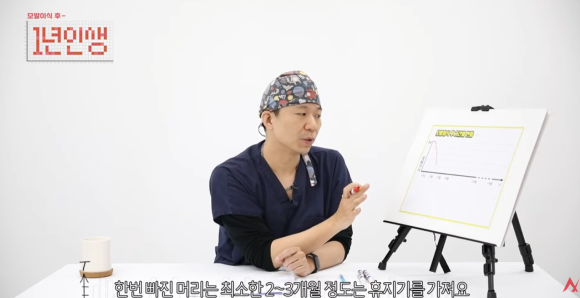
In other words, shedding is one part of the dark phase, and the dark phase is a broader concept.¹


Q5. Are there cases where the dark phase does not occur?
Some patients may experience little to no dark phase.¹
This may be related to the following:
However, the absence of a dark phase does not necessarily mean better results.¹
Follicle take is more important than whether the dark phase occurs.
Q6. How can I get through the dark phase in a healthy way?
The following care may help.
| Care method | Reason |
|---|
| Keep the scalp clean | Prevents inflammation |
| Get enough sleep | Promotes cell recovery |
| Quit smoking | Improves blood flow |
| Manage stress | Helps progression into the growth phase |
| Regular checkups | Confirms graft take status |
From a clinical standpoint, scalp inflammation or excessive stimulation can affect graft take, so early care is important.¹


The dark phase after a hair transplant is a normal recovery stage experienced by most patients.
During this period, hair falling out is not a sign of follicle damage, but a natural process of preparing for new growth.¹
The key points are the following three:
-
Shedding is a normal process
-
Regrowth usually begins after 3 to 4 months
-
The final result should be evaluated after 12 months
So rather than worrying too much about the dark phase, it is important to understand and manage the recovery process from a long-term perspective.
It is now time to have your hair grow, Kim Jino.
May new hair be born (必生新毛).

Written by: Kim Jino of New Hair Plastic Surgery (Public Relations Director, Korean Society of Plastic and Reconstructive Surgeons / Academic Director, Korean Association of Laser, Dermatology and Hair)

Related posts worth reading