「Reviewed and approved by the Medical Advertising Review Committee of the Korean Medical Association, No. 260219-중-207967」
�0b
Family history–related hair loss is often judged based on whether one’s parents or grandparents had hair loss.
However, it is difficult to conclude that family history–related hair loss is something that must be confirmed in earlier generations before it appears.
�0b
Genetic factors are one of the elements that can influence the occurrence of hair loss,
and the time and pattern of actual changes can vary depending on the response of the hair follicles, the scalp environment, lifestyle habits, stress, and more.
As a result, even if hair loss is not obvious in family members, changes in hair thickness or density may appear first in oneself.
�0b
Therefore, rather than judging family history–related hair loss simply by whether there is a family history, it is necessary to look at what changes are appearing in the current hair and scalp condition.
Can hair loss changes appear even without a family history?
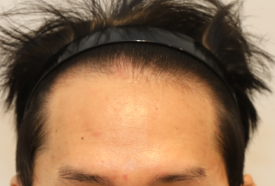
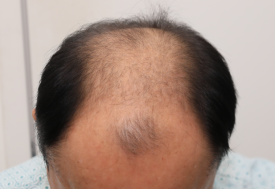
Even if people share the same genetic factors, not everyone experiences changes at the same time, in the same area, or at the same speed.
Even if there were no noticeable changes in previous generations, in the current generation hair changes may be observed for the first time as environmental factors are added.
�0b
For this reason, rather than completely ruling out the possibility of hair loss simply because the family history is not obvious, it is important to look at how one’s current hair and scalp condition has changed compared to before.
When is it helpful to start looking into hair loss?
Regardless of whether there is a family history, if the following changes are repeatedly noticed, it may be helpful to check the condition at least once.
�0b
-
When the hair in a specific area looks thinner than before
-
When the density around the hairline or crown seems to have changed
-
When the overall volume of hair feels reduced
�0b
At this point, rather than rushing into treatment, it is better to understand it as a stage of objectively checking and recording the current condition.
Keeping a record based on the current state can also be meaningful for comparison if changes occur in the future.
How is family history–related hair loss determined?
At present, it is difficult to determine whether someone has family history–related hair loss based on a single test alone.
In general, the pattern of hair thinning, changes in density, area-specific features, and scalp condition are examined comprehensively to judge the progression of hair loss and the direction of care.
�0b
The important point is not simply to distinguish whether there is a family history,
but to understand what type of change is currently appearing and what should be carefully observed going forward.
The hair loss care approach at New Hair Hair Transplant Clinic
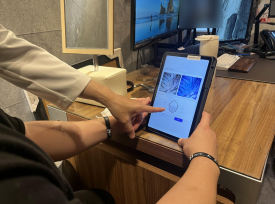
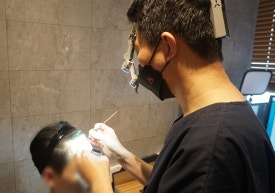
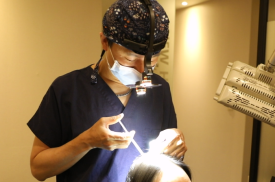
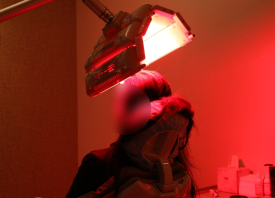
At New Hair Hair Transplant Clinic, rather than judging hair loss solely by whether there is a family history,
we place importance on looking at the pattern of change and its course based on the current hair and scalp condition.
�0b
Hair loss is not something that appears in only one form,
and it can be broadly divided into various categories such as:
- classification by pattern, such as male pattern or female pattern hair loss
- classification by cause, such as hereditary or non-hereditary hair loss
- classification by progression type, such as diffuse, localized, or acute
�0b
Because the type and progression of hair loss differ from person to person, there are limits to approaching it with a uniform standard alone.
By comprehensively checking hair thickness and density, the condition of each area, and the scalp environment and characteristics,
we assess what changes are being observed at this point in time
and what should be managed going forward.
�0b
Expectations for hair loss care can also differ from person to person, so we place importance on the process of setting a management direction suited to each individual’s condition by considering the areas of concern,
the direction of hair changes, and the characteristics of the scalp condition together.
If you are concerned about family history–related hair loss or would like to organize your current hair and scalp condition, the diagnostic process may be helpful in checking your current status.
�0b
The validity of this review is limited to this page.
�0b