As more people struggle with hair loss, interest in hair transplantation has continued to grow steadily.
In particular, more patients have recently been looking for non-incisional hair transplantation rather than the incisional method.
The non-incisional method is a technique in which follicles are collected one by one and transplanted without cutting the skin, and it is characterized by less concern about scarring and faster recovery.
However, in actual consultations, many patients ask the following questions.
-
Does non-incisional hair transplantation really leave no scar?
-
Is it always better than the incisional method?
-
When does hair start growing after surgery?
In this article, we will organize the non-incisional hair transplantation method in a Q&A format that patients often ask about, and explain it in a way that is easy to understand for those considering surgery.
A Complete Guide to Non-Incisional Hair Transplant Methods Summary
| Non-incisional hair transplantation is a hair transplant method without incisions, in which follicles are collected one by one and transplanted. |
|---|
| Many patients prefer it because it leaves almost no scar and recovery is fast. |
| The surgery usually takes about 3 to 8 hours, depending on the amount transplanted. |
| Transplanted hairs begin to grow about 3 to 4 months later, and the final results can be seen between 10 and 12 months. |
| For good results, the harvesting skill of an experienced medical team and post-surgery care are very important. |
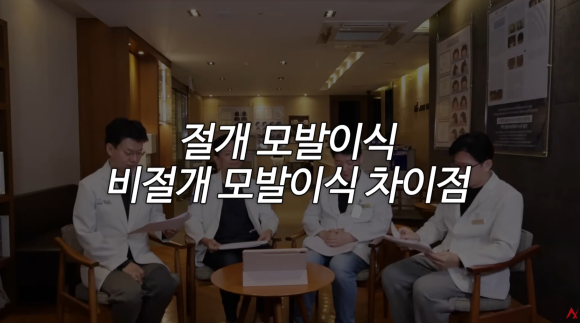
Q1. What kind of surgery is non-incisional hair transplantation?
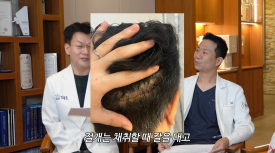
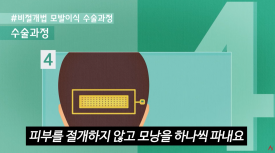
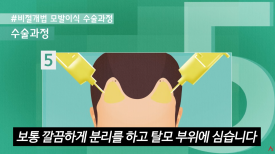
Non-incisional hair transplantation is a method in which follicles are collected one by one from the occipital or temporal area and transplanted to the hair loss area.
The surgery is generally performed under local anesthesia, and follicles are harvested using a micro punch device.
The collected follicles are then organized under a microscope and inserted one by one into the hair loss area.
The biggest feature of this method is that there is no skin incision.
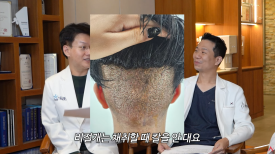
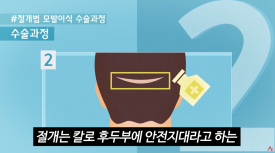
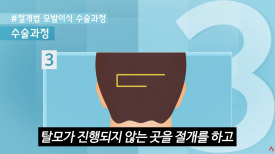
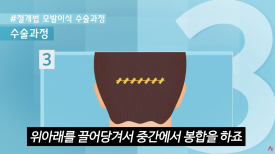
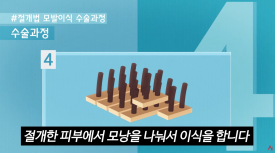
In incisional hair transplantation, part of the scalp is cut to harvest follicles, but in the non-incisional method, follicles are extracted directly, so there is no large scar left behind.
For this reason, it is a surgical method often chosen by people who keep their hair short or patients who are sensitive about scars.
Q2. Does non-incisional hair transplantation really leave no scar?
It is not accurate to say that there are absolutely no scars.
Even with non-incisional hair transplantation, very small dot-like marks may remain during the follicle harvesting process.
However, compared with the linear scar seen in incisional hair transplantation, in most cases these are barely noticeable.
Also, because the harvest holes are very small, they often become hidden by surrounding hair over time and are difficult to see.
Therefore, the non-incisional method may be relatively advantageous for patients who want to maintain a short hairstyle.
Q3. How long does non-incisional hair transplantation surgery take?
The surgery time varies depending on the number of transplanted follicles and the harvesting method, but it generally takes about 3 to 8 hours.
Because the non-incisional method requires harvesting follicles one by one, it may take longer than the incisional method.
However, with recent advances in equipment and surgical techniques, efficiency has improved significantly.
During surgery, it is often performed in an environment where the patient can relax comfortably, watch a movie, or rest.
Q4. When does hair start growing after non-incisional hair transplantation?
The transplanted hair begins to grow again about 3 to 4 months after surgery.
Immediately after surgery, the transplanted hair may temporarily shed, which is a normal process.
After that, as the follicles stabilize, new hair begins to grow again.
| Recovery stage | Change |
|---|
| Immediately after surgery | Redness and slight swelling may occur |
| 3 to 4 months | Transplanted hair begins to grow |
| 6 months | Noticeable increase in hair |
| 10 to 12 months | State close to final results |
Q5. Which is better, incisional or non-incisional?
It is hard to say that either of the two methods is always better.
Incisional hair transplantation can be advantageous for patients with extensive hair loss because a large number of follicles can be harvested at once.
On the other hand, non-incisional hair transplantation has the advantages of less scar burden and faster recovery.
Therefore, it is important to decide by considering factors such as the following.
-
Extent of hair loss
-
Amount of transplanted hair needed
-
Priority given to recovery time
-
Cost
-
Experience of the medical team
Ultimately, the results of a hair transplant depend more on the skill and planning ability of the medical team than on the surgical method itself.
| Category | Non-incisional Hair Transplantation | Incisional Hair Transplantation |
|---|
| Harvesting method | Individual follicle extraction | Harvesting after scalp incision |
| Scar | Dot-like scars | Linear scar |
| Recovery period | Relatively fast | Relatively long |
| Surgery time | May take longer | Relatively short |
| Large-volume transplantation | May be limited | Advantageous |
The non-incisional hair transplantation method involves harvesting and transplanting follicles one by one without an incision, and many patients choose it because it has the advantages of less concern about scarring and faster recovery.
However, it is not the same best option for every patient.
Depending on the extent of hair loss, the amount of transplanted hair needed, and the condition of the scalp, the incisional method may be more suitable in some cases.
Above all, what matters most is the experience and skill of the medical team that can harvest follicles without damage and transplant them naturally.
Therefore, if you are considering a hair transplant, rather than comparing only the surgical methods, it is most important to have a thorough consultation and make a plan that fits your condition.
Now is the time to let your hair grow, Kim Jin-oh.
Pilsaengsinmo (必生新毛).

Written by: Kim Jin-oh of New Hair Plastic Surgery (Public Relations Director of the Korean Society of Plastic and Reconstructive Surgeons / Academic Director of the Korean Laser, Dermatology and Hair Society)
Related articles