One of the most common questions asked when starting hair loss treatment is this.
Can I use just one medicine, or do I need both?
This question is not simply about the number of medications, but about the strategy for managing hair loss.
To put it simply, when we combine the current research and clinical experience, using the two medications together shows the most reproducible results.
I’ll explain the reasons in the form of questions that patients actually want answered.
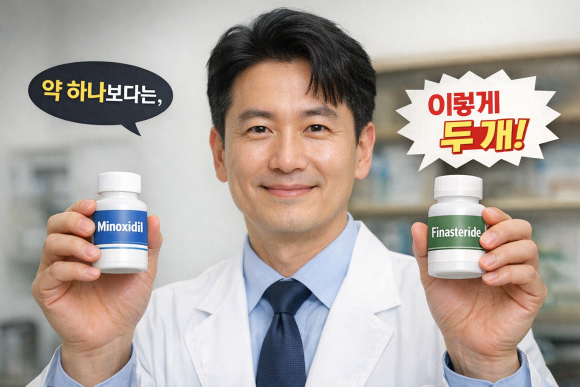
Summary of combination effects when using two or more hair loss medications (Finasteride + Minoxidil)
| Combination therapy with minoxidil + finasteride is more effective than monotherapy¹⁻³ |
|---|
| Finasteride → suppresses hair loss progression (reduces DHT) |
| Minoxidil → promotes hair growth (prolongs the growth phase) |
| Combining for at least 6 months, and preferably 12 months or longer, stabilizes the effect |
| If side effects are a concern, dose adjustment and a gradual approach are possible |
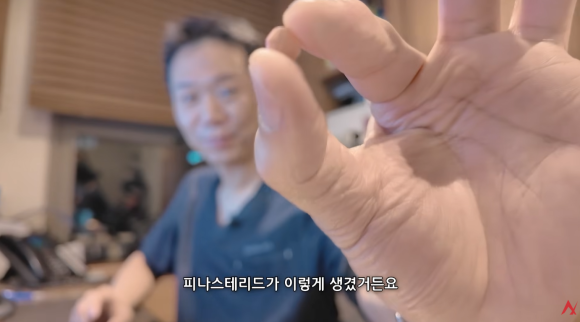
Q1. Minoxidil vs. finasteride: can I use just one?
It is possible, but there are clear limitations in terms of effectiveness.
In other words, one is a “protective medicine,” and the other is a “growth medicine.”
Because the two medications work in completely different ways, using only one leaves one function unaddressed.
That is why the conclusion that combination therapy is more advantageous keeps coming up repeatedly¹⁻³
Q2. Why is combination therapy more effective? (The core principle of hair loss treatment)
The essence of male pattern hair loss is follicular miniaturization caused by DHT.
-
Finasteride → reduces DHT by about 60–70%⁴
-
Minoxidil → prolongs the hair follicle growth phase, improves blood flow²
The problem is that using only one disrupts the balance.
-
Minoxidil alone → hair may grow, but it continues to be under pressure
-
Finasteride alone → helps preserve hair, but limits the speed of thickening
So suppression + growth must happen at the same time for results to be stable.
In meta-analyses as well, combination therapy showed higher hair density and retention rates¹⁻³
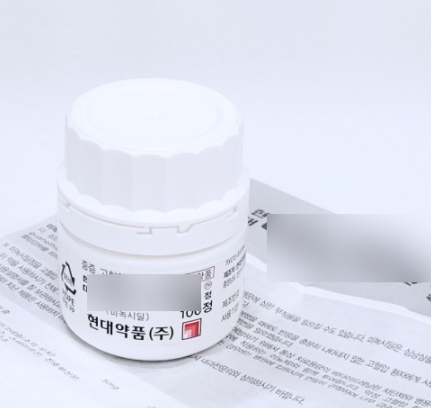
Q3. Is there a reason minoxidil alone is less effective?
Yes. This is a surprisingly important point.
Minoxidil needs the activating enzyme (sulfotransferase) to work, and about 40% of people are deficient in this enzyme, so their response is weaker¹
In other words,
That is why, in clinical practice, there are quite a few cases where “minoxidil alone” falls short of expectations.
Q4. When will I start seeing results? (Changes over time)
This is the part patients find most frustrating.
-
0–3 months → almost no change
-
4–8 months → thin hairs begin to thicken²
-
12 months → noticeable improvement in density
-
12–18 months → effects stabilize
So at least 6 months is the “evaluation period,” and 12 months is the “benchmark for judging results.”
If you stop in the middle, hair often starts shedding again within 3–6 months²
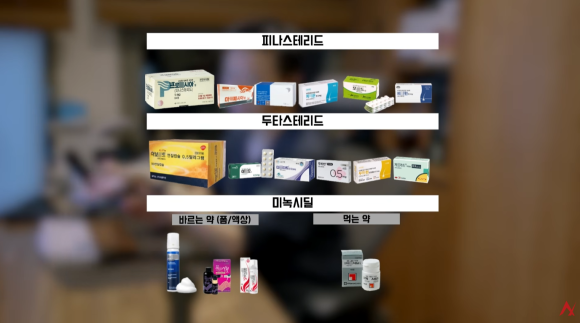
Q5. I’m worried about side effects. Is combination therapy okay?
This requires an individualized approach.
Reduced libido, erectile problems (in some cases) — can be managed by lowering the dose or taking it every other day
Scalp irritation, itching — can be managed by changing the formulation (foam vs. liquid)
The key is not “stopping,” but maintaining treatment while adjusting the intensity.
Q6. Is combination therapy needed in these cases too?
Combination therapy is especially beneficial in the following cases.
-
Early hair loss → rapidly suppress progression
-
Progressive hair loss → secure maintenance
-
After hair transplantation → protect surrounding hair
If you have a strong family history of hair loss, the main goal is to maintain your hair so it does not get worse than it is now.
Q7. Can women use it too?
This part must be clearly distinguished.
-
Women of childbearing age → finasteride is contraindicated
-
Postmenopausal women → limited use may be possible
-
Minoxidil → can be used relatively safely⁵
Women should always decide after consulting a specialist.
| Treatment method | Advantages | Limitations | Recommended for |
|---|
| Minoxidil alone | Promotes growth | Insufficient maintenance | Early / mild cases |
| Finasteride alone | Suppresses shedding | Limited thickening improvement | Maintenance purpose |
| Combination therapy | Improves density and maintenance at the same time | Side effects must be considered | Most patients |
Hair loss treatment is not a matter of “just doing one thing well.”
Hair loss is a condition that requires managing suppression and growth at the same time.
So the treatment strategy is simple.
Finasteride → prevents further shedding
Minoxidil → helps hair grow
These two pillars must work together for density + maintenance to be achieved at the same time.
What matters is not a perfect recovery, but maintaining a better state than you have now for as long as possible. Hair loss treatment is not a short sprint, but a long race that requires ongoing management.
Now it’s time for hair hair to grow, Kim Jino.
필생신모(必生新毛).
Written by: Kim Jino, New Hair Plastic Surgery (Public Relations Director, Korean Association of Plastic Surgeons / Academic Director, Korean Association of Laser, Dermatology and Hair)
References
-
Da Silva, B.F., Gomes-Firmino, R., Dantas-Ferreira, S.R. and Andrade Júnior, F.P. (2026) Use of finasteride and minoxidil for the treatment of androgenetic alopecia: a review. Rev. Colomb. Cienc. Quím. Farm., 55(1), 141–150. cited:"Use of finasteride and minoxidil for the treatment of androgenetic alopecia: a review"
-
Gupta, A.K., Venkataraman, M. and Talukder, M. (2022) Relative efficacy of minoxidil and the 5-α reductase inhibitors in androgenetic alopecia. JAMA Dermatology, 158(3), 266–274. cited:"Relative efficacy of minoxidil and the 5-α reductase inhibitors in androgenetic alopecia"
-
Zhou, Y. et al. (2020) The effectiveness of combination therapies for androgenetic alopecia: a systematic review and meta-analysis. Dermatologic Therapy, 33(4), e13741. cited:"The effectiveness of combination therapies for androgenetic alopecia"
-
Kaiser, M. et al. (2023) Treatment of androgenetic alopecia: current guidance and unmet needs. Clinical, Cosmetic and Investigational Dermatology, 16, 1387–1406. cited:"Treatment of androgenetic alopecia: current guidance and unmet needs"
-
Vastarella, M. et al. (2020) Efficacy and safety of oral minoxidil in female androgenetic alopecia. Dermatologic Therapy, 33(6), e14234. cited:"Efficacy and safety of oral minoxidil in female androgenetic alopecia"
Related posts you may find useful